115195
论文已发表
注册即可获取德孚的最新动态
IF 收录期刊
- 3.6 Breast Cancer (Dove Med Press)
- 4.3 Clin Epidemiol
- 2.6 Cancer Manag Res
- 3.2 Infect Drug Resist
- 4.1 Clin Interv Aging
- 6.1 Drug Des Dev Ther
- 4.1 Int J Chronic Obstr
- 8.7 Int J Nanomed
- 2.5 Int J Women's Health
- 3.2 Neuropsych Dis Treat
- 2.4 OncoTargets Ther
- 2.6 Patient Prefer Adher
- 2.6 Ther Clin Risk Manag
- 3.1 J Pain Res
- 3.5 Diabet Metab Synd Ob
- 4.5 Psychol Res Behav Ma
- 3.4 Nat Sci Sleep
- 2.4 Pharmgenomics Pers Med
- 2.6 Risk Manag Healthc Policy
- 4.6 J Inflamm Res
- 2.3 Int J Gen Med
- 3.9 J Hepatocell Carcinoma
- 3.3 J Asthma Allergy
- 2.5 Clin Cosmet Investig Dermatol
- 3.0 J Multidiscip Healthc

鉴定肺腺癌的八基因预后特征
Authors Li S, Xuan Y, Gao B, Sun X, Miao S, Lu T, Wang Y, Jiao W
Received 12 May 2018
Accepted for publication 28 June 2018
Published 10 September 2018 Volume 2018:10 Pages 3383—3392
DOI https://doi.org/10.2147/CMAR.S173941
Checked for plagiarism Yes
Review by Single-blind
Peer reviewers approved by Dr Andrew Yee
Peer reviewer comments 3
Editor who approved publication: Dr Antonella D'Anneo
Background: Lung adenocarcinoma (LUAD) is the leading cause of cancer-related death worldwide. The main obstacle to early diagnosis or monitoring of patients at high risk of poor survival has been the lack of essential predictive biomarkers.
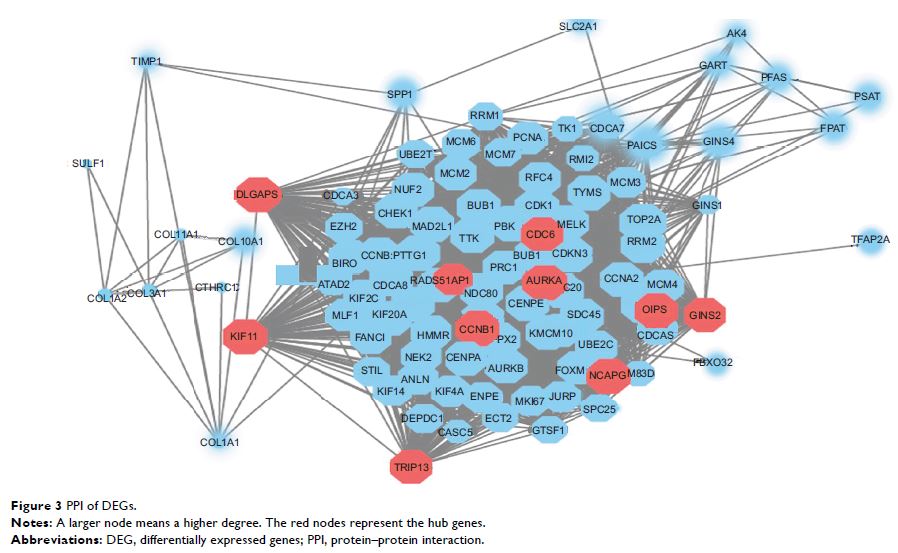
Methods: RNA-sequencing was performed on LUAD affected tissue and paired adjacent to noncancerous tissue samples and Gene Expression Omnibus dataset GSE19188 and GSE33532 were used to obtain an intersection of differential expressed genes and construct a protein–protein interaction network to get hub genes. Then corresponding overall survival information of two cohorts of LUAD patients from our hospital and The Cancer Genome Atlas project-LUAD were included in the present study. An analysis of the Kyoto Encyclopedia of Genes and Genomes database and Gene Ontology were carried out to study the signature mechanism.
Results: In our study, we identified eight candidate genes (DLGAP5, KIF11, RAD51AP1, CCNB1, AURKA, CDC6, OIP5 and NCAPG) closely related to survival in LUAD. A linear prognostic model of the eight genes was constructed and weighted by the regression coefficient (β) from the multivariate Cox regression analysis of The Cancer Genome Atlas-LUAD cohort to divide patients into low- and high-risk groups. The prognostic ability of the signature was validated in LUAD patients at our hospital. Patients assigned to the high-risk group exhibited poor overall survival compared to patients in the low-risk group. Finally, functional enrichment analysis showed that cell division played a vital role in the development of LUAD.
Conclusion: The study identified an mRNA signature including eight genes, which may serve as a potential prognostic marker of LUAD.
Keywords: RNA-seq, prognostic, signature, lung adenocarcinoma