115195
论文已发表
注册即可获取德孚的最新动态
IF 收录期刊
- 3.6 Breast Cancer (Dove Med Press)
- 4.3 Clin Epidemiol
- 2.6 Cancer Manag Res
- 3.2 Infect Drug Resist
- 4.1 Clin Interv Aging
- 6.1 Drug Des Dev Ther
- 4.1 Int J Chronic Obstr
- 8.7 Int J Nanomed
- 2.5 Int J Women's Health
- 3.2 Neuropsych Dis Treat
- 2.4 OncoTargets Ther
- 2.6 Patient Prefer Adher
- 2.6 Ther Clin Risk Manag
- 3.1 J Pain Res
- 3.5 Diabet Metab Synd Ob
- 4.5 Psychol Res Behav Ma
- 3.4 Nat Sci Sleep
- 2.4 Pharmgenomics Pers Med
- 2.6 Risk Manag Healthc Policy
- 4.6 J Inflamm Res
- 2.3 Int J Gen Med
- 3.9 J Hepatocell Carcinoma
- 3.3 J Asthma Allergy
- 2.5 Clin Cosmet Investig Dermatol
- 3.0 J Multidiscip Healthc

对 IL-6 和 IL-8 的联合检测有助于早期食管鳞状细胞癌的诊断:对用蛋白质芯片筛选血清标志物的初步研究
Authors Tong Q, Wang XL, Li SB, Yang GL, Jin S, Gao ZY, Liu XB
Received 16 April 2018
Accepted for publication 13 June 2018
Published 12 September 2018 Volume 2018:11 Pages 5777—5787
DOI https://doi.org/10.2147/OTT.S171242
Checked for plagiarism Yes
Review by Single-blind
Peer reviewers approved by Dr Justinn Cochran
Peer reviewer comments 2
Editor who approved publication: Dr XuYu Yang
Background: The diagnosis rate of early stage esophageal squamous cell carcinoma (ESCC) is low due to the lack of specific tumor markers. Seeking for these markers is beneficial to improve the early diagnosis rate and the prognosis of patients. This study profiles the differentially expressed proteins of early stage ESCC patients via the AAH-BLG-507 protein chip, which further consolidates the clinical evidence of ESCC diagnosis.
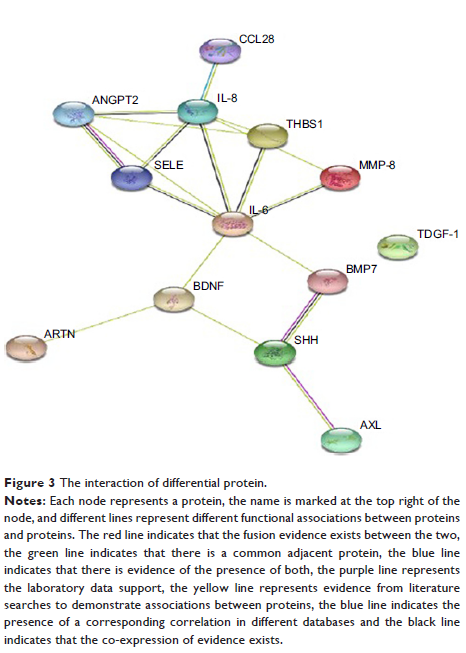
Materials and methods: In this study, 20 serum samples were collected from Taihe Hospital between August 2016 and June 2017. Ten of them carried ESCC, while the rest were healthy controls. To profile the proteins’ expression level, the AAH-BLG-507 protein chip was used, and both highly expressed and lowly expressed proteins were fished out. Meanwhile, their biological roles were examined by using Gene Ontology (GO) database and String database, and they were further verified by ELISA.
Results: Results showed that the expression levels of AXL, ARTN, Ang2, BDNF, BMP7, cripto-1, CCL28, E-selectin, IL-6, IL-8 and SHH in the serum of early ESCC were significantly upregulated (P <0.05), particularly IL-6 and IL-8. The expression levels of TSP1 and MMP-8 were markedly downregulated (P <0.05). Analysis showed that these proteins were mainly involved in angiogenesis, signal transduction, cell proliferation and migration, indicating the close relationship with the development of ESCC.
Conclusion: It suggested that IL-6 and IL-8 proteins could be considered as the markers for ESCC diagnosis.
Keywords: early stage esophageal cancer, squamous cell carcinoma, protein chip, tumor marker, bioinformatics analysis