115195
论文已发表
注册即可获取德孚的最新动态
IF 收录期刊
- 3.6 Breast Cancer (Dove Med Press)
- 4.3 Clin Epidemiol
- 2.6 Cancer Manag Res
- 3.2 Infect Drug Resist
- 4.1 Clin Interv Aging
- 6.1 Drug Des Dev Ther
- 4.1 Int J Chronic Obstr
- 8.7 Int J Nanomed
- 2.5 Int J Women's Health
- 3.2 Neuropsych Dis Treat
- 2.4 OncoTargets Ther
- 2.6 Patient Prefer Adher
- 2.6 Ther Clin Risk Manag
- 3.1 J Pain Res
- 3.5 Diabet Metab Synd Ob
- 4.5 Psychol Res Behav Ma
- 3.4 Nat Sci Sleep
- 2.4 Pharmgenomics Pers Med
- 2.6 Risk Manag Healthc Policy
- 4.6 J Inflamm Res
- 2.3 Int J Gen Med
- 3.9 J Hepatocell Carcinoma
- 3.3 J Asthma Allergy
- 2.5 Clin Cosmet Investig Dermatol
- 3.0 J Multidiscip Healthc

手术后强化恢复可减少接受根治性胃切除术患者的肠道恢复时间和疼痛强度
Authors Ji W, Chandoo A, Guo X, You T, Shao Z, Zheng K, Wang J, Bi J, Smith FG, Tucker ON, Shen X
Received 21 March 2018
Accepted for publication 9 June 2018
Published 13 September 2018 Volume 2018:10 Pages 3513—3520
DOI https://doi.org/10.2147/CMAR.S168909
Checked for plagiarism Yes
Review by Single-blind
Peer reviewers approved by Dr Andrew Yee
Peer reviewer comments 4
Editor who approved publication: Professor Nakshatri
Background: Enhanced recovery after surgery (ERAS) reduces postoperative stress, increases patient satisfaction, and reduces postoperative stay and cost. In this study, we evaluated the feasibility and effectiveness of ERAS protocols compared with conventional perioperative care group and their effect in gastric cancer patients undergoing gastrectomy.
Methods: A cohort of 366 patients were analyzed from a prospectively maintained database. The patients’ characteristics, tumor profile, surgical information data and postoperative complications were evaluated.
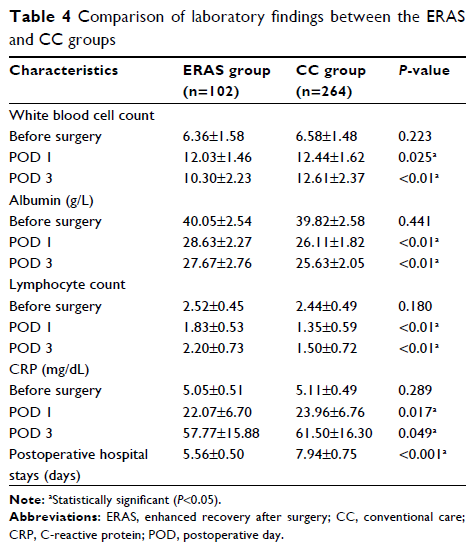
Results: Patients in the ERAS had a faster gastrointestinal function recovery and first flatus (3.26±0.64; P <0.001). Pain intensity of patients in the ERAS group was significantly lower than that of patients in the conventional care group on postoperative days 1 (2.33±0.98; P <0.001) and 3 (1.06±0.63; P <0.001). Postoperative hospital stays were significantly shorter in patients receiving ERAS program (6.66±3.36; P <0.001), than in those patients who received conventional perioperative care (9.02±2.61).
Conclusion: ERAS can reduce postoperative stress, enhance the recovery of the gut, reduce the pain intensity, and increase satisfaction in gastric cancer patient undergoing curative gastrectomy.
Keywords: enhanced recovery after surgery, postoperative stress, pain intensity, postoperative complications, gastric cancer