115195
论文已发表
注册即可获取德孚的最新动态
IF 收录期刊
- 3.6 Breast Cancer (Dove Med Press)
- 4.3 Clin Epidemiol
- 2.6 Cancer Manag Res
- 3.2 Infect Drug Resist
- 4.1 Clin Interv Aging
- 6.1 Drug Des Dev Ther
- 4.1 Int J Chronic Obstr
- 8.7 Int J Nanomed
- 2.5 Int J Women's Health
- 3.2 Neuropsych Dis Treat
- 2.4 OncoTargets Ther
- 2.6 Patient Prefer Adher
- 2.6 Ther Clin Risk Manag
- 3.1 J Pain Res
- 3.5 Diabet Metab Synd Ob
- 4.5 Psychol Res Behav Ma
- 3.4 Nat Sci Sleep
- 2.4 Pharmgenomics Pers Med
- 2.6 Risk Manag Healthc Policy
- 4.6 J Inflamm Res
- 2.3 Int J Gen Med
- 3.9 J Hepatocell Carcinoma
- 3.3 J Asthma Allergy
- 2.5 Clin Cosmet Investig Dermatol
- 3.0 J Multidiscip Healthc

巨大的边缘型乳腺叶状肿瘤反复复发并向恶性表型发展:病例报告和文献回顾
Authors Wang Y, Zhang Y, Chen G, Liu F, Liu C, Xu T, Ma Z
Received 20 April 2018
Accepted for publication 10 September 2018
Published 2 November 2018 Volume 2018:11 Pages 7787—7793
DOI https://doi.org/10.2147/OTT.S171714
Checked for plagiarism Yes
Review by Single-blind
Peer reviewers approved by Dr Justinn Cochran
Peer reviewer comments 3
Editor who approved publication: Dr William Cho
Background: Phyllodes tumor (PT) is a rare breast fibroepithelial biphasic
tumor composed of stromal and epithelial components. The patients suffering
from this disease present with a large, round, mobile, fast-growing lump, and
the giant PT of more than 10 cm in diameter is so uncommon. Surgery is regarded
as the primary treatment, but curative efficiency of adjuvant chemotherapy and
radiotherapy is so indefinite.
Case
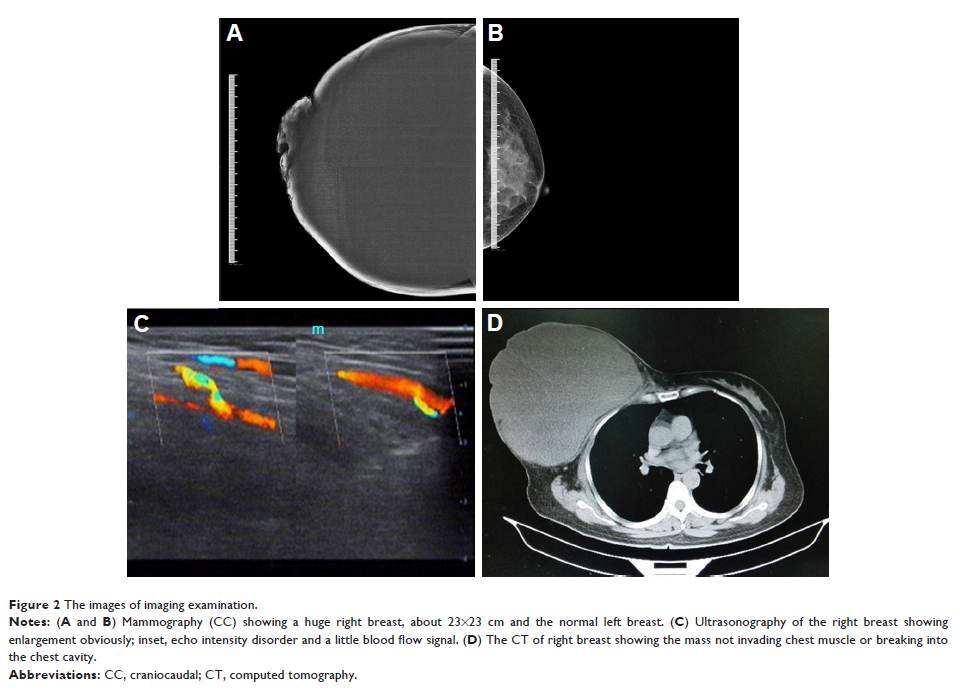
presentation: We reported one case of a
middle-aged woman with a huge borderline PT in the right breast, over 20 cm in
size. The pathology of needle core biopsy of the lump was suggestive of PT of
the borderline subgroup, and then she underwent mastectomy of the right breast.
The patient had recovered well without any postoperative treatment until a
local recurrence occurred 1 year after operation. The tumor was removed with
lumpectomy, which was pathologically diagnosed as malignant PT. We followed up
her by telephone and heard about her postoperative adjuvant radiotherapy and
chemotherapy, as well as her well recovery.
Conclusion: The pathology of PT with low incidence is mostly benign, but local
recurrence is common, and the histopathology progresses toward worsen trend.
Besides, due to the difficulty in precise diagnosis of the borderline PTs, it
is recommended that this subtype of patients should undergo total mastectomy.
Although the curative effect of postoperative treatment has not been recognized
internationally, patients, especially those with huge tumors, may benefit from
these treatments.
Keywords: phyllodes tumor, breast neoplasms, recurrence, diagnosis,
treatment