115195
论文已发表
注册即可获取德孚的最新动态
IF 收录期刊
- 3.6 Breast Cancer (Dove Med Press)
- 4.3 Clin Epidemiol
- 2.6 Cancer Manag Res
- 3.2 Infect Drug Resist
- 4.1 Clin Interv Aging
- 6.1 Drug Des Dev Ther
- 4.1 Int J Chronic Obstr
- 8.7 Int J Nanomed
- 2.5 Int J Women's Health
- 3.2 Neuropsych Dis Treat
- 2.4 OncoTargets Ther
- 2.6 Patient Prefer Adher
- 2.6 Ther Clin Risk Manag
- 3.1 J Pain Res
- 3.5 Diabet Metab Synd Ob
- 4.5 Psychol Res Behav Ma
- 3.4 Nat Sci Sleep
- 2.4 Pharmgenomics Pers Med
- 2.6 Risk Manag Healthc Policy
- 4.6 J Inflamm Res
- 2.3 Int J Gen Med
- 3.9 J Hepatocell Carcinoma
- 3.3 J Asthma Allergy
- 2.5 Clin Cosmet Investig Dermatol
- 3.0 J Multidiscip Healthc

Osthole 对放射疗法敏感,可以在体外和体内抑制人鼻咽癌的肿瘤发生
Authors Peng L, Huang YT, Chen J, Zhuang YX, Zhang F, Chen JY, Zhou L, Zhang DH
Received 6 August 2018
Accepted for publication 6 October 2018
Published 8 November 2018 Volume 2018:10 Pages 5471—5477
DOI https://doi.org/10.2147/CMAR.S182798
Checked for plagiarism Yes
Review by Single-blind
Peer reviewers approved by Dr Amy Norman
Peer reviewer comments 2
Editor who approved publication: Dr Ahmet Emre Eskazan
Background: Radiotherapy is one of the most comment and useful treatment for
nasopharyngeal carcinoma (NPC), but the radioresistance remains a major
obstacle. Osthole, a natural coumarin derivative, has been shown to have
anti-tumor and anti-inflammatory activity. However, the relationship between
osthole and NPC treatment, especially for radiotherapy, is still elusive.
Methods: Osthole with or without X ray radiotherapy treated with CNE2
cells, a human EC cell line. Cell viability, proliferation, migration and
apoptosis were measured by MTT, colony formation, Annexin V/PI double staining,
Transwell assay, respectively. NPC tumor models were established on BALB/c nude
mice by subcutaneously injection of CNE2 cells and the effect of osthole and
radiotherapy on tumor growth in vivo was studied.
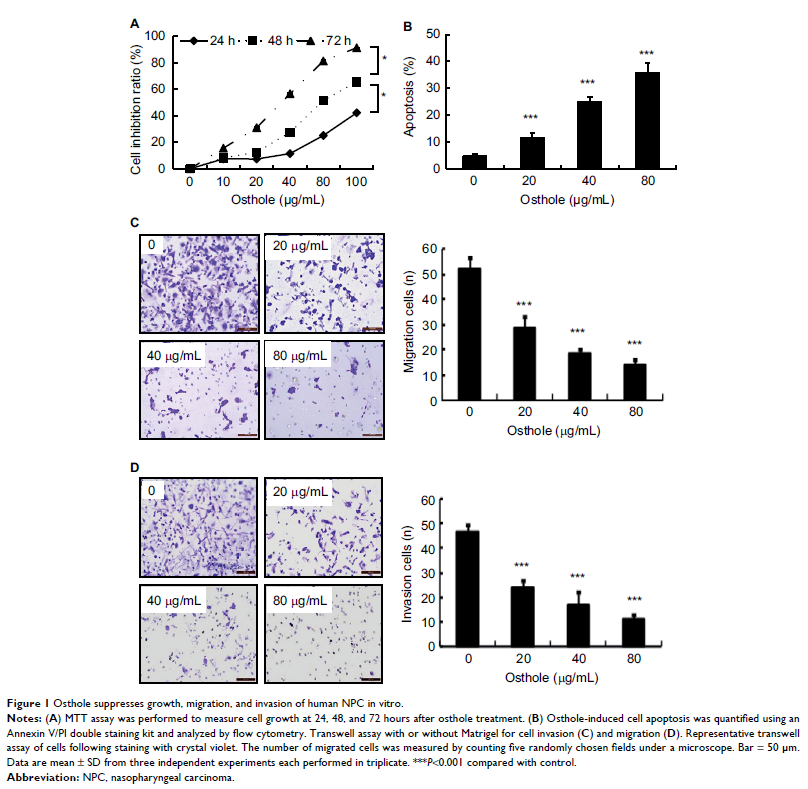
Results: We found that in a dose-dependent manner, osthole could
individually, and synergistically with radiotherapy, reduce NPC cell (CNE2)
viability, proliferation, migration, and invasion, and induce apoptosis,
respectively. This effect of anti-tumor growth and induction of apoptosis was
further confirmed in mice induced by subcutaneously injection with CNE2 cells
and following treated with osthole or/and radiation.
Conclusion: Osthole increases the effect of radiotherapy on anti-human
nasopharyngeal cancer.
Keywords: osthole, radiotherapy, human nasopharyngeal carcinoma,
tumorigenesis, proliferation, apoptosis