115195
论文已发表
注册即可获取德孚的最新动态
IF 收录期刊
- 3.6 Breast Cancer (Dove Med Press)
- 4.3 Clin Epidemiol
- 2.6 Cancer Manag Res
- 3.2 Infect Drug Resist
- 4.1 Clin Interv Aging
- 6.1 Drug Des Dev Ther
- 4.1 Int J Chronic Obstr
- 8.7 Int J Nanomed
- 2.5 Int J Women's Health
- 3.2 Neuropsych Dis Treat
- 2.4 OncoTargets Ther
- 2.6 Patient Prefer Adher
- 2.6 Ther Clin Risk Manag
- 3.1 J Pain Res
- 3.5 Diabet Metab Synd Ob
- 4.5 Psychol Res Behav Ma
- 3.4 Nat Sci Sleep
- 2.4 Pharmgenomics Pers Med
- 2.6 Risk Manag Healthc Policy
- 4.6 J Inflamm Res
- 2.3 Int J Gen Med
- 3.9 J Hepatocell Carcinoma
- 3.3 J Asthma Allergy
- 2.5 Clin Cosmet Investig Dermatol
- 3.0 J Multidiscip Healthc

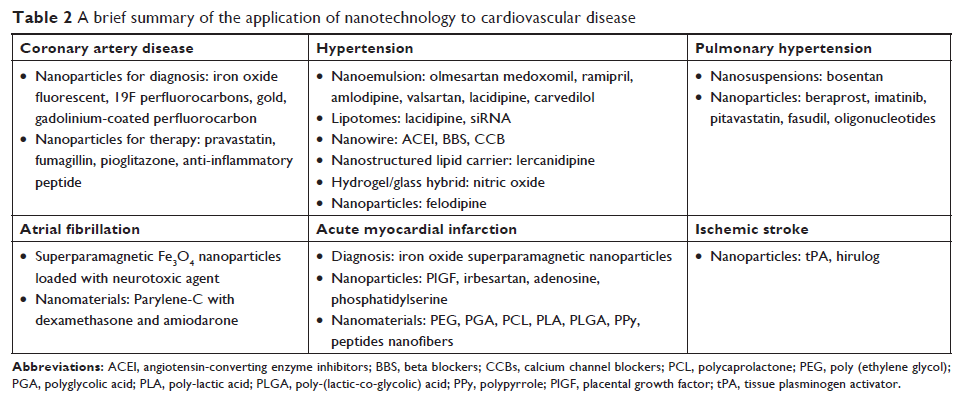
纳米技术是具有前景和优势的心血管疾病治疗替代措施
Authors Li T, Liang W, Xiao X, Qian Y
Received 10 July 2018
Accepted for publication 23 September 2018
Published 9 November 2018 Volume 2018:13 Pages 7349—7362
DOI https://doi.org/10.2147/IJN.S179678
Checked for plagiarism Yes
Review by Single-blind
Peer reviewers approved by Dr Cristina Weinberg
Peer reviewer comments 2
Editor who approved publication: Dr Linlin Sun
Abstract: Cardiovascular diseases (CVDs) are one of the most important
causes of mortality and affecting the health status of patients. At the same
time, CVDs cause a huge health and economic burden to the whole world. Although
a variety of therapeutic drugs and measures have been produced to delay the
progress of the disease and improve the quality of life of patients, most of
the traditional therapeutic strategies can only cure the symptoms and cannot
repair or regenerate the damaged ischemic myocardium. In addition, they may
bring some unpleasant side effects. Therefore, it is vital to find and explore
new technologies and drugs to solve the shortcomings of conventional
treatments. Nanotechnology is a new way of using and manipulating the matter at
the molecular scale, whose functional organization is measured in nanometers.
Because nanoscale phenomena play an important role in cell signal transduction,
enzyme action and cell cycle, nanotechnology is closely related to medical
research. The application of nanotechnology in the field of medicine provides
an alternative and novel direction for the treatment of CVDs, and shows
excellent performance in the field of targeted drug therapy and the development
of biomaterials. This review will briefly introduce the latest applications of
nanotechnology in the diagnosis and treatment of common CVDs.
Keywords: nanotechnology, application, targeted therapy, biomaterials,
cardiovascular diseases