115195
论文已发表
注册即可获取德孚的最新动态
IF 收录期刊
- 3.6 Breast Cancer (Dove Med Press)
- 4.3 Clin Epidemiol
- 2.6 Cancer Manag Res
- 3.2 Infect Drug Resist
- 4.1 Clin Interv Aging
- 6.1 Drug Des Dev Ther
- 4.1 Int J Chronic Obstr
- 8.7 Int J Nanomed
- 2.5 Int J Women's Health
- 3.2 Neuropsych Dis Treat
- 2.4 OncoTargets Ther
- 2.6 Patient Prefer Adher
- 2.6 Ther Clin Risk Manag
- 3.1 J Pain Res
- 3.5 Diabet Metab Synd Ob
- 4.5 Psychol Res Behav Ma
- 3.4 Nat Sci Sleep
- 2.4 Pharmgenomics Pers Med
- 2.6 Risk Manag Healthc Policy
- 4.6 J Inflamm Res
- 2.3 Int J Gen Med
- 3.9 J Hepatocell Carcinoma
- 3.3 J Asthma Allergy
- 2.5 Clin Cosmet Investig Dermatol
- 3.0 J Multidiscip Healthc

塞来昔布通过抑制 SDF1 诱导的 CXCR4 内吞作用来遏制皮肤鳞状细胞癌细胞迁移
Authors Gong T, Yu Y, Yang B, Lin M, Huang JW, Cheng B, Ji C
Received 17 July 2018
Accepted for publication 15 October 2018
Published 12 November 2018 Volume 2018:11 Pages 8063—8071
DOI https://doi.org/10.2147/OTT.S180472
Checked for plagiarism Yes
Review by Single-blind
Peer reviewers approved by Dr Cristina Weinberg
Peer reviewer comments 2
Editor who approved publication: Prof. Dr. Geoffrey Pietersz
Background: Cutaneous
squamous cell carcinoma (CSCC), the main type of non-melanoma skin cancer
(NMSC), contributes to 20-30% of the overall number of NMSC cases. Some CSCCs
are observed to have metastatic potential induced by solar ultra violet (UV)
radiation. Celecoxib, a nonsteroidal anti-inflammatory drug, has been largely
associated with prevention of many cancer types. However, the relationship
between celecoxib and CSCC cell migration has yet to be determined.
Methods: To determine
the association between celecoxib and CSCC, we performed a series of studies in
human samples and in vitro models to assess the influence of celecoxib in CSCC
cell migration.
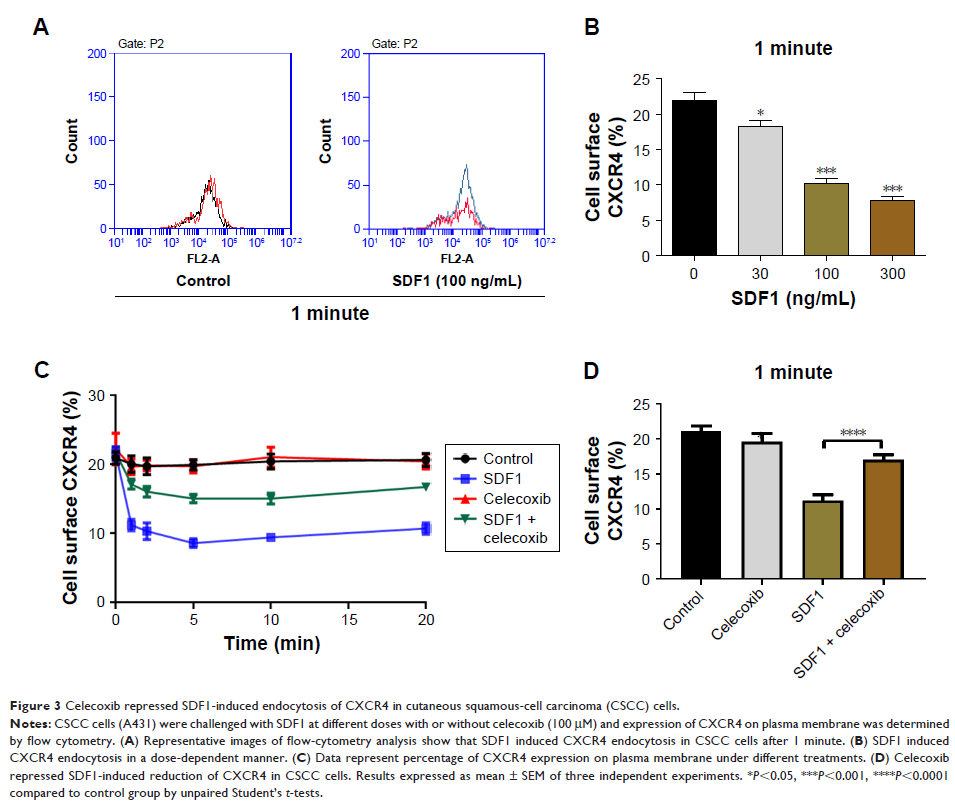
Results: In the present
study, we found that celecoxib suppresses CSCC cell migration via inhibition of
SDF1-induced endocytosis of CXCR4. In addition, ERK/AKT signaling pathways were
found to play a key role in this biological process.
Conclusion: Our study
provides promising evidence that celecoxib could serve as a potential
preventative agent for the metastasis of CSCC cells.
Keywords: celecoxib,
SDF1, cell migration, CXCR4, ERK–Akt pathway