115195
论文已发表
注册即可获取德孚的最新动态
IF 收录期刊
- 3.6 Breast Cancer (Dove Med Press)
- 4.3 Clin Epidemiol
- 2.6 Cancer Manag Res
- 3.2 Infect Drug Resist
- 4.1 Clin Interv Aging
- 6.1 Drug Des Dev Ther
- 4.1 Int J Chronic Obstr
- 8.7 Int J Nanomed
- 2.5 Int J Women's Health
- 3.2 Neuropsych Dis Treat
- 2.4 OncoTargets Ther
- 2.6 Patient Prefer Adher
- 2.6 Ther Clin Risk Manag
- 3.1 J Pain Res
- 3.5 Diabet Metab Synd Ob
- 4.5 Psychol Res Behav Ma
- 3.4 Nat Sci Sleep
- 2.4 Pharmgenomics Pers Med
- 2.6 Risk Manag Healthc Policy
- 4.6 J Inflamm Res
- 2.3 Int J Gen Med
- 3.9 J Hepatocell Carcinoma
- 3.3 J Asthma Allergy
- 2.5 Clin Cosmet Investig Dermatol
- 3.0 J Multidiscip Healthc

开发和验证用于预测三阴性乳腺癌患者总体和乳腺癌特异性存活的诺模图
Authors Guo LW, Jiang LM, Gong Y, Zhang HH, Li XG, He M, Sun WL, Ling H, Hu X
Received 2 July 2018
Accepted for publication 2 October 2018
Published 19 November 2018 Volume 2018:10 Pages 5881—5894
DOI https://doi.org/10.2147/CMAR.S178859
Checked for plagiarism Yes
Review by Single-blind
Peer reviewers approved by Dr Colin Mak
Peer reviewer comments 4
Editor who approved publication: Dr Rituraj Purohit
Purpose: TNBC is
generally more aggressive than other BC subtypes and has limited therapeutic
options. We aimed to construct comprehensive and reliable nomograms to predict
the OS and BCSS of TNBC patients to offer clinicians therapeutic guidance for
improving the prognosis of TNBC patients.
Patients and methods: We used
the SEER 19 Cancer Registry to identify 21,419 eligible TNBC patients diagnosed
from January 1, 2010 to December 31, 2015, and divided the database randomly
into a training cohort (n=10,709) and a validation cohort (n=10,710). The
log-rank test and Cox analysis together with a competing risk model were
utilized to identify independent prognostic factors for OS and BCSS, which were
then integrated to construct nomograms.
Results: According to
the training cohort, except for laterality, the following factors were all
predictive of OS and BCSS: age at diagnosis, race, tumor size, number of
positive lymph nodes, grade, and histological subtype. The 1-, 3-, and 5-year
probabilities of BC-specific mortality were 2.7%, 12.5%, and 17.1%,
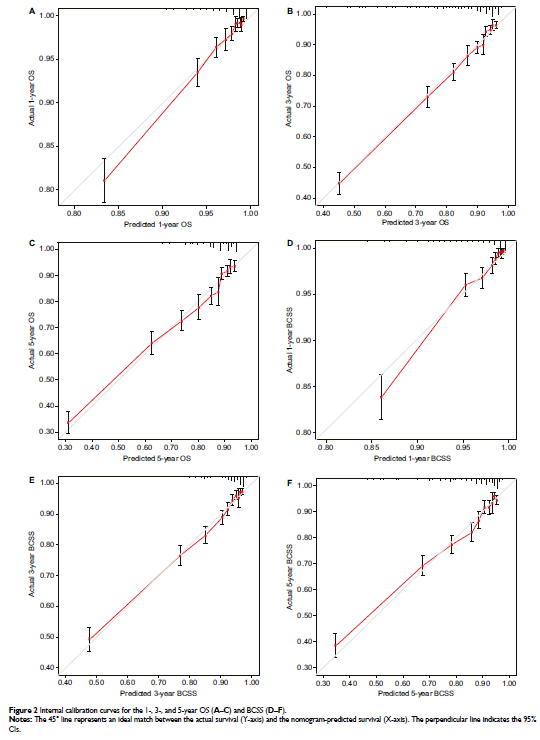
respectively. The precision of the nomograms was assessed by the C-index value
and calibration plot diagrams. The C-index value were 0.779 for OS and 0.793
for BCSS in the internal validation and 0.774 for OS and 0.792 for BCSS in the
external validation. Both internal and external calibration plot diagrams
showed good consistency between the actual and predicted outcomes, especially
for 3- and 5-year OS and BCSS.
Conclusion: These
nomograms hold promise as a novel and accurate tool in predicting OS and BCSS
of TNBC patients and could be used in clinical practice to assist clinicians in
developing more effective therapeutic strategies and to evaluate prognostic
personally.
Keywords: TNBC,
nomogram, SEER, cancer-specific survival, prognosis