115195
论文已发表
注册即可获取德孚的最新动态
IF 收录期刊
- 3.6 Breast Cancer (Dove Med Press)
- 4.3 Clin Epidemiol
- 2.6 Cancer Manag Res
- 3.2 Infect Drug Resist
- 4.1 Clin Interv Aging
- 6.1 Drug Des Dev Ther
- 4.1 Int J Chronic Obstr
- 8.7 Int J Nanomed
- 2.5 Int J Women's Health
- 3.2 Neuropsych Dis Treat
- 2.4 OncoTargets Ther
- 2.6 Patient Prefer Adher
- 2.6 Ther Clin Risk Manag
- 3.1 J Pain Res
- 3.5 Diabet Metab Synd Ob
- 4.5 Psychol Res Behav Ma
- 3.4 Nat Sci Sleep
- 2.4 Pharmgenomics Pers Med
- 2.6 Risk Manag Healthc Policy
- 4.6 J Inflamm Res
- 2.3 Int J Gen Med
- 3.9 J Hepatocell Carcinoma
- 3.3 J Asthma Allergy
- 2.5 Clin Cosmet Investig Dermatol
- 3.0 J Multidiscip Healthc

KIAA1199 过表达与 EMT 标志物的异常表达有关,是肝细胞癌的一种新的独立的预后生物标志物
Authors Jiang Z, Zhai X, Shi B, Luo D, Jin B
Received 13 September 2018
Accepted for publication 31 October 2018
Published 23 November 2018 Volume 2018:11 Pages 8341—8348
DOI https://doi.org/10.2147/OTT.S187389
Checked for plagiarism Yes
Review by Single-blind
Peer reviewers approved by Dr Amy Norman
Peer reviewer comments 2
Editor who approved publication: Dr Tohru Yamada
Purpose: To
determined KIAA1199 expression and investigate its correlation with the
clinicopathologic data and prognosis of hepatocellular carcinoma (HCC), as well
as markers of epithelial-mesenchymal transition (EMT); N-cadherin, E-cadherin
and vimentin.
Materials and methods: Western
blot, quantitative real-time PCR, and immunohistochemical staining were used to
measure KIAA1199 expression in human HCC specimens. Subsequently, the
correlation between KIAA1199 expression and the pathological characteristics of
HCC patients was analyzed. Univariate and multivariate analyses were used to
explore the risk factors associated with disease-free survival (DFS) and
overall survival (OS).
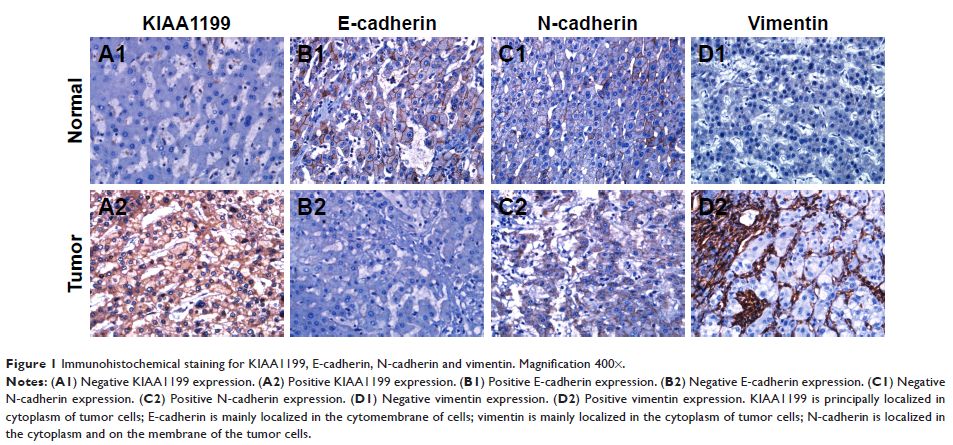
Results: KIAA1199
expression was remarkably increased in hepatocellular carcinoma tissues
compared to paracarcinomatous tissues. This phenomenon was accompanied by
aberrant expression of EMT-associated markers. In addition, high KIAA1199
expression was associated with severe pathological symptoms, low DFS, and low
OS. Results of the multivariate analysis showed that KIAA1199 expression may be
an independent predictor of low disease-free survival and OS of HCC patients.
Conclusion: KIAA1199
overexpression in HCC patients is associated with aberrant expression of
EMT-associated markers and severe clinicopathological symptoms, and thus may
function as a marker of poor prognosis in HCC.
Keywords: KIAA1199,
hepatocellular carcinoma, EMT, prognosis, biomarker