115195
论文已发表
注册即可获取德孚的最新动态
IF 收录期刊
- 3.6 Breast Cancer (Dove Med Press)
- 4.3 Clin Epidemiol
- 2.6 Cancer Manag Res
- 3.2 Infect Drug Resist
- 4.1 Clin Interv Aging
- 6.1 Drug Des Dev Ther
- 4.1 Int J Chronic Obstr
- 8.7 Int J Nanomed
- 2.5 Int J Women's Health
- 3.2 Neuropsych Dis Treat
- 2.4 OncoTargets Ther
- 2.6 Patient Prefer Adher
- 2.6 Ther Clin Risk Manag
- 3.1 J Pain Res
- 3.5 Diabet Metab Synd Ob
- 4.5 Psychol Res Behav Ma
- 3.4 Nat Sci Sleep
- 2.4 Pharmgenomics Pers Med
- 2.6 Risk Manag Healthc Policy
- 4.6 J Inflamm Res
- 2.3 Int J Gen Med
- 3.9 J Hepatocell Carcinoma
- 3.3 J Asthma Allergy
- 2.5 Clin Cosmet Investig Dermatol
- 3.0 J Multidiscip Healthc

miR-23b-3p 和 miR-130a-5p 经由 Wnt/β-catenin 信号通路靶向 CB1R,以影响胃癌细胞生长、迁移和侵袭
Authors Xian X, Tang L, Wu C, Huang L
Received 28 July 2018
Accepted for publication 21 September 2018
Published 25 October 2018 Volume 2018:11 Pages 7503—7512
DOI https://doi.org/10.2147/OTT.S181706
Checked for plagiarism Yes
Review by Single-blind
Peer reviewers approved by Dr Amy Norman
Peer reviewer comments 3
Editor who approved publication: Dr Takuya Aoki
Background: Gastric cancer (GC) is the most common malignancy and third leading cause of cancer mortality worldwide. The identification of a sensitive biomarker as well as effective therapeutic targets for the treatment of GC is of critical importance. microRNAs play significant roles in the development of cancer and may serve as promising therapeutic targets.
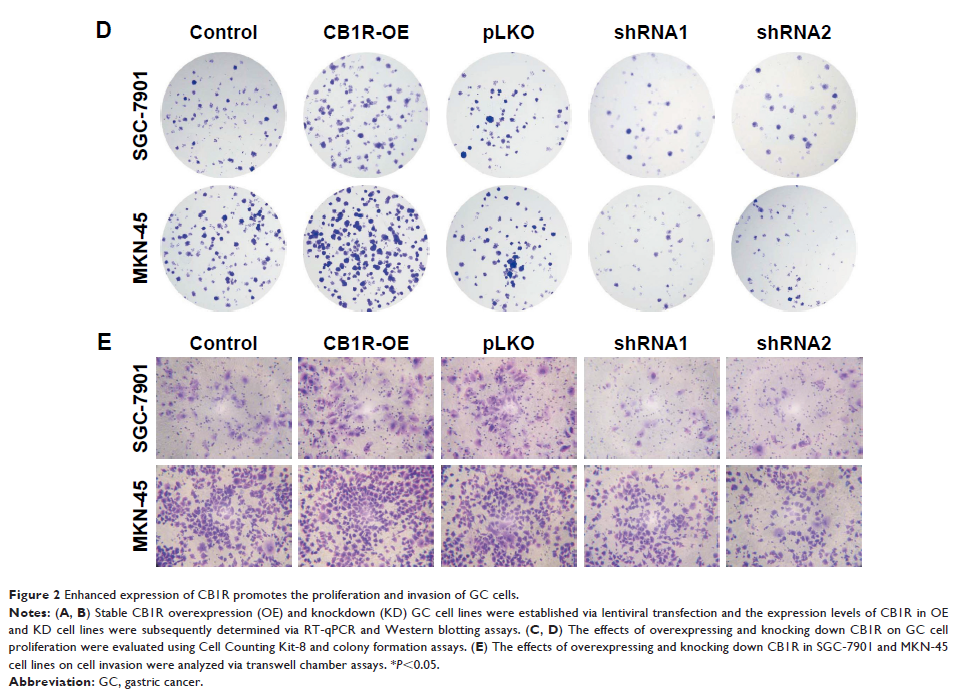
Methods: The mRNA and protein expression of CB1R were studied both in GC cells and tissues. GC cell lines with specific gene overexpression and knockdown vectors were constructed. CCK-8 assay, matrigel invasion and colony formation assays were performed to evaluate the proliferation and invasion abilities. The binding and regulatory effects of miR-23b-3 and miR-130a-5p on CB1R mRNA were investigated using a luciferase reporter assay. Western blot analysis was performed to explore the potential interaction proteins of CB1R.
Results: In the present study, it was demonstrated that the cannabinoid receptor 1 (CB1R) was overexpressed, and miR-23b-3p and miR-130a-5p were downregulated, in GC cells. In addition, the results revealed that these effects are associated with malignant biological behaviors exhibited by GC cells. Furthermore, miR-23b-3p and miR-130a-5p may regulate CB1R expression via the Wnt/β-catenin signaling pathway.
Conclusion: Our results suggested dysregulation of CB1R expression is closely related to the malignant biological behavior of gastric cancer cells. miRNA/CB1R-based therapy may represent a promising therapeutic strategy for the clinical treatment of GC patients.
Keywords: miRNA, CB1R, Wnt, β-catenin, gastric carcinoma