115195
论文已发表
注册即可获取德孚的最新动态
IF 收录期刊
- 3.6 Breast Cancer (Dove Med Press)
- 4.3 Clin Epidemiol
- 2.6 Cancer Manag Res
- 3.2 Infect Drug Resist
- 4.1 Clin Interv Aging
- 6.1 Drug Des Dev Ther
- 4.1 Int J Chronic Obstr
- 8.7 Int J Nanomed
- 2.5 Int J Women's Health
- 3.2 Neuropsych Dis Treat
- 2.4 OncoTargets Ther
- 2.6 Patient Prefer Adher
- 2.6 Ther Clin Risk Manag
- 3.1 J Pain Res
- 3.5 Diabet Metab Synd Ob
- 4.5 Psychol Res Behav Ma
- 3.4 Nat Sci Sleep
- 2.4 Pharmgenomics Pers Med
- 2.6 Risk Manag Healthc Policy
- 4.6 J Inflamm Res
- 2.3 Int J Gen Med
- 3.9 J Hepatocell Carcinoma
- 3.3 J Asthma Allergy
- 2.5 Clin Cosmet Investig Dermatol
- 3.0 J Multidiscip Healthc

Postpartum anticoagulation in women with mechanical heart valves
Authors Irani RA, Santa-Ines A, Elder RW, Lipkind HS, Paidas MJ, Campbell KH
Received 20 June 2018
Accepted for publication 27 August 2018
Published 25 October 2018 Volume 2018:10 Pages 663—670
DOI https://doi.org/10.2147/IJWH.S177547
Checked for plagiarism Yes
Review by Single-blind
Peer reviewers approved by Dr Justinn Cochran
Peer reviewer comments 2
Editor who approved publication: Professor Elie Al-Chaer
Background: Women with mechanical heart valves (MHV) requiring anticoagulation (AC) are at high risk for hemorrhagic complications. Despite guidelines to manage antenatal and peripartum AC, there are few evidence-based recommendations to guide the initiation of postpartum AC. We reviewed our institutional experience of pregnant women with MHV to lay the groundwork for recommendations of immediate postpartum AC therapy.
Study design: This descriptive retrospective cohort used ICD-9 and -10 codes to identify pregnant women with MHV on AC at the Yale-New Haven Hospital from 2007 to 2018. All identified patients were confirmed by chart review. Delivery hospitalization and the immediate postpartum AC management were reviewed. Maternal complications recorded were postpartum hemorrhage, transfusion, wound hematoma, intra-abdominal bleeding, stroke, valve thrombosis, and death. Further, immediate neonatal outcomes were detailed.
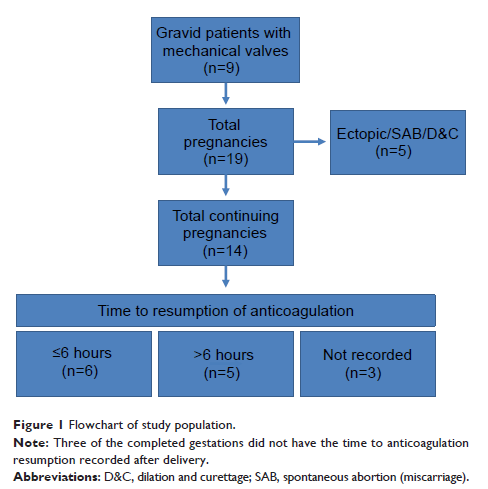
Results: Forty-two pregnant women with nonnative heart valves were identified during the study period. From those pregnant women, nine had an MHV and were anticoagulated throughout gestation. Of 19 total pregnancies, 14 met the inclusion criteria. The median gestational age of the delivered pregnancies was early term (37w2d). Nine deliveries were via cesarean (64%). The median time to restart AC after birth was 6 hours. After six deliveries (43%), AC was initiated ≤6 hours postpartum. Hemorrhagic complications occurred in six cases (43%), including wound and intra-abdominal hematomas. Four cases (29%) required blood transfusion. No maternal strokes, thrombotic events, or deaths were recorded. Five (38.5%) neonates required admission to the neonatal intensive care unit.
Conclusion: MHV in pregnancy was rare but was associated with significant maternal morbidity, particularly postpartum hemorrhagic complications. We noted significant variability in the timing of restarting postpartum AC and in the selected agents. Pooled institutional data and an interdisciplinary approach are recommended to minimize competing risks and sequelae of valve thrombosis and obstetrical hemorrhage and, thereby, to optimize maternal outcomes and develop evidence-based guidelines for postpartum AC management.
Keywords: pregnancy, anticoagulation, postpartum hemorrhage, mechanical heart valve