115195
论文已发表
注册即可获取德孚的最新动态
IF 收录期刊
- 3.6 Breast Cancer (Dove Med Press)
- 4.3 Clin Epidemiol
- 2.6 Cancer Manag Res
- 3.2 Infect Drug Resist
- 4.1 Clin Interv Aging
- 6.1 Drug Des Dev Ther
- 4.1 Int J Chronic Obstr
- 8.7 Int J Nanomed
- 2.5 Int J Women's Health
- 3.2 Neuropsych Dis Treat
- 2.4 OncoTargets Ther
- 2.6 Patient Prefer Adher
- 2.6 Ther Clin Risk Manag
- 3.1 J Pain Res
- 3.5 Diabet Metab Synd Ob
- 4.5 Psychol Res Behav Ma
- 3.4 Nat Sci Sleep
- 2.4 Pharmgenomics Pers Med
- 2.6 Risk Manag Healthc Policy
- 4.6 J Inflamm Res
- 2.3 Int J Gen Med
- 3.9 J Hepatocell Carcinoma
- 3.3 J Asthma Allergy
- 2.5 Clin Cosmet Investig Dermatol
- 3.0 J Multidiscip Healthc

Acyl-CoA 脱氢酶长链表达与食管鳞状细胞癌进展和预后不良有关
Authors Yu DL, Li HW, Wang Y, Li CQ, You D, Jiang L, Song YP, Li XH
Received 22 April 2018
Accepted for publication 11 September 2018
Published 31 October 2018 Volume 2018:11 Pages 7643—7653
DOI https://doi.org/10.2147/OTT.S171963
Checked for plagiarism Yes
Review by Single-blind
Peer reviewers approved by Dr Andrew Yee
Peer reviewer comments 3
Editor who approved publication: Dr Faris Farassati
Background: Acyl-CoA dehydrogenase long chain (ACADL) was revealed to have a correlation with malignant progression of cancer. However, whether ACADL plays a role in clinical therapy remains unclear. The clinicopathological role of ACADL in esophageal squamous cell carcinoma (ESCC) will be discussed in this study.
Materials and methods: The expression of ACADL was analyzed via real-time PCR and Western blotting to assess mRNA and protein levels in ESCC cell lines and normal esophageal epithelial cells (NEECs), in six paired ESCC tumors and relative normal tissues. Furthermore, immunohistochemical staining was performed on 135 paraffin-embedded ESCC specimens to assess ACADL expression. The clinicopathological significance of ACADL expression was further investigated via survival analysis and Cox regression analysis.
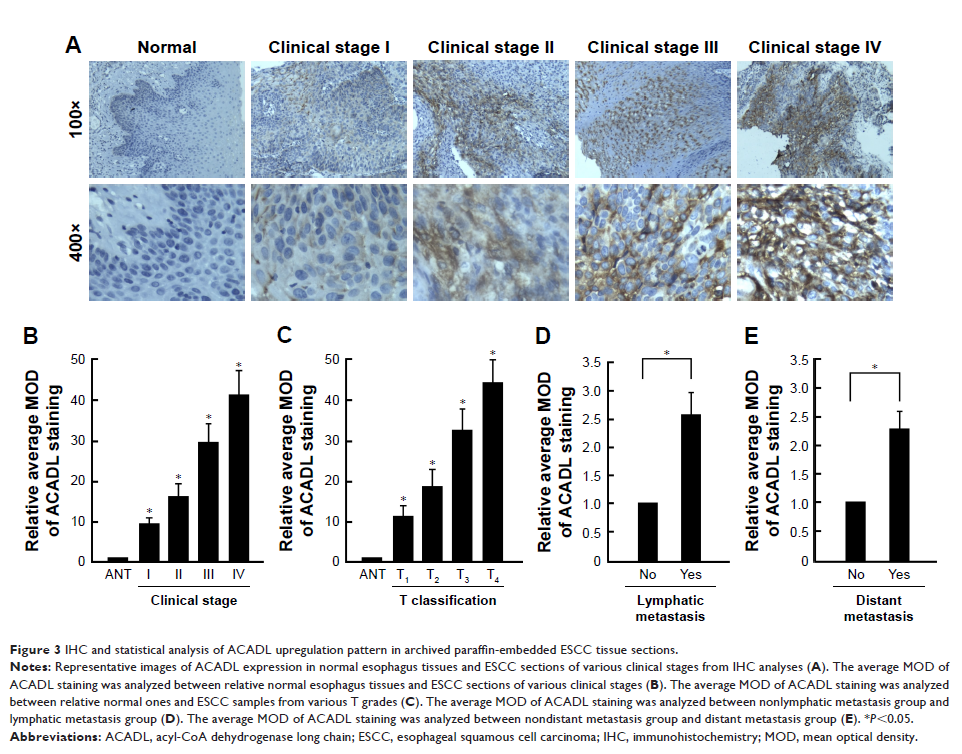
Results: ACADL was found to be markedly upregulated in ESCC cell lines when compared with NEECs. Moreover, various experiments such as quantitative real-time PCR, Western blot, and immunohistochemical analyses all revealed that ACADL expression was increased in all six paired ESCC tumors and matched normal tissues. Furthermore, immunohistochemical analysis revealed an increased level of ACADL protein expression in all 135 paraffin-embedded samples from ESCC patients, which increased with disease progression.
Conclusion: We demonstrated that ACADL is overexpressed in ESCC, both in cell lines and clinical specimens. ACADL is found to be a vital regulator in ESCC progression and can predict a worse outcome for ESCC patients, suggesting that ACADL might be a valuable molecule to be targeted for clinical therapy of ESCC treatment.
Keywords: ESCC, ACADL, prognosis, IHC, target