115195
论文已发表
注册即可获取德孚的最新动态
IF 收录期刊
- 3.6 Breast Cancer (Dove Med Press)
- 4.3 Clin Epidemiol
- 2.6 Cancer Manag Res
- 3.2 Infect Drug Resist
- 4.1 Clin Interv Aging
- 6.1 Drug Des Dev Ther
- 4.1 Int J Chronic Obstr
- 8.7 Int J Nanomed
- 2.5 Int J Women's Health
- 3.2 Neuropsych Dis Treat
- 2.4 OncoTargets Ther
- 2.6 Patient Prefer Adher
- 2.6 Ther Clin Risk Manag
- 3.1 J Pain Res
- 3.5 Diabet Metab Synd Ob
- 4.5 Psychol Res Behav Ma
- 3.4 Nat Sci Sleep
- 2.4 Pharmgenomics Pers Med
- 2.6 Risk Manag Healthc Policy
- 4.6 J Inflamm Res
- 2.3 Int J Gen Med
- 3.9 J Hepatocell Carcinoma
- 3.3 J Asthma Allergy
- 2.5 Clin Cosmet Investig Dermatol
- 3.0 J Multidiscip Healthc

纤维蛋白原和中性粒细胞 - 淋巴细胞的综合比值作为可切除的结直肠腺癌的预测因素
Authors Li X, An B, Zhao Q, Qi J, Wang W, Zhang D, Li Z, Qin C
Received 30 May 2018
Accepted for publication 24 October 2018
Published 26 November 2018 Volume 2018:10 Pages 6285—6294
DOI https://doi.org/10.2147/CMAR.S161094
Checked for plagiarism Yes
Review by Single-blind
Peer reviewers approved by Dr Andrew Yee
Peer reviewer comments 3
Editor who approved publication: Dr Beicheng Sun
Purpose: The aim
of this study was to investigate the clinical significance of the combined
fibrinogen and neutrophil–lymphocyte ratio (F-NLR) in patients with resectable
colorectal cancer (CRC).
Patients and methods: We
retrospectively recruited 693 patients with stage I–III CRC following curative
surgery. Cutoff values of the preoperative fibrinogen and neutrophil–lymphocyte
ratio (NLR) were determined with the receiver operating characteristic
analysis. Patients were divided into three groups based on the F-NLR value and
were further divided into the chemotherapy and nonchemotherapy groups. The
overall survival (OS) and disease-free survival (DFS) were evaluated with the
Kaplan–Meier survival method, the log-rank test, univariate and multivariate
Cox proportional hazards models, and subgroup analyses.
Results: The
Kaplan–Meier survival curves revealed that the 5-year OS rates in the F-NLR 0,
1, and 2 groups were 78.4%, 52%, 42.6%, respectively (P <0.001), and
the 5-year DFS rates were 54.9%, 43.9%, 26.7%, respectively (P <0.001).
Multivariate analyses revealed that the F-NLR score was an independent
prognostic factor for both the OS (P =0.035) and the DFS (P =0.001). In
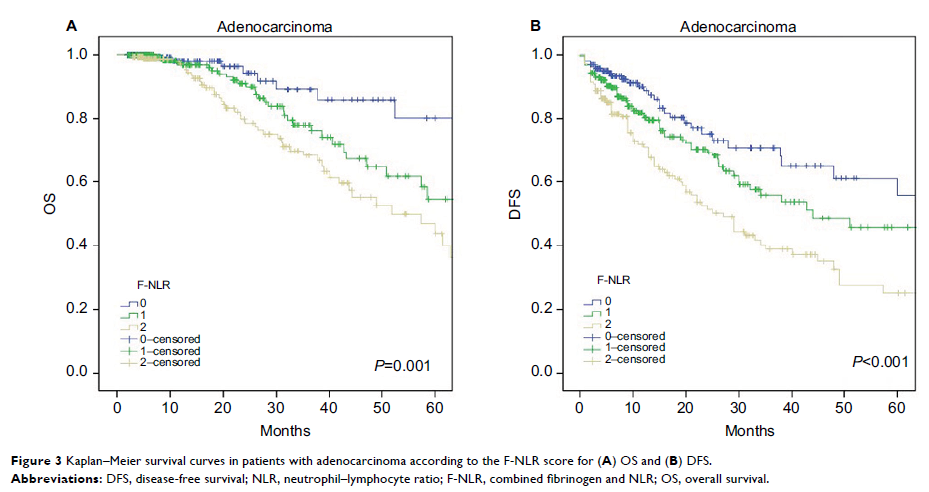
addition, subgroup analyses based on the histological type showed that an
elevated F-NLR score was significantly associated with worse OS (P =0.001) and DFS (P <0.001) in
patients with colorectal adenocarcinoma. Furthermore, DFS in the F-NLR 0–1
group was significantly shortened after the administration of chemotherapy (P =0.005); however,
patients with a relatively higher F-NLR score showed slight OS benefit from
adjuvant chemotherapy (P =0.144).
Conclusion: The F-NLR
score, as a novel inflammation-based grading index, was a potential predictor
for the prognosis and responses to chemotherapy in patients with resectable
CRC.
Keywords: inflammation,
fibrinogen, neutrophil–lymphocyte ratio, colorectal cancer, prognosis