115195
论文已发表
注册即可获取德孚的最新动态
IF 收录期刊
- 3.6 Breast Cancer (Dove Med Press)
- 4.3 Clin Epidemiol
- 2.6 Cancer Manag Res
- 3.2 Infect Drug Resist
- 4.1 Clin Interv Aging
- 6.1 Drug Des Dev Ther
- 4.1 Int J Chronic Obstr
- 8.7 Int J Nanomed
- 2.5 Int J Women's Health
- 3.2 Neuropsych Dis Treat
- 2.4 OncoTargets Ther
- 2.6 Patient Prefer Adher
- 2.6 Ther Clin Risk Manag
- 3.1 J Pain Res
- 3.5 Diabet Metab Synd Ob
- 4.5 Psychol Res Behav Ma
- 3.4 Nat Sci Sleep
- 2.4 Pharmgenomics Pers Med
- 2.6 Risk Manag Healthc Policy
- 4.6 J Inflamm Res
- 2.3 Int J Gen Med
- 3.9 J Hepatocell Carcinoma
- 3.3 J Asthma Allergy
- 2.5 Clin Cosmet Investig Dermatol
- 3.0 J Multidiscip Healthc

开发和验证预后标签,用于胃癌患者总体生存率的术前预测
Authors Zhu M, Wang Q, Luo Z, Liu K, Zhang Z
Received 28 July 2018
Accepted for publication 26 October 2018
Published 4 December 2018 Volume 2018:11 Pages 8711—8722
DOI https://doi.org/10.2147/OTT.S181741
Checked for plagiarism Yes
Review by Single-blind
Peer reviewers approved by Dr Amy Norman
Peer reviewer comments 3
Editor who approved publication: Dr Leo Jen-Liang Su
Background: As a serious
challenge for public health, the prognosis of gastric cancer patients is still
poor. The current study aimed to develop and validate a prognostic signature to
predict the overall survival of gastric cancer patients.
Patients and methods: The dataset in
the present study was obtained from The Cancer Genome Atlas database. The
present study finally included 343 gastric cancer patients with information on
long non-coding RNA (lncRNA) expression and overall survival.
Results: A
prognostic model named Eleven-lncRNA signature was constructed according to the
expression values of eleven prognostic lncRNA predictors identified by
univariate and multivariate Cox regression model. According to time-dependent
receiver operating characteristic curves, the Harrell’s concordance indexes of
Eleven-lncRNA signature were 0.764 (95% CI 0.720–0.808), 0.776 (95% CI 0.732–0.820),
and 0.807 (95% CI 0.763–0.851) for 1-year overall survival, 3-year overall
survival, and 5-year overall survival respectively in the model group. In the
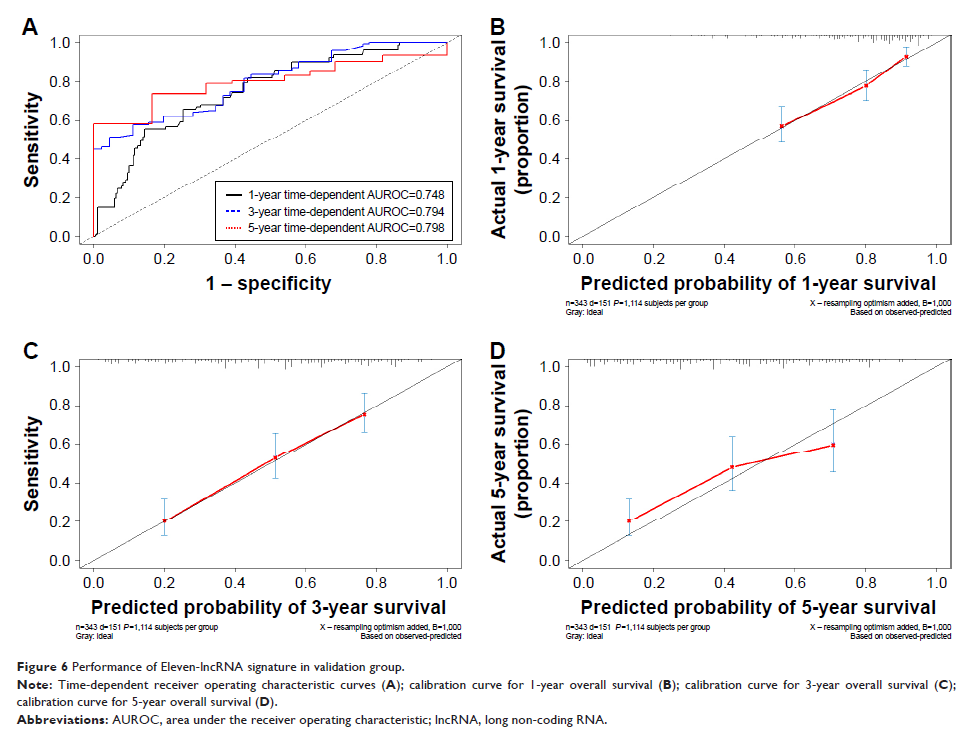
validation group, the Harrell’s concordance indexes of Eleven-lncRNA signature
were 0.748 (95% CI 0.704–0.792), 0.794 (95% CI 0.750–0.838), and 0.798 (95% CI
0.754–0.842) for 1-year overall survival, 3-year overall survival, and 5-year
overall survival respectively. The gastric cancer patients (n=343) in the model
group could be stratified into low-risk group (n=171) and high-risk group
(n=172) according to the median of Eleven-lncRNA signature score. Kaplan–Meier
survival curves showed that the mortality rate in the high-risk group was
significantly poorer than that in the low-risk group (P <0.001).
Conclusion: The
present study constructed and validated a prognostic model named Eleven-lncRNA
signature for preoperative individual mortality risk prediction in gastric
cancer patients. This Eleven-lncRNA signature can predict the individual
mortality risk of gastric cancer patients and is helpful in improving clinical
decision making regarding individualized treatment.
Keywords: long
non-coding RNA, gastric cancer, overall survival, signature, prognosis