115195
论文已发表
注册即可获取德孚的最新动态
IF 收录期刊
- 3.6 Breast Cancer (Dove Med Press)
- 4.3 Clin Epidemiol
- 2.6 Cancer Manag Res
- 3.2 Infect Drug Resist
- 4.1 Clin Interv Aging
- 6.1 Drug Des Dev Ther
- 4.1 Int J Chronic Obstr
- 8.7 Int J Nanomed
- 2.5 Int J Women's Health
- 3.2 Neuropsych Dis Treat
- 2.4 OncoTargets Ther
- 2.6 Patient Prefer Adher
- 2.6 Ther Clin Risk Manag
- 3.1 J Pain Res
- 3.5 Diabet Metab Synd Ob
- 4.5 Psychol Res Behav Ma
- 3.4 Nat Sci Sleep
- 2.4 Pharmgenomics Pers Med
- 2.6 Risk Manag Healthc Policy
- 4.6 J Inflamm Res
- 2.3 Int J Gen Med
- 3.9 J Hepatocell Carcinoma
- 3.3 J Asthma Allergy
- 2.5 Clin Cosmet Investig Dermatol
- 3.0 J Multidiscip Healthc

含有草药的马兜铃酸可诱导上尿路上皮癌患者与性别有关的肿瘤学差异
Authors Xiong G, Yao L, Hong P, Yang L, Ci W, Liu L, He Q, Gong K, Li X, Zhou L
Received 29 June 2018
Accepted for publication 24 September 2018
Published 4 December 2018 Volume 2018:10 Pages 6627—6639
DOI https://doi.org/10.2147/CMAR.S178554
Checked for plagiarism Yes
Review by Single-blind
Peer reviewers approved by Dr Cristina Weinberg
Peer reviewer comments 3
Editor who approved publication: Dr Antonella D'Anneo
Background: In China, upper
tract urothelial carcinoma (UTUC) is less prevalent but more malignant in
males. This study investigates the prognostic factors and causes of
gender-based differences in Chinese populations.
Methods: Between 1999
and 2011, 687 UTUC patients who underwent surgery were utilized for this study.
We evaluated the differences in oncological characteristics, epigenetic
biomarkers, cancer-specific survival (CSS), bladder recurrence (BR) rate, and
contralateral upper tract recurrence (CUTR) rate. Smoking history, benzene
exposure history, and the history of using aristolochic acid (AA) containing
herbs were analyzed in detail.
Results: Compared
with male patients, female patients showed poorer renal function, lower
proportions of tumor stage III/IV, and smaller tumor diameters. The CSS in male
patients was lower than that in female patients. Significant gender-related
differences were observed concerning various prognostic factors. In female
patients, poorer survival rates were attributed to the primary tumor location
in the ureter, large diameter primary tumors, severe chronic kidney disease,
papillary tumor architecture, high tumor stages, positive N status, and
methylated ABCC6 promoters. In male patients, older age, ipsilateral
hydronephrosis, large tumor diameters, sessile tumor architecture, high tumor
stages, and methylated TMEFF2 promoters were associated with higher
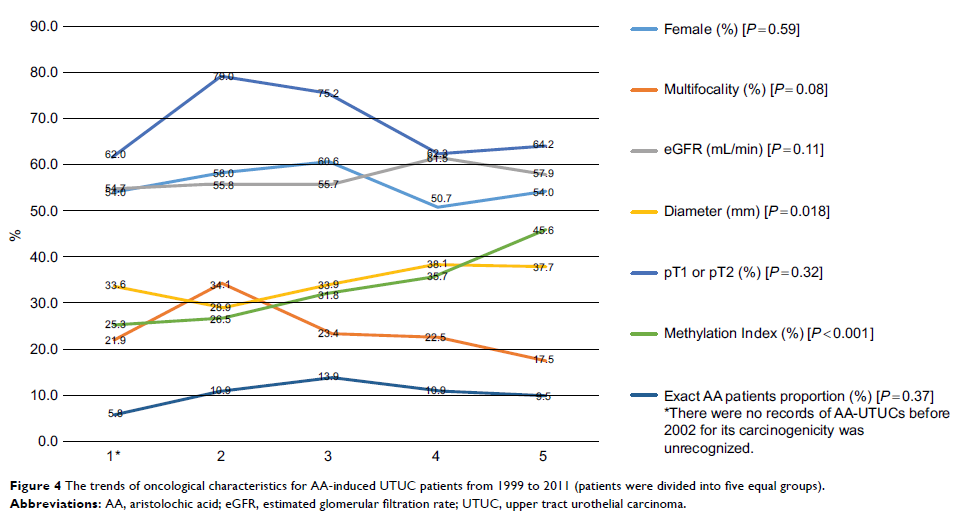
cancer-specific mortality. AA might be the main cause of these gender-based
differences. The AA-induced UTUC patients presented smaller tumor diameters,
lower tumor stages, fewer positive N statuses, more multifocal tumors, lower
methylation indices, and poorer renal function. Although AA-induced UTUC
patients exhibited better survival rates, BR and CUTR rates were significantly
worse.
Conclusion: In China,
there exist significant AA-induced differences between male and female UTUC
patients. The bladders and contralateral upper urinary tracts of AA-induced
UTUC patients should be carefully monitored after surgery.
Keywords: upper
tract urothelial carcinoma, aristolochic acid, gender difference, oncological
outcomes, China