115195
论文已发表
注册即可获取德孚的最新动态
IF 收录期刊
- 3.6 Breast Cancer (Dove Med Press)
- 4.3 Clin Epidemiol
- 2.6 Cancer Manag Res
- 3.2 Infect Drug Resist
- 4.1 Clin Interv Aging
- 6.1 Drug Des Dev Ther
- 4.1 Int J Chronic Obstr
- 8.7 Int J Nanomed
- 2.5 Int J Women's Health
- 3.2 Neuropsych Dis Treat
- 2.4 OncoTargets Ther
- 2.6 Patient Prefer Adher
- 2.6 Ther Clin Risk Manag
- 3.1 J Pain Res
- 3.5 Diabet Metab Synd Ob
- 4.5 Psychol Res Behav Ma
- 3.4 Nat Sci Sleep
- 2.4 Pharmgenomics Pers Med
- 2.6 Risk Manag Healthc Policy
- 4.6 J Inflamm Res
- 2.3 Int J Gen Med
- 3.9 J Hepatocell Carcinoma
- 3.3 J Asthma Allergy
- 2.5 Clin Cosmet Investig Dermatol
- 3.0 J Multidiscip Healthc

间皮细胞纤维化诱导卵巢癌腹膜种植转移
Authors Wang J, Liu C, Chang X, Qi Y, Zhu Z, Yang X
Received 7 August 2018
Accepted for publication 31 October 2018
Published 4 December 2018 Volume 2018:10 Pages 6641—6647
DOI https://doi.org/10.2147/CMAR.S183043
Checked for plagiarism Yes
Review by Single-blind
Peer reviewers approved by Dr Justinn Cochran
Peer reviewer comments 3
Editor who approved publication: Dr Rituraj Purohit
Background: Peritoneal
metastasis frequently occurs in patients with advanced ovarian cancer and is
the main basis for a poor prognosis. The mechanism underlying preferential
ovarian cancer spread to the peritoneum is not well understood.
Methods: Herein,
we investigated the significance and mechanism underlying fibrosis of
mesothelial cells promoting peritoneal implantation of ovarian cancer. We have
assessed the mesothelial cell fibroblast transformation process in
peritoneal tissues of omentum and fibrotic mesothelial cell release of
chemokines to promote dissemination by scanning electron microscopy, ELISA,
Western blot, and Transwell chamber assay.
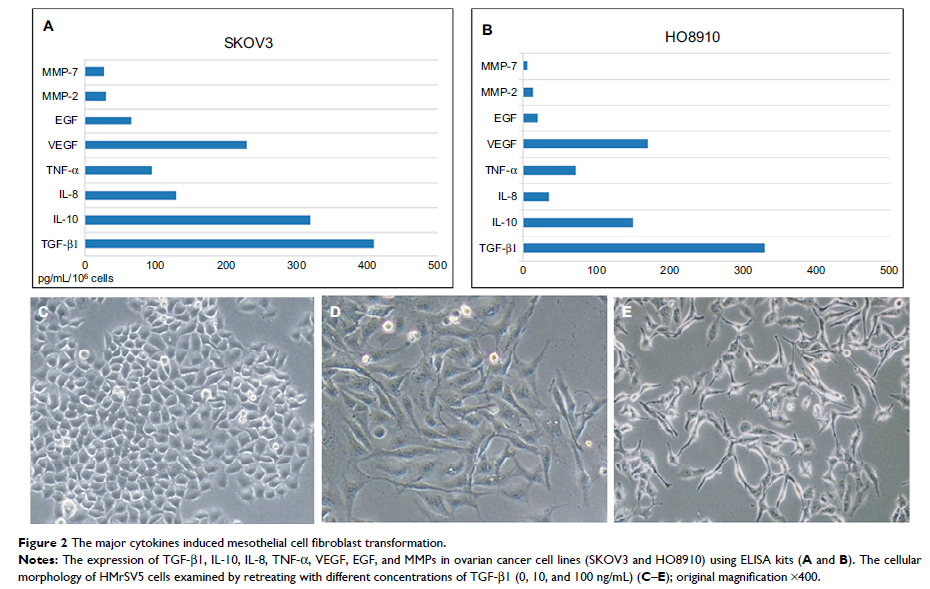
Results: We showed that
the fibrosis of mesothelial cells exists in the peritoneum of ovarian cancer
patients with peritoneal metastasis. Fibrosis of the mesothelial cells was
induced by TGF-β1, which upregulates the CXCL12–CXCR4 and CXCL16–CXCR6 axes of
mesothelial cells.
Conclusion: CXCL12–CXCR4
and CXCL16–CXCR6 may be important signaling pathways closely involved in
peritoneal metastasis of ovarian cancer that require further investigation. The
findings may lead to developing alternative strategies aimed at preventing and
treating the metastasis of ovarian cancer.
Keywords: ovarian cancer,
peritoneal, mesothelial cell, fibrosis