115195
论文已发表
注册即可获取德孚的最新动态
IF 收录期刊
- 3.6 Breast Cancer (Dove Med Press)
- 4.3 Clin Epidemiol
- 2.6 Cancer Manag Res
- 3.2 Infect Drug Resist
- 4.1 Clin Interv Aging
- 6.1 Drug Des Dev Ther
- 4.1 Int J Chronic Obstr
- 8.7 Int J Nanomed
- 2.5 Int J Women's Health
- 3.2 Neuropsych Dis Treat
- 2.4 OncoTargets Ther
- 2.6 Patient Prefer Adher
- 2.6 Ther Clin Risk Manag
- 3.1 J Pain Res
- 3.5 Diabet Metab Synd Ob
- 4.5 Psychol Res Behav Ma
- 3.4 Nat Sci Sleep
- 2.4 Pharmgenomics Pers Med
- 2.6 Risk Manag Healthc Policy
- 4.6 J Inflamm Res
- 2.3 Int J Gen Med
- 3.9 J Hepatocell Carcinoma
- 3.3 J Asthma Allergy
- 2.5 Clin Cosmet Investig Dermatol
- 3.0 J Multidiscip Healthc

SFRP5 通过 Wnt signaling 途径抑制黑素瘤细胞的迁移和侵袭
Authors Chen Y, Zou D, Wang N, Tan T, Liu Y, Zhao Q, Pu Y, Thapa RJ, Chen J
Received 26 July 2018
Accepted for publication 1 November 2018
Published 6 December 2018 Volume 2018:11 Pages 8761—8772
DOI https://doi.org/10.2147/OTT.S181146
Checked for plagiarism Yes
Review by Single-blind
Peer reviewers approved by Dr Colin Mak
Peer reviewer comments 2
Editor who approved publication: Dr William Cho
Background: Secreted
frizzled-related protein 5 (SFRP5) plays a key role in the development and
progression of multiple tumors. However, the role and underlying mechanisms of
SFRP5 in melanoma cells remain unknown.
Materials and methods: We used
immunohistochemistry and Western blot analysis to detect the expression of
SFRP5 in melanoma tissues and melanoma cells, respectively. Furthermore, both
in vitro and in vivo assays were used to determine the effect of SFRP5 on
malignant behavior in melanoma cells.
Results: We found
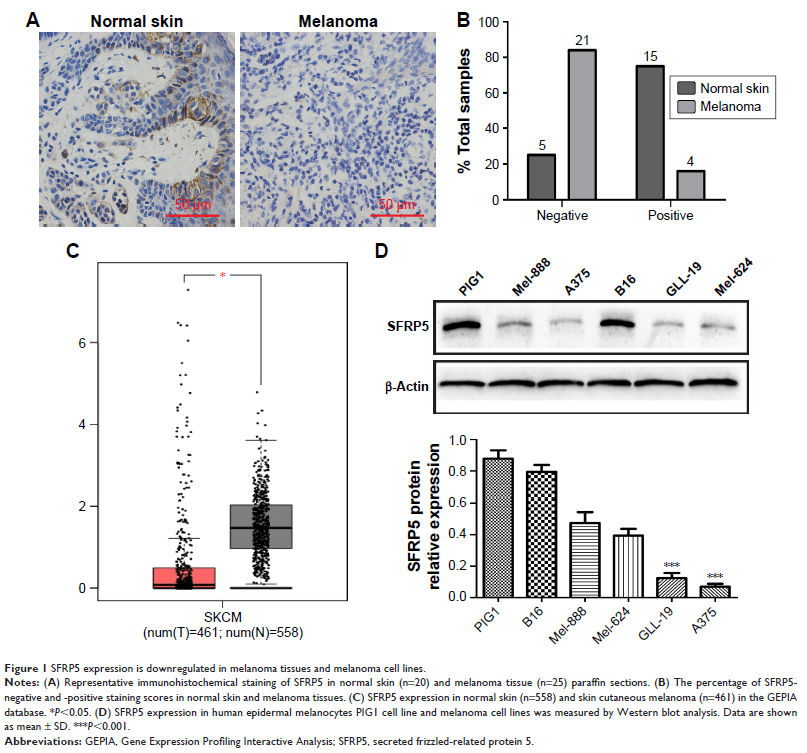
that SFRP5 was markedly downregulated in melanoma tissues and cell lines. The
SFRP5 overexpression exhibited no effect on the proliferation and apoptosis of
melanoma cells but markedly suppressed the migration and invasion of melanoma
cells in vitro. Regarding mechanisms, the SFRP5 overexpression inhibited the
migration and invasion of melanoma cells by suppressing the
epithelial–mesenchymal transition process and decreasing the matrix
metalloproteinase-2/9 expression through the Wnt signaling pathway. Finally, in
a xenograft animal model, we illustrated that the SFRP5 overexpression
suppressed the tumor growth by decreasing angiogenesis and declined lung
metastasis.
Conclusion: This study
suggests that SFRP5 expression could be potentially useful in the invasion and
metastasis of melanoma and serve as a putative promising target for human
melanoma therapy.
Keywords: SFRP5, Wnt
signaling, melanoma, migration, invasion