115195
论文已发表
注册即可获取德孚的最新动态
IF 收录期刊
- 3.6 Breast Cancer (Dove Med Press)
- 4.3 Clin Epidemiol
- 2.6 Cancer Manag Res
- 3.2 Infect Drug Resist
- 4.1 Clin Interv Aging
- 6.1 Drug Des Dev Ther
- 4.1 Int J Chronic Obstr
- 8.7 Int J Nanomed
- 2.5 Int J Women's Health
- 3.2 Neuropsych Dis Treat
- 2.4 OncoTargets Ther
- 2.6 Patient Prefer Adher
- 2.6 Ther Clin Risk Manag
- 3.1 J Pain Res
- 3.5 Diabet Metab Synd Ob
- 4.5 Psychol Res Behav Ma
- 3.4 Nat Sci Sleep
- 2.4 Pharmgenomics Pers Med
- 2.6 Risk Manag Healthc Policy
- 4.6 J Inflamm Res
- 2.3 Int J Gen Med
- 3.9 J Hepatocell Carcinoma
- 3.3 J Asthma Allergy
- 2.5 Clin Cosmet Investig Dermatol
- 3.0 J Multidiscip Healthc

DAPK 在治疗非小细胞肺癌中的临床病理意义:一个系统评价和荟萃分析
Authors Zhang Y, Wu J, Huang G, Xu S
Received 21 May 2018
Accepted for publication 30 August 2018
Published 12 December 2018 Volume 2018:10 Pages 6897—6904
DOI https://doi.org/10.2147/CMAR.S174815
Checked for plagiarism Yes
Review by Single-blind
Peer reviewers approved by Dr Andrew Yee
Peer reviewer comments 2
Editor who approved publication: Professor Nakshatri
Background: Lung
carcinogenesis is related to silencing of tumor suppressor genes and activation
of oncogenes. The aim was to investigate the significance of death-associated
protein kinase (DAPK) methylation in non-small-cell lung cancer (NSCLC) through
a meta-analysis.
Methods: A
detailed literature search was made in PubMed, Embase, and Web of Science
databases. All analysis was performed with Review Manager 5.2.
Results: In total,
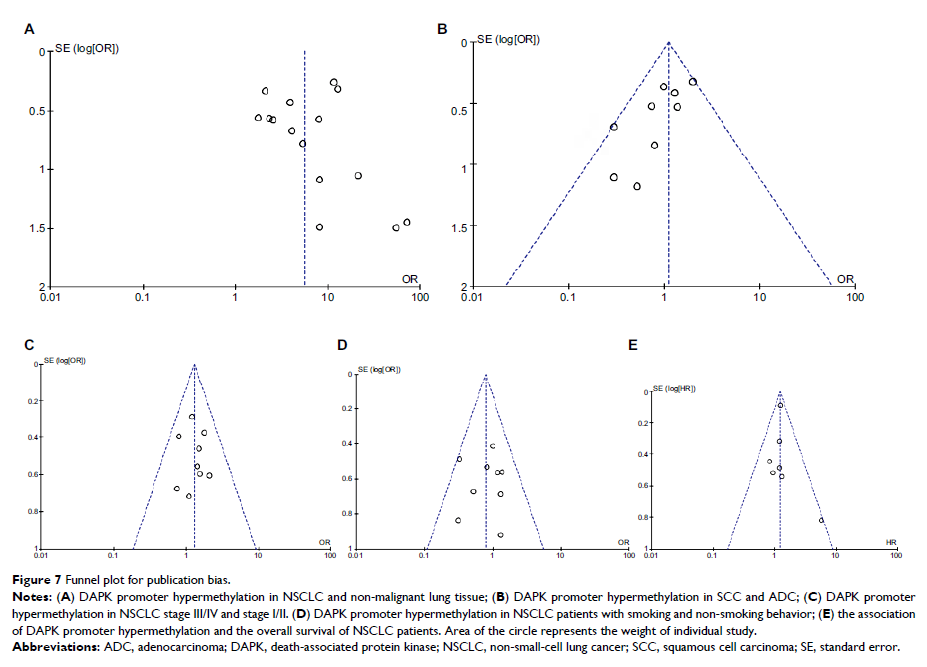
28 studies with a total of 2,148 patients were involved. The frequency of DAPK
promoter hypermethylation was 40.50% in NSCLC, significantly higher than in
non-malignant lung tissue; the pooled OR was 5.69, P <0.00001.
Additionally, DAPK promoter hypermethylation was significantly correlated with
poor overall survival in patients with NSCLC. However, there was no significant
difference found while comparing the rate of DAPK promoter hypermethylation in
adenocarcinoma and squamous cell cancer. The rate of DAPK promoter
hypermethylation was similar between stage III/IV and stage I/II. In addition,
the data showed that DAPK promoter hypermethylation was not associated
with smoking behavior in patients with NSCLC.
Conclusion: DAPK
promoter hypermethylation is correlated with risk of NSCLC and is a potential
biomarker for prediction of poor prognosis in patients with NSCLC.
Keywords: DAPK, NSCLC,
biomarker, methylation, adenocarcinoma, squamous cell cancer, drug target