115195
论文已发表
注册即可获取德孚的最新动态
IF 收录期刊
- 3.6 Breast Cancer (Dove Med Press)
- 4.3 Clin Epidemiol
- 2.6 Cancer Manag Res
- 3.2 Infect Drug Resist
- 4.1 Clin Interv Aging
- 6.1 Drug Des Dev Ther
- 4.1 Int J Chronic Obstr
- 8.7 Int J Nanomed
- 2.5 Int J Women's Health
- 3.2 Neuropsych Dis Treat
- 2.4 OncoTargets Ther
- 2.6 Patient Prefer Adher
- 2.6 Ther Clin Risk Manag
- 3.1 J Pain Res
- 3.5 Diabet Metab Synd Ob
- 4.5 Psychol Res Behav Ma
- 3.4 Nat Sci Sleep
- 2.4 Pharmgenomics Pers Med
- 2.6 Risk Manag Healthc Policy
- 4.6 J Inflamm Res
- 2.3 Int J Gen Med
- 3.9 J Hepatocell Carcinoma
- 3.3 J Asthma Allergy
- 2.5 Clin Cosmet Investig Dermatol
- 3.0 J Multidiscip Healthc

AIB1 和 EIF5A2 对上尿路上皮癌术后膀胱内复发的预后价值
Authors Huang Y, Wei J, Fang Y, Chen Z, Cen J, Feng Z, Lu J, Liang Y, Luo J, Chen W
Received 26 August 2018
Accepted for publication 16 November 2018
Published 14 December 2018 Volume 2018:10 Pages 6997—7011
DOI https://doi.org/10.2147/CMAR.S185392
Checked for plagiarism Yes
Review by Single-blind
Peer reviewers approved by Dr Andrew Yee
Peer reviewer comments 3
Editor who approved publication: Dr Ahmet Emre Eskazan
Objectives: The aim of this study was to investigate
the prognostic effect of amplified in AIB1 and EIF5A2 expression on
postoperative intravesical recurrence for upper urinary tract urothelial
carcinoma (UTUC) and improve postoperative risk stratification and prediction
of intravesical chemotherapy benefit.
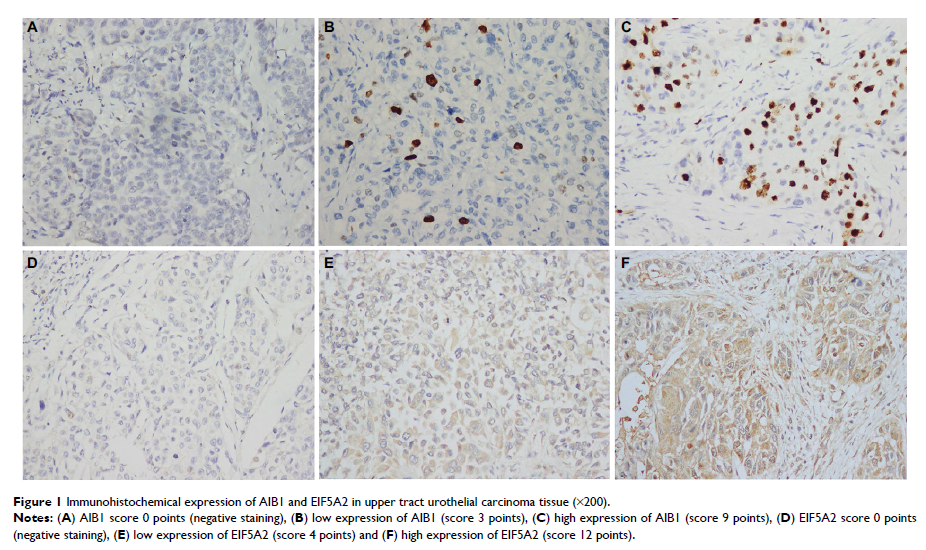
Materials and methods: We evaluated immunohistochemical expression of AIB1 and EIF5A2 in
109 UTUC patients to determine the predictive significance in intravesical
recurrence. A prognostic model was developed based on univariate and multivariate
analyses.
Results: Intravesical
recurrence occurred in 18 out of the 109 (16.5%) patients during the follow-up
period. Significant associations of high expression of AIB1 and EIF5A2 with
shortened bladder recurrence interval (median: 24 months vs
46 months, P =0.021; 28 months vs 39 months, P =0.002) were
demonstrated. In different subsets of UTUC patients, high expression of AIB1
was a prognostic indicator in high grade (P =0.006) and pT2–4 (P =0.007), and high expression of EIF5A2 for high grade
(P =0.014), pT2–4 (P =0.002) and pN0 (P =0.009). Moreover,
in multivariate analysis, AIB1 and EIF5A2 expression (P =0.034 and 0.022,
respectively) together with pN stage (P =0.009) provided significant independent predictors
for intravesical recurrence after surgery for UTUC. Surgical approach with
radical nephroureterectomy (RNU) was an informative factor toward good
oncologic outcomes for intravesical recurrence (P =0.056). Based on
a prognostic model with these factors, patients with UTUC were classified into the
low-risk group and the high-risk group. In a subset analysis, the patients in
the high-risk group were found to have a favorable response to intravesical
chemotherapy (P =0.047).
A nomogram based on the multivariate analysis was developed to predict intravesical
recurrence accurately and guide postoperative intravesical instillations. The
concordance index (c-index) of this model was 0.806.
Conclusion: High
expression of AIB1 and EIF5A2 were independent predictors for intravesical
recurrence after RNU and might be able to predict which patients benefit from
postoperative intravesical chemotherapy.
Keywords: AIB1,
EIF5A2, intravesical recurrence, prognosis, nomogram, upper tract urothelial
carcinoma