115195
论文已发表
注册即可获取德孚的最新动态
IF 收录期刊
- 3.6 Breast Cancer (Dove Med Press)
- 4.3 Clin Epidemiol
- 2.6 Cancer Manag Res
- 3.2 Infect Drug Resist
- 4.1 Clin Interv Aging
- 6.1 Drug Des Dev Ther
- 4.1 Int J Chronic Obstr
- 8.7 Int J Nanomed
- 2.5 Int J Women's Health
- 3.2 Neuropsych Dis Treat
- 2.4 OncoTargets Ther
- 2.6 Patient Prefer Adher
- 2.6 Ther Clin Risk Manag
- 3.1 J Pain Res
- 3.5 Diabet Metab Synd Ob
- 4.5 Psychol Res Behav Ma
- 3.4 Nat Sci Sleep
- 2.4 Pharmgenomics Pers Med
- 2.6 Risk Manag Healthc Policy
- 4.6 J Inflamm Res
- 2.3 Int J Gen Med
- 3.9 J Hepatocell Carcinoma
- 3.3 J Asthma Allergy
- 2.5 Clin Cosmet Investig Dermatol
- 3.0 J Multidiscip Healthc

转录组学分析鉴定三阴性和非三阴性乳腺癌之间的关键差异表达基因和临床结果
Authors Chen B, Tang H, Chen X, Zhang G, Wang Y, Xie X, Liao N
Received 11 September 2018
Accepted for publication 16 November 2018
Published 21 December 2018 Volume 2019:11 Pages 179—190
DOI https://doi.org/10.2147/CMAR.S187151
Checked for plagiarism Yes
Review by Single-blind
Peer reviewers approved by Dr Andrew Yee
Peer reviewer comments 2
Editor who approved publication: Dr Beicheng Sun
Purpose: There are
significant differences in the biological behavior between triple-negative
breast cancer (TNBC) and non-triple-negative breast cancer (non-TNBC). In the
present study, we identify key differential genes and clinical outcomes between
TNBC and non-TNBC.
Materials and methods: Transcriptomic
analyses used GEO datasets (GSE76275), gene ontology, KEGG pathway analysis and
cBioPortal. Quantitative RT-PCR analysis (qRT-PCR) was used to validate the
differentially expressed genes. We used the KM Plotter Online Tool and 240
patients with TNBC tissue microarray to assay the prognostic value of HORMAD1 .
Results: The
upregulated differentially expressed genes were enriched in transcription
factor activity, sequence-specific DNA binding and nucleic acid binding
transcription factor activity. Only 16 genes were upregulated when further
screened for fold change >4-fold change. HORMAD1 and SOX8 exhibited high
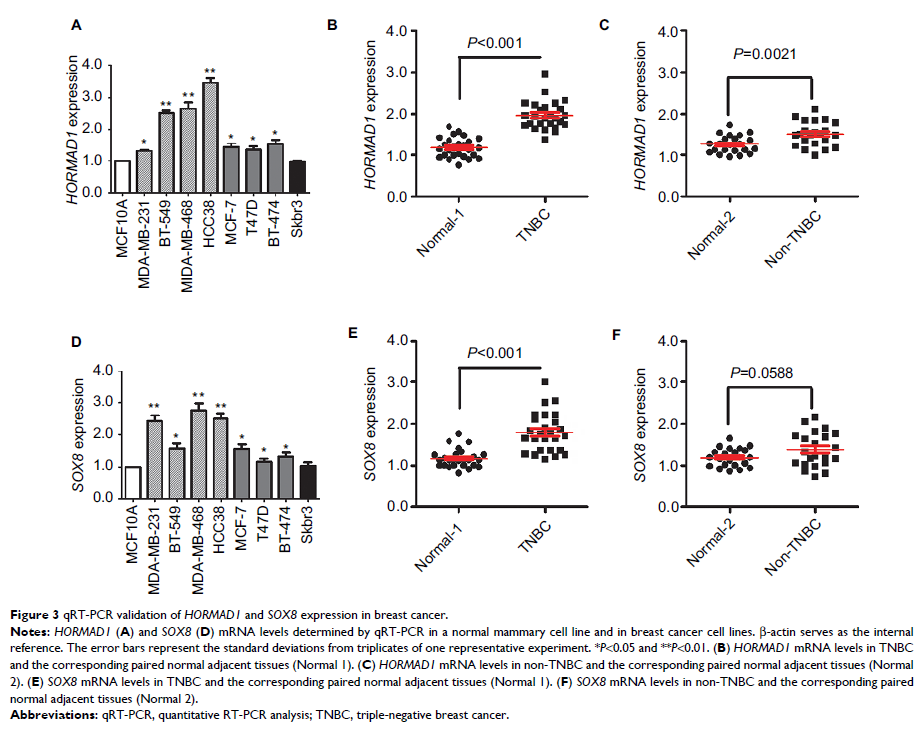
frequencies of change of greater than 10% (HORMAD1 was close to 20%). qRT-PCR results
indicated that HORMAD1 and SOX8 mRNA
levels were significantly upregulated in TNBC samples. In KM Plotter Online
Tool, high HORMAD1 was
associated with worse outcome. In our tissue microarray (including 240 TNBC
tissues), IHC analysis revealed that 29.7% (55/240) of the tumor samples
exhibited high HORMAD1 expression and 70.3% (185/240) of the tumor
samples exhibited low HORMAD1 expression levels. Meanwhile, high HORMAD1 group
has a bad prognosis.
Conclusion: The
status of transcriptional activation is an important difference between TNBC
and non-TNBC. HORMAD1 is a key differential gene associated
with poor outcome in TNBC. Epigenetic therapy and agents targeting
cancer/testis antigens might potentially help to customize therapies of TNBC.
Keywords: HORMAD1 ,
triple-negative breast cancer, non-triple-negative breast cancer, prognostic
factor, transcriptome