115195
论文已发表
注册即可获取德孚的最新动态
IF 收录期刊
- 3.6 Breast Cancer (Dove Med Press)
- 4.3 Clin Epidemiol
- 2.6 Cancer Manag Res
- 3.2 Infect Drug Resist
- 4.1 Clin Interv Aging
- 6.1 Drug Des Dev Ther
- 4.1 Int J Chronic Obstr
- 8.7 Int J Nanomed
- 2.5 Int J Women's Health
- 3.2 Neuropsych Dis Treat
- 2.4 OncoTargets Ther
- 2.6 Patient Prefer Adher
- 2.6 Ther Clin Risk Manag
- 3.1 J Pain Res
- 3.5 Diabet Metab Synd Ob
- 4.5 Psychol Res Behav Ma
- 3.4 Nat Sci Sleep
- 2.4 Pharmgenomics Pers Med
- 2.6 Risk Manag Healthc Policy
- 4.6 J Inflamm Res
- 2.3 Int J Gen Med
- 3.9 J Hepatocell Carcinoma
- 3.3 J Asthma Allergy
- 2.5 Clin Cosmet Investig Dermatol
- 3.0 J Multidiscip Healthc

MicroRNA-562 在胶质母细胞瘤细胞的生长中对 c-MET/AKT 通路进行负调节
Authors Nie X, Su Z, Yan R, Yan A, Qiu S, Zhou Y
Received 6 September 2018
Accepted for publication 26 November 2018
Published 21 December 2018 Volume 2019:12 Pages 41—49
DOI https://doi.org/10.2147/OTT.S186701
Checked for plagiarism Yes
Review by Single-blind
Peer reviewers approved by Dr Andrew Yee
Peer reviewer comments 3
Editor who approved publication: Dr Sanjay Singh
Background: MicroRNA-562
(miR-562) has been found to possess anti-cancer function in certain tumors.
However, the function of miR-562 in glioblastoma (GBM) is still not fully
understood.
Purpose: The aim at present study is to analyze
the function of miR-562 and its possible target in GBM cells.
Patients and methods: In the present
study, a total of 80 GBM samples and 16 adjacent noncancerous tissues were used
to examine the expression of miR-562 and c-MET. In order to gain a deep insight
into the molecular network of miR-562 and c-MET in GBM, the miR-562 mimic and
inhibitor were transfected into two GBM cell lines (U251 and U87),
respectively. Meanwhile, lentiviral vector was used to mediate overexpression
of c-MET. Cell proliferation was examined via Cell Counting Kit-8 (CCK-8)
assays. Meanwhile, cell apoptosis was analyzed by Annexin V-FTTC/PI staining
assay.
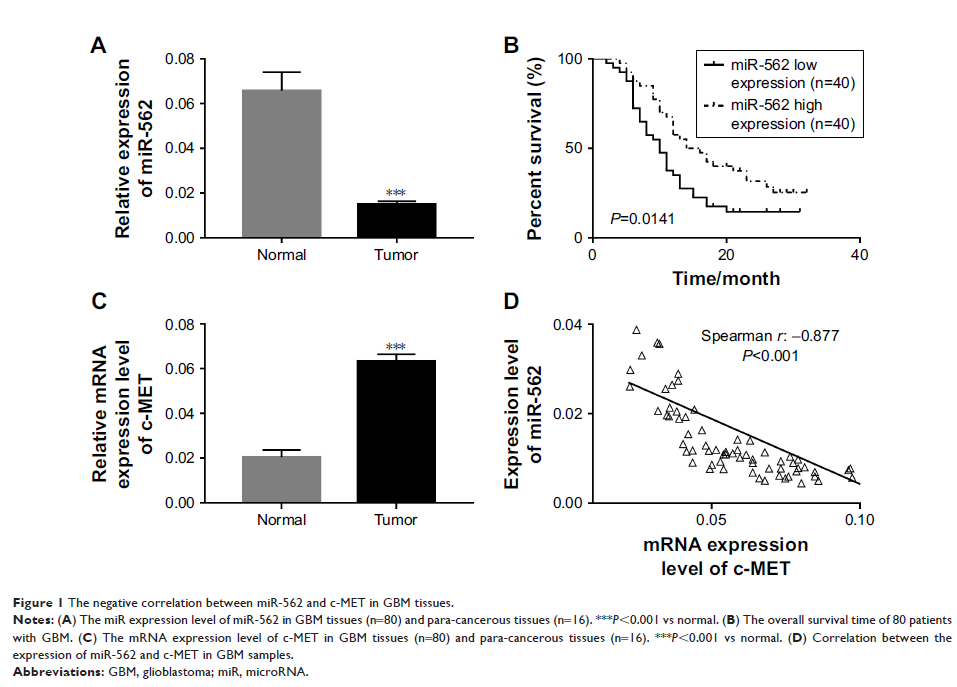
Results: Our
results indicated that the level of miR-562 was downregulated in GBM tissues
and the expression of c-MET was upregulated in tumors. Cell proliferation
analysis indicated that miR-562 was an anti-proliferation effector in GBM
cells. Moreover, cell apoptosis analysis suggested the pro-apoptosis function
of miR-562 in GBM cells.
Conclusion: Our
results demonstrated that miR-562 negatively regulated the c-MET/AKT signal
pathway. In addition, caspase-3 might also serve as another target for miR-562
in GBM cells. This research not only obtained a deep understanding of miR-562
but also provided evidence in terms of developing new prognostic biomarker for
GBM.
Keywords: glioblastoma,
miR-562, c-MET, AKT, p-AKT, caspase-3