115195
论文已发表
注册即可获取德孚的最新动态
IF 收录期刊
- 3.6 Breast Cancer (Dove Med Press)
- 4.3 Clin Epidemiol
- 2.6 Cancer Manag Res
- 3.2 Infect Drug Resist
- 4.1 Clin Interv Aging
- 6.1 Drug Des Dev Ther
- 4.1 Int J Chronic Obstr
- 8.7 Int J Nanomed
- 2.5 Int J Women's Health
- 3.2 Neuropsych Dis Treat
- 2.4 OncoTargets Ther
- 2.6 Patient Prefer Adher
- 2.6 Ther Clin Risk Manag
- 3.1 J Pain Res
- 3.5 Diabet Metab Synd Ob
- 4.5 Psychol Res Behav Ma
- 3.4 Nat Sci Sleep
- 2.4 Pharmgenomics Pers Med
- 2.6 Risk Manag Healthc Policy
- 4.6 J Inflamm Res
- 2.3 Int J Gen Med
- 3.9 J Hepatocell Carcinoma
- 3.3 J Asthma Allergy
- 2.5 Clin Cosmet Investig Dermatol
- 3.0 J Multidiscip Healthc

CD44st 和 HER2 表达对乳腺癌患者手术预后的影响
Authors Chen DD, Ji JA, Yan HC, Huang GH, Fang XJ
Received 20 July 2018
Accepted for publication 3 November 2018
Published 15 January 2019 Volume 2019:12 Pages 577—585
DOI https://doi.org/10.2147/OTT.S180972
Checked for plagiarism Yes
Review by Single-blind
Peer reviewers approved by Dr Andrew Yee
Peer reviewer comments 2
Editor who approved publication: Dr Jianmin Xu
Objective: CD44st is
a member of the CD44 family; abnormal expression of some CD44 isoforms are
closely associated with axillary lymph node metastasis, cancer progression, and
patients’ prognosis. The objective of this study is to investigate the
correlation between the expression of CD44st and HER2 in breast cancer and the
effect on patients’ prognosis.
Methods: Primers
were designed to target the CD44st mRNA (Gene Bank No FJ216964) which has been
newly identified in a drug-resistant breast cancer cell line. The expression of
CD44st and HER2 mRNA and proteins in cancerous and paracancerous tissue of
postoperative breast cancer patients was detected and compared. Tissue samples
were obtained from 102 cases of invasive ductal carcinoma, 19 cases of
intraductal carcinoma, and 11 cases of medullary carcinoma. The correlation between
CD44st and HER2 expression and clinical pathological features was examined.
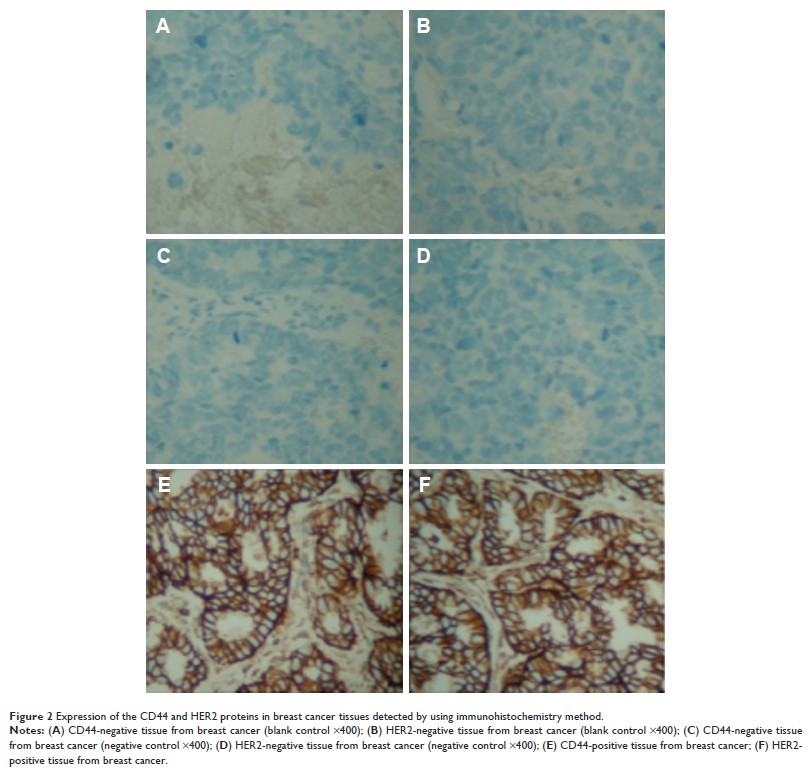
Results: The expression
rate of CD44st mRNA and protein in breast cancer tissue was 64.4% (85/132),
while HER2 mRNA and protein was expressed in 22.0% (29/106) of the samples. The
expression of CD44st and HER2 were low in paracancerous tissue. In breast
cancer tissue, the expression rate of HER2 mRNA and protein in the
CD44st-positive group was 28.2% (24/85), and 10.6% (5/47) in the
CD44st-negative group. This difference was statistically significant (P =0.015).
Sequencing analysis showed that the amplified CD44st gene in this study was the
same as that which was previously discovered in the drug-resistant breast
cancer cell line. A linear correlation was found between the expression of
CD44st and HER2 (r =0.972, r 2=0.945, F =2,213.51, P <0.001). The expression of CD44st and HER2 was
also closely associated with luminal cancer subtypes, lymph node metastasis,
and TNM stage (P <0.05),
but not associated with age, pathological type, or tumor size (P >0.05). The
median overall survival in the CD44st high-expression group was 51.85 months
(95% CI: 48.48–55.22), which was significantly shorter than that in the CD44st
low-expression group (57.61 months; 95% CI: 55.54–59.68, P =0.032).
Conclusion: CD44st is
closely related to the expression of HER2. The expression of CD44st affects
patient prognosis and is associated with lymph node metastasis, TNM staging,
and molecular subtyping.
Keywords: CD44st,
HER2, invasion, breast cancer, metastasis, prognosis