115195
论文已发表
注册即可获取德孚的最新动态
IF 收录期刊
- 3.6 Breast Cancer (Dove Med Press)
- 4.3 Clin Epidemiol
- 2.6 Cancer Manag Res
- 3.2 Infect Drug Resist
- 4.1 Clin Interv Aging
- 6.1 Drug Des Dev Ther
- 4.1 Int J Chronic Obstr
- 8.7 Int J Nanomed
- 2.5 Int J Women's Health
- 3.2 Neuropsych Dis Treat
- 2.4 OncoTargets Ther
- 2.6 Patient Prefer Adher
- 2.6 Ther Clin Risk Manag
- 3.1 J Pain Res
- 3.5 Diabet Metab Synd Ob
- 4.5 Psychol Res Behav Ma
- 3.4 Nat Sci Sleep
- 2.4 Pharmgenomics Pers Med
- 2.6 Risk Manag Healthc Policy
- 4.6 J Inflamm Res
- 2.3 Int J Gen Med
- 3.9 J Hepatocell Carcinoma
- 3.3 J Asthma Allergy
- 2.5 Clin Cosmet Investig Dermatol
- 3.0 J Multidiscip Healthc

新型糖转运蛋白 SLC50A1 作为潜在的血清为基础的乳腺癌诊断和预后生物标志物
Authors Wang Y, Shu Y, Gu C, Fan Y
Received 12 October 2018
Accepted for publication 17 December 2018
Published 17 January 2019 Volume 2019:11 Pages 865—876
DOI https://doi.org/10.2147/CMAR.S190591
Checked for plagiarism Yes
Review by Single-blind
Peer reviewers approved by Dr Andrew Yee
Peer reviewer comments 3
Editor who approved publication: Dr Kenan Onel
Background: The novel
sugar transporter and membrane protein SLC50A1 has been identified as a
potential candidate biomarker for breast cancer; however, its potential as a
serum biomarker for breast cancer detection and prognosis is unclear. The aim
of this study was to investigate the serum expression profile of SLC50A1 and to
determine its diagnostic and prognostic significance in breast cancer.
Materials and methods: Bioinformatics
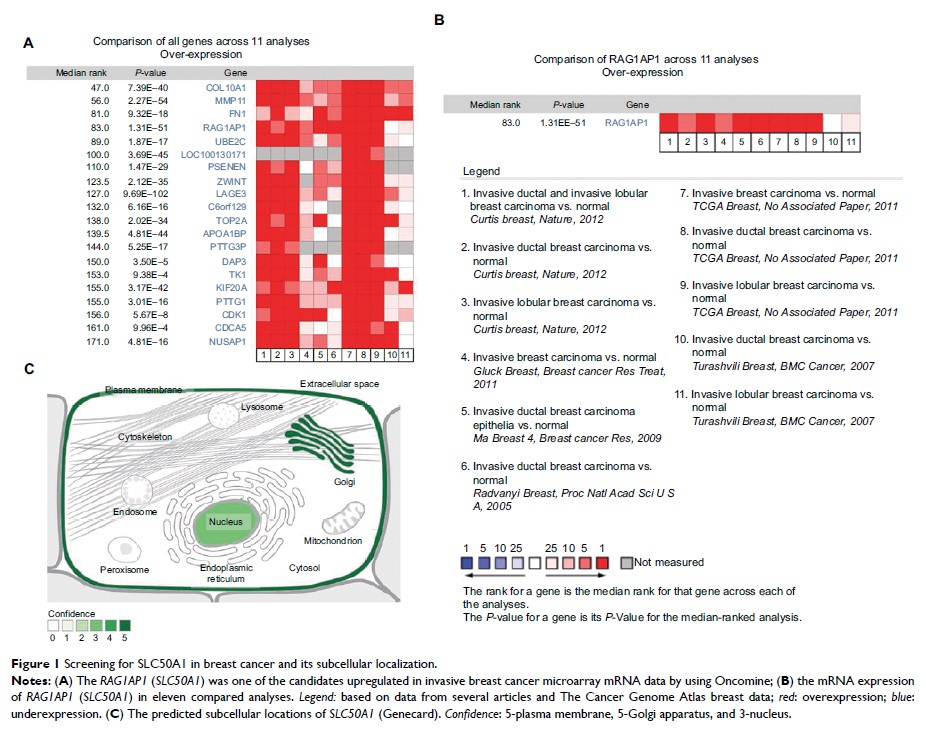
analysis was conducted, and data for SLC50A1 expression in human breast cancer were
collected. Semi-quantitative real-time PCR and ELISA were performed to compare
SLC50A1 expression in several breast cancer cell lines, one paired tissue
cohort (n=20) and two independent cohorts of human breast cancer patients
(n=85) and healthy individuals (n=30). The results were analyzed statistically,
and associations between clinicopathological and survival data were evaluated
by multivariate Cox regression analysis.
Results: SLC50A1
was confirmed as a candidate breast cancer gene by bioinformatics
analysis. SLC50A1 mRNA
expression levels were significantly upregulated in breast cancer (P <0.001). Serum
SLC50A1 levels were able to discriminate between women with breast cancer and
healthy women with a sensitivity of 75.3% and a specificity of 100.0% (P <0.001; area
under the curve=0.915). Interestingly, SLC50A1 protein expression was
associated with estrogen receptor (P =0.016) and HER2 status (P =0.037).
Furthermore, SLC50A1 levels were positively related to unfavorable 3-year
outcomes in patients with high-grade breast cancer (HR =1.823, P =0.01), indicating
its potential use as an independent prognostic factor.
Conclusion: SLC50A1
can be used as a serum-based diagnostic and prognostic biomarker in breast
cancer. However, further studies are needed to clarify its potential role as a
therapeutic target.
Keywords: breast
cancer, SLC50A1, biomarker, serum, prognosis