115195
论文已发表
注册即可获取德孚的最新动态
IF 收录期刊
- 3.6 Breast Cancer (Dove Med Press)
- 4.3 Clin Epidemiol
- 2.6 Cancer Manag Res
- 3.2 Infect Drug Resist
- 4.1 Clin Interv Aging
- 6.1 Drug Des Dev Ther
- 4.1 Int J Chronic Obstr
- 8.7 Int J Nanomed
- 2.5 Int J Women's Health
- 3.2 Neuropsych Dis Treat
- 2.4 OncoTargets Ther
- 2.6 Patient Prefer Adher
- 2.6 Ther Clin Risk Manag
- 3.1 J Pain Res
- 3.5 Diabet Metab Synd Ob
- 4.5 Psychol Res Behav Ma
- 3.4 Nat Sci Sleep
- 2.4 Pharmgenomics Pers Med
- 2.6 Risk Manag Healthc Policy
- 4.6 J Inflamm Res
- 2.3 Int J Gen Med
- 3.9 J Hepatocell Carcinoma
- 3.3 J Asthma Allergy
- 2.5 Clin Cosmet Investig Dermatol
- 3.0 J Multidiscip Healthc

RAP80 在乳腺癌中的表达及其与乳腺癌细胞凋亡的关系
Authors Jin GH, Mao X, Qiao Z, Chen B, Jin F
Received 9 September 2018
Accepted for publication 31 October 2018
Published 18 January 2019 Volume 2019:12 Pages 625—634
DOI https://doi.org/10.2147/OTT.S186981
Checked for plagiarism Yes
Review by Single-blind
Peer reviewers approved by Dr Amy Norman
Peer reviewer comments 3
Editor who approved publication: Dr Jianmin Xu
Background: RAP80 is
a member of BRCA1-A complex, which plays an important role in regulating the
cell cycle checkpoint and DNA damage repair in the nucleus.
Method: We
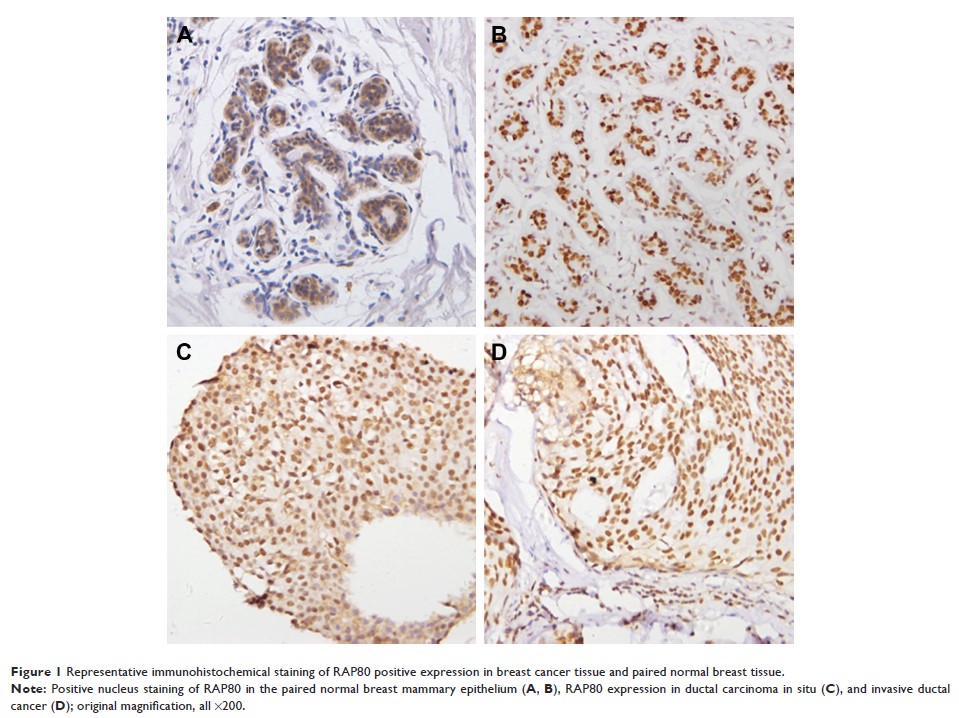
investigated RAP80 expression in breast cancer and its paired normal breast
tissues to further analyze its role in the biological behavior of breast cancer
cells.
Results: RAP80
expression in breast cancer (62.3%, 101/162) was significantly lower than that
in adjacent normal breast tissues (P <0.05). RAP80 expression was related to tumor
size, lymph node metastasis, TNM stage, and molecular subtype (P <0.05). RAP80
mRNA expression was significantly lower in triple-negative breast cancer than
other types. The mRNA and protein of RAP80 were obvious in MCF-7 and very weak
in ZR-75 or MDA-MB-231, so we picked MCF-7 to be transfected with RAP80 siRNA.
The survival rate of both cells decreased in a dose-dependent manner and the
IC50 value for cisplatin in MCF-7 RAP80 siRNA cells was 0.83 µg/mL, and 1.69
µg/mL in wild-type MCF-7 according to MTT. RAP80 siRNA transfection upregulated
the apoptosis and downregulated invasive or migrating ability of MCF-7. RAP80
siRNA also upregulated the protein expression of Caspase-3, cleaved Caspase-3,
Apaf-1, Cytochrome C, Bax, and Fas, and downregulated the protein expression of
Bcl-2.
Conclusion: RAP80
expression was related to ER or PR activity. Inhibition of RAP80 expression can
induce apoptosis in breast cancer cells and improve chemosensitivity to
cisplatin. Tumor cells can activate protective responses to inhibit cell cycle
progression, which may be related to RAP80, and repair cisplatin-induced DNA
damage. RAP80 is related to BRCA1’s effect, which can be used as an interesting
target for pharmacological modulation that can increase the efficiency of
cisplatin chemotherapy.
Keywords: RAP80,
apoptosis, breast cancer, chemosensitivity