115195
论文已发表
注册即可获取德孚的最新动态
IF 收录期刊
- 3.6 Breast Cancer (Dove Med Press)
- 4.3 Clin Epidemiol
- 2.6 Cancer Manag Res
- 3.2 Infect Drug Resist
- 4.1 Clin Interv Aging
- 6.1 Drug Des Dev Ther
- 4.1 Int J Chronic Obstr
- 8.7 Int J Nanomed
- 2.5 Int J Women's Health
- 3.2 Neuropsych Dis Treat
- 2.4 OncoTargets Ther
- 2.6 Patient Prefer Adher
- 2.6 Ther Clin Risk Manag
- 3.1 J Pain Res
- 3.5 Diabet Metab Synd Ob
- 4.5 Psychol Res Behav Ma
- 3.4 Nat Sci Sleep
- 2.4 Pharmgenomics Pers Med
- 2.6 Risk Manag Healthc Policy
- 4.6 J Inflamm Res
- 2.3 Int J Gen Med
- 3.9 J Hepatocell Carcinoma
- 3.3 J Asthma Allergy
- 2.5 Clin Cosmet Investig Dermatol
- 3.0 J Multidiscip Healthc

长非编码 RNA LINC00662 促进口腔鳞状细胞癌的增殖和迁移
Authors Xu D, Chen Y, Yuan C, Zhang S, Peng W
Received 25 September 2018
Accepted for publication 3 January 2019
Published 18 January 2019 Volume 2019:12 Pages 647—656
DOI https://doi.org/10.2147/OTT.S188691
Checked for plagiarism Yes
Review by Single-blind
Peer reviewers approved by Dr Amy Norman
Peer reviewer comments 3
Editor who approved publication: Dr Tohru Yamada
Background: Although
increasing evidence has demonstrated important roles for long non-coding RNAs
(lncRNAs) in cancer development, their functions in oral squamous cell
carcinoma (OSCC) growth remain largely unknown. Therefore, we aimed to
investigate the role of LINC00662 in OSCC.
Methods: The
expression of LINC00662 in 61 OSCC tissues and four OSCC cell lines were
detected by quantitative reverse-transcription polymerase chain reaction
(qRT-PCR). Cell proliferation was detected using Cell Counting Kit-8 (CCK-8)
and EdU staining methods. Migration and invasion abilities were analyzed using
transwell and wound healing assay. Cell cycle distribution and apoptosis rate
were evaluated by flow cytometry. Western blot method was performed to detect
protein expression.
Results: We found
that the expression of LINC00662 was significantly increased in OSCC tissues,
and a higher expression of LINC00662 was detected in larger tumor size, higher
stage tumors and with lymph node metastasis. Moreover, overexpression of
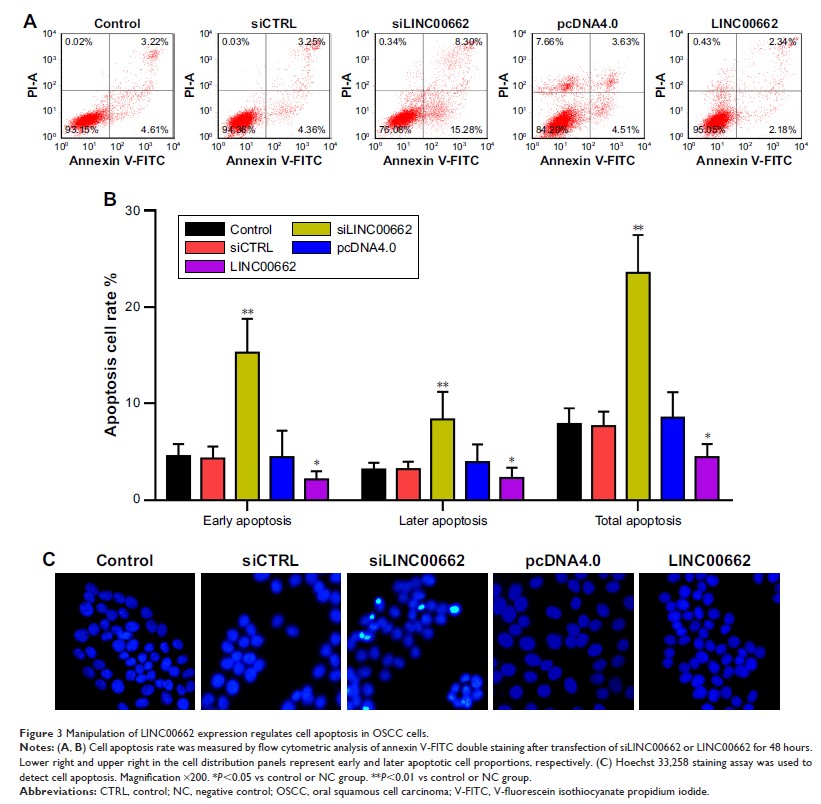
LINC00662 induced OSCC cell proliferation, increased migration and invasion
abilities, and suppressed cell apoptosis. Knockdown of LINC00662 decreased the
proliferation, migration, and invasion abilities of OSCC cell, and induced
apoptosis. Furthermore, LINC00662 regulated the Wnt/β-catenin pathway.
Conclusion: Our data
indicate that LINC00662 may represent a novel indicator of OSCC and may be a
potential therapeutic target for diagnosis and therapy.
Keywords: LINC00662,
proliferation, migration, Wnt/β-catenin pathway, OSCC