115195
论文已发表
注册即可获取德孚的最新动态
IF 收录期刊
- 3.6 Breast Cancer (Dove Med Press)
- 4.3 Clin Epidemiol
- 2.6 Cancer Manag Res
- 3.2 Infect Drug Resist
- 4.1 Clin Interv Aging
- 6.1 Drug Des Dev Ther
- 4.1 Int J Chronic Obstr
- 8.7 Int J Nanomed
- 2.5 Int J Women's Health
- 3.2 Neuropsych Dis Treat
- 2.4 OncoTargets Ther
- 2.6 Patient Prefer Adher
- 2.6 Ther Clin Risk Manag
- 3.1 J Pain Res
- 3.5 Diabet Metab Synd Ob
- 4.5 Psychol Res Behav Ma
- 3.4 Nat Sci Sleep
- 2.4 Pharmgenomics Pers Med
- 2.6 Risk Manag Healthc Policy
- 4.6 J Inflamm Res
- 2.3 Int J Gen Med
- 3.9 J Hepatocell Carcinoma
- 3.3 J Asthma Allergy
- 2.5 Clin Cosmet Investig Dermatol
- 3.0 J Multidiscip Healthc

视神经脊髓炎患者血清中细胞因子和趋化因子的表达
Authors Ai NP, Liu HJ, Zhou HF, Lin DH, Wang JQ, Yang M, Song HG, Sun MM, Xu QG, Wei SH
Received 25 August 2018
Accepted for publication 19 December 2018
Published 21 January 2019 Volume 2019:15 Pages 303—310
DOI https://doi.org/10.2147/NDT.S185336
Checked for plagiarism Yes
Review by Single-blind
Peer reviewers approved by Dr Amy Norman
Peer reviewer comments 1
Editor who approved publication: Dr Yu-Ping Ning
Objective: To study
the differences in immunopathogenesis based on chemokine profile in
neuromyelitis optica patients positive for AQP4 antibodies or MOG antibodies.
Patients and methods: We measured
52 cytokines/chemokines using ELISA in 59 serum samples, which were divided
into three groups according to CBA results: HCs (n=16), AQP4+(n=20) and MOG+
(n=23). The regression equation (R 2 >0.98) of the standard curve was calculated
according to the standard concentration and the corresponding A value. And then
the corresponding sample concentration was calculated according to the A value
of the sample.
Results: Eleven of
52 measured serum cytokine/chemokines (CCL22/MDC, CCL13/MCP-4, CCL21/6Ckine,
CCL27/CTACK, CCL8/MCP-2, CXCL14/BRAK, Contactin-1, Kallilrein 6/Neurosin,
Midkine, VCAM-1 and Fas) were significantly different between MOG+ group and
controls. Ten of 52 measured serum cytokine/chemokines (CCL1/I-309, CCL22/MDC,
CCL28, CCL17/TARC, CCL27/CTACK, CXCL2/GRO beta, Contactin-1, Midkine, Chemerin
and Synuclein-alpha) were significantly different between AQP4+ group and
controls. There was no difference between serum AQP4+ and MOG+ groups for CC
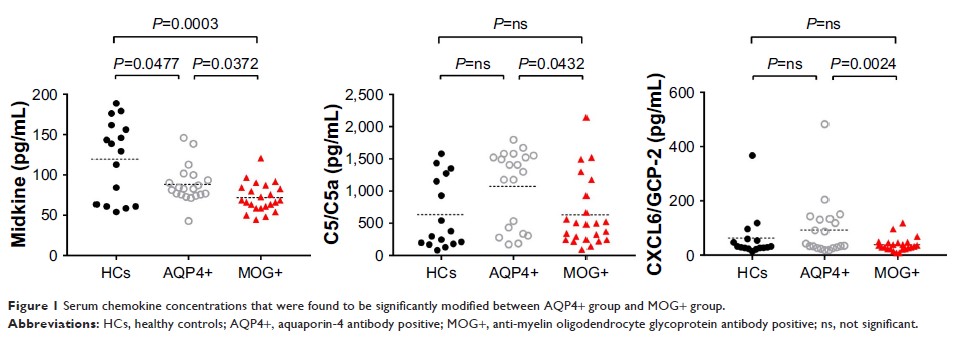
chemokines. All measured chemokines CXC except CXCL6/GCP-2 showed no
significant differences in serum AQP4+ group compared to MOG+ group. However,
there was significant difference between serum AQP4+ and MOG+ groups for C5/C5a
and Midkine. C5/C5a and Midkine were significantly higher in AQP4+ group
compared to MOG+ group (P <0.05).
Conclusion: Our
findings suggest that the differences of mean concentration in CXCL6/GCP-2,
Midkine and C5/C5a probably reveal different immunologic mechanism between
AQP4+ NMO and MOG+ NMO. This cytokine/chemokine profiling provides new insight
into NMO pathogenesis associated with MOG antibody seropositivity and provides
guidance to monitor inflammation and response to treatment in a way.
Keywords: NMO, AQP4
antibodies, MOG antibodies, cytokines, chemokines