115195
论文已发表
注册即可获取德孚的最新动态
IF 收录期刊
- 3.6 Breast Cancer (Dove Med Press)
- 4.3 Clin Epidemiol
- 2.6 Cancer Manag Res
- 3.2 Infect Drug Resist
- 4.1 Clin Interv Aging
- 6.1 Drug Des Dev Ther
- 4.1 Int J Chronic Obstr
- 8.7 Int J Nanomed
- 2.5 Int J Women's Health
- 3.2 Neuropsych Dis Treat
- 2.4 OncoTargets Ther
- 2.6 Patient Prefer Adher
- 2.6 Ther Clin Risk Manag
- 3.1 J Pain Res
- 3.5 Diabet Metab Synd Ob
- 4.5 Psychol Res Behav Ma
- 3.4 Nat Sci Sleep
- 2.4 Pharmgenomics Pers Med
- 2.6 Risk Manag Healthc Policy
- 4.6 J Inflamm Res
- 2.3 Int J Gen Med
- 3.9 J Hepatocell Carcinoma
- 3.3 J Asthma Allergy
- 2.5 Clin Cosmet Investig Dermatol
- 3.0 J Multidiscip Healthc

脂肪酶家族成员 H 型脂肪酶是下游靶标分子,可促进 BCPAP 和 KTC-1 细胞系中甲状腺乳头状癌细胞迁移
Authors Li Y, Zhou X, Zhang Q, Chen E, Sun Y, Ye D, Wang O, Zhang X, Lyu J
Received 12 August 2018
Accepted for publication 26 December 2018
Published 22 January 2019 Volume 2019:11 Pages 931—941
DOI https://doi.org/10.2147/CMAR.S183355
Checked for plagiarism Yes
Review by Single-blind
Peer reviewers approved by Dr Amy Norman
Peer reviewer comments 2
Editor who approved publication: Dr Antonella D'Anneo
Background: Papillary
thyroid carcinoma (PTC) is the most common type of thyroid carcinoma, which is
associated with a high incidence of lymph-node metastasis. Multiple biomarkers
have been identified for the precise diagnosis of PTC at an early stage.
However, their role in PTC remains poorly elucidated. Previously, we reported
that lipase H (LIPH), a membrane-bound protein, was highly expressed in PTC.
This study aimed to fully elucidate the causal role of LIPH in the
development of PTC and investigated its relationship with lymph-node metastasis
in PTC.
Materials and methods: Quantitative
reverse transcription PCR and immunohistochemistry were used to measure the
mRNA and protein expression levels of LIPH in 45 and 6 pairs of PTC tissues and
adjacent normal tissues, respectively. Clinical tissue data of 504 PTC tissues
and 60 normal thyroid tissues from The Cancer Genome Atlas database were used
to analyze the correlation between LIPH expression level and clinical features in PTC.
siRNAs were used to knock down genes, while plasmids were used to overexpress
genes. Two PTC cell lines (KTC-1 and BCPAP) were used in subsequent cytological
function studies. In addition, a hypoxia stress model was constructed using
cobaltous chloride hexahydrate reagent, and the protein expression level of the
corresponding biomarkers was measured by Western blotting.
Results: This
study revealed that high expression of LIPH in PTC was closely associated with
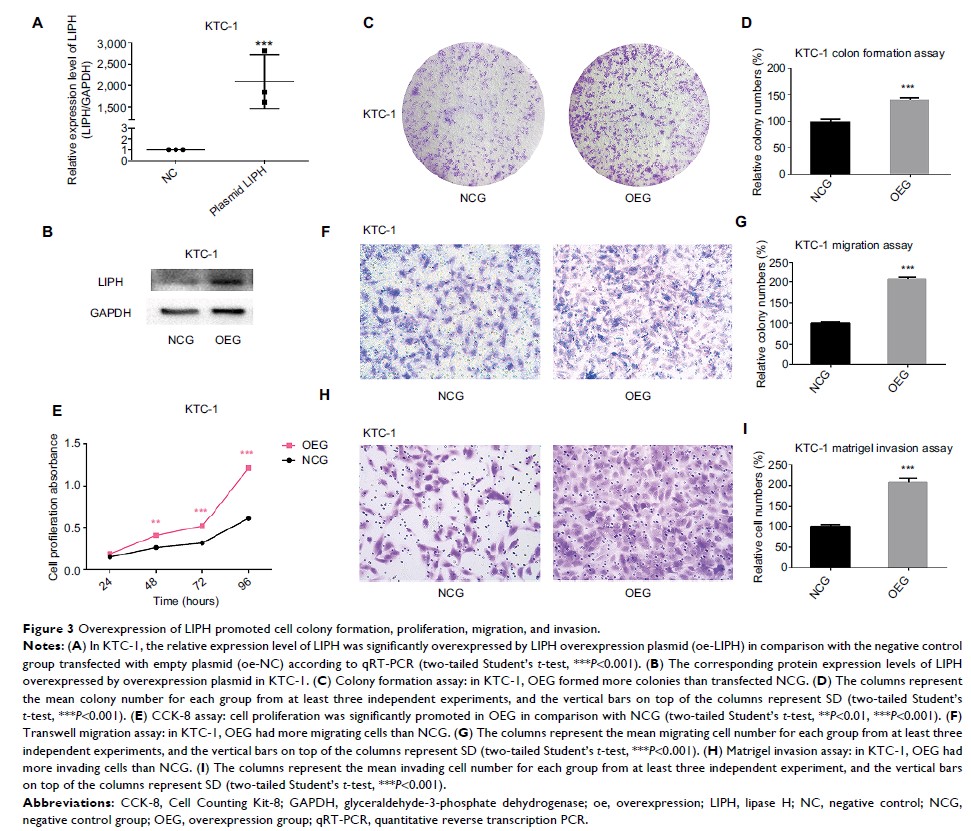
lymph-node metastasis. Our cellular function experiments indicated that LIPH positively
correlated with the malignant behavior of PTC cell lines. We further confirmed
the role of LIPH in hypoxia and its relationship with the
epithelial–mesenchymal transition pathway in PTC.
Conclusion: LIPH plays an
important role in PTC oncogenesis and development, especially in lymph-node
metastasis. It can be regarded as a biomarker for the diagnosis and treatment
of PTC in the near future.
Keywords: papillary
thyroid carcinoma, hypoxia, metastasis, epithelial–mesenchymal transition