115195
论文已发表
注册即可获取德孚的最新动态
IF 收录期刊
- 3.6 Breast Cancer (Dove Med Press)
- 4.3 Clin Epidemiol
- 2.6 Cancer Manag Res
- 3.2 Infect Drug Resist
- 4.1 Clin Interv Aging
- 6.1 Drug Des Dev Ther
- 4.1 Int J Chronic Obstr
- 8.7 Int J Nanomed
- 2.5 Int J Women's Health
- 3.2 Neuropsych Dis Treat
- 2.4 OncoTargets Ther
- 2.6 Patient Prefer Adher
- 2.6 Ther Clin Risk Manag
- 3.1 J Pain Res
- 3.5 Diabet Metab Synd Ob
- 4.5 Psychol Res Behav Ma
- 3.4 Nat Sci Sleep
- 2.4 Pharmgenomics Pers Med
- 2.6 Risk Manag Healthc Policy
- 4.6 J Inflamm Res
- 2.3 Int J Gen Med
- 3.9 J Hepatocell Carcinoma
- 3.3 J Asthma Allergy
- 2.5 Clin Cosmet Investig Dermatol
- 3.0 J Multidiscip Healthc

基于 SEER 数据库的原发性气管癌的竞争风险分析
Authors Gao HX, He X, Du JF, Yang SH, Wang Y, Zhang JW, Zhao CN
Received 8 October 2018
Accepted for publication 17 December 2018
Published 24 January 2019 Volume 2019:11 Pages 1059—1065
DOI https://doi.org/10.2147/CMAR.S190124
Checked for plagiarism Yes
Review by Single-blind
Peer reviewers approved by Dr Cristina Weinberg
Peer reviewer comments 3
Editor who approved publication: Dr Beicheng Sun
Purpose: To
analyze the prognostic factors of primary tracheal carcinoma.
Patients and methods: All
patients of primary tracheal carcinoma were extracted from the Surveillance,
Epidemiology, and End Results database during 1973–2015. The potential
prognostic factors were analyzed by using the competing risk analysis of R
statistical software.
Results: A total
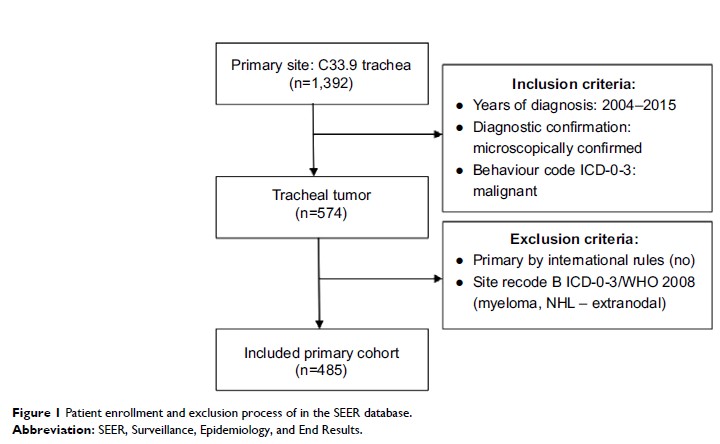
of 485 eligible patients were enrolled. The univariate analysis indicated that
age, sex, diagnostic confirmation, extension, lymph node, metastasis, multiple primary
tumors, primary site surgery, and lymph node dissection were statistically
significant for the patients’ death due to tracheal tumor. The multivariate
analysis indicated that age (P =0.0000, CI: 1.0255–1.0630), lymph node (P =0.0000, CI:
1.6031–3.4890), metastasis (P =0.0100, CI: 1.1342–2.5790), multiple primary tumors
(P =0.0000, CI:
0.0276–0.1090), and primary site surgery (P =0.0001, CI: 0.3565–0.7110) were independent
prognostic factors affecting survival, and there were significant differences
in the stratification of each prognostic factors.
Conclusion: Age,
lymph node, metastasis, multiple primary tumors, and primary site surgery were
independent prognostic factors of primary tracheal carcinoma.
Keywords: primary
tracheal carcinoma, SEER, prognostic factor, competing risk analysis