115195
论文已发表
注册即可获取德孚的最新动态
IF 收录期刊
- 3.6 Breast Cancer (Dove Med Press)
- 4.3 Clin Epidemiol
- 2.6 Cancer Manag Res
- 3.2 Infect Drug Resist
- 4.1 Clin Interv Aging
- 6.1 Drug Des Dev Ther
- 4.1 Int J Chronic Obstr
- 8.7 Int J Nanomed
- 2.5 Int J Women's Health
- 3.2 Neuropsych Dis Treat
- 2.4 OncoTargets Ther
- 2.6 Patient Prefer Adher
- 2.6 Ther Clin Risk Manag
- 3.1 J Pain Res
- 3.5 Diabet Metab Synd Ob
- 4.5 Psychol Res Behav Ma
- 3.4 Nat Sci Sleep
- 2.4 Pharmgenomics Pers Med
- 2.6 Risk Manag Healthc Policy
- 4.6 J Inflamm Res
- 2.3 Int J Gen Med
- 3.9 J Hepatocell Carcinoma
- 3.3 J Asthma Allergy
- 2.5 Clin Cosmet Investig Dermatol
- 3.0 J Multidiscip Healthc

由人疱疹病毒 6 型编码的 DR7 促进神经胶质瘤的发展和进展
Authors Gu B, Li M, Zhang Y, Li L, Yao K, Wang S
Received 10 July 2018
Accepted for publication 10 January 2019
Published 12 March 2019 Volume 2019:11 Pages 2109—2118
DOI https://doi.org/10.2147/CMAR.S179762
Checked for plagiarism Yes
Review by Single-blind
Peer reviewers approved by Dr Amy Norman
Peer reviewer comments 3
Editor who approved publication: Dr Beicheng Sun
Purpose: We
previously identified human herpesvirus 6 (HHV-6) infection in the pathogenesis
of glioma. Direct repeat (DR)7, encoded by HHV-6, has been reported to possess
malignant transforming activity and involved in Hodgkin’s lymphoma
carcinogenesis. Here, we aimed to determine the role of DR7 in the development
and progression of glioma.
Patients and methods: A total
of 27 glioma and 30 normal brain tissues were collected for detection of DR7.
Glioma cell proliferation, colony formation, cell cycle, migration, invasion
and angiogenesis were evaluated by Cell Counting Kit-8 (CCK-8), soft agar,
propidium iodide staining, wound healing, Transwell and chick embryo
chorioallantoic membrane assays, respectively. The potential mRNA targets of
DR7 were determined using mRNA microarray and validated via Western blot and
ELISA.
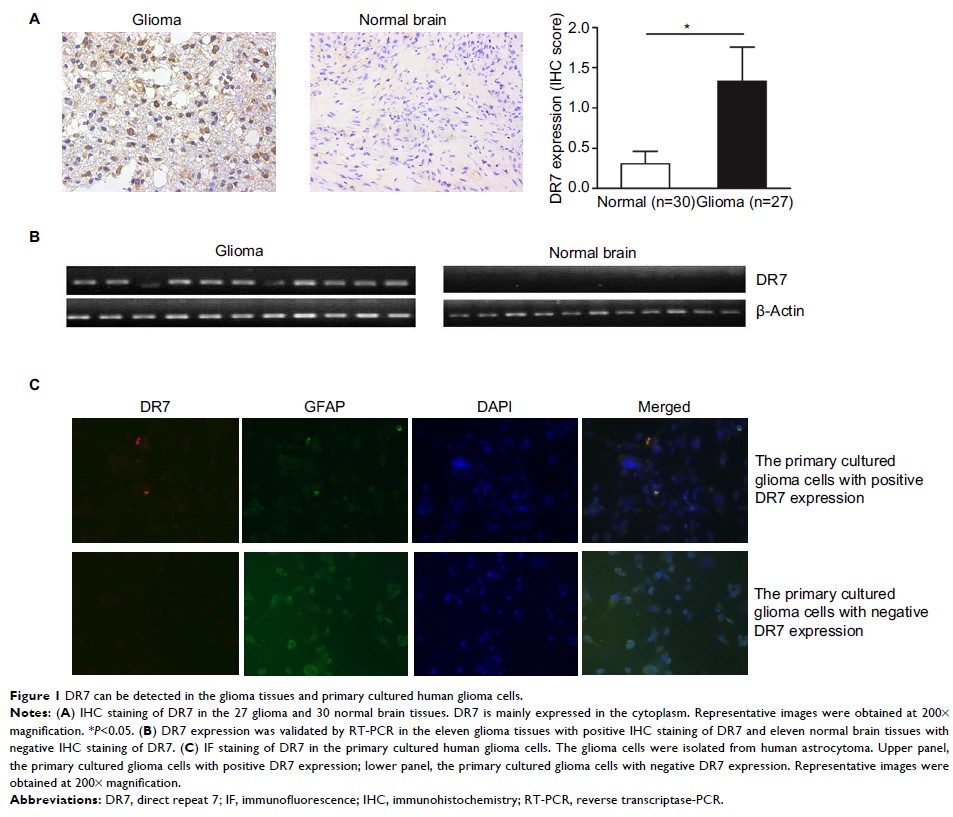
Results: DR7 could
be detected in the 13 glioma tissues with a positive rate of 48.15%, but only
the 5 normal brain tissues with a lower positive rate of 16.7%. The two strains
of cells isolated from glioma tissues were also found to express DR7. CCK-8 and
soft agar assays showed enhanced proliferation and colony formation in the
cells expressing DR7 which might be in relation to acceleration of the G1/S
phase transition by DR7. Further analyses showed that DR7 could promote glioma
cell migration, invasion and angiogenesis. Expression profiles identified
hundreds of differentially expressed mRNAs, among which P53, extracellular
matrix (ECM) fibronectin, integrin receptor ITGβ5 and specific inhibitors of
MMPs, tissue inhibitor of MMPs (TIMP)-2 and TIMP-4, were downregulated, whereas
ECM-degrading proteinase MMP-3, proinflammatory cytokines IL-1β, IL-6 and IL-8,
were upregulated by DR7, respectively.
Conclusion: We
observed existence of DR7 in the glioma tissues, and overexpression of DR7
could promote glioma cell development and progression, which might be through
creating an inflammatory microenvironment and enhancing degradation of ECM.
Keywords: HHV-6,
DR7, development, progression, glioma