115195
论文已发表
注册即可获取德孚的最新动态
IF 收录期刊
- 3.6 Breast Cancer (Dove Med Press)
- 4.3 Clin Epidemiol
- 2.6 Cancer Manag Res
- 3.2 Infect Drug Resist
- 4.1 Clin Interv Aging
- 6.1 Drug Des Dev Ther
- 4.1 Int J Chronic Obstr
- 8.7 Int J Nanomed
- 2.5 Int J Women's Health
- 3.2 Neuropsych Dis Treat
- 2.4 OncoTargets Ther
- 2.6 Patient Prefer Adher
- 2.6 Ther Clin Risk Manag
- 3.1 J Pain Res
- 3.5 Diabet Metab Synd Ob
- 4.5 Psychol Res Behav Ma
- 3.4 Nat Sci Sleep
- 2.4 Pharmgenomics Pers Med
- 2.6 Risk Manag Healthc Policy
- 4.6 J Inflamm Res
- 2.3 Int J Gen Med
- 3.9 J Hepatocell Carcinoma
- 3.3 J Asthma Allergy
- 2.5 Clin Cosmet Investig Dermatol
- 3.0 J Multidiscip Healthc

非同源末端连接的关键因子 XLF 可增强结肠直肠癌中 5-氟尿嘧啶和奥沙利铂的耐药性
Authors Liu Z, Yu M, Fei B, Sun J, Wang D
Received 31 October 2018
Accepted for publication 16 January 2019
Published 20 March 2019 Volume 2019:12 Pages 2095—2104
DOI https://doi.org/10.2147/OTT.S192923
Checked for plagiarism Yes
Review by Single-blind
Peer reviewers approved by Dr Cristina Weinberg
Peer reviewer comments 2
Editor who approved publication: Dr William Cho
Background: Colorectal
cancer (CRC) is the third commonly diagnosed cancer with a high risk of death.
After curative surgery, 40% of patients will have metastases or develop
recurrence. Therefore, chemotherapy is significantly responsible as the major
therapy method. However, chemoresistance is found in almost all metastatic
patients and remains a critical obstacle to curing CRC.
Materials and methods: Cell
viability is analyzed by sulforhodamine B staining assay. The nonhomologous end
joining (NHEJ) repair ability of each cell line was determined by NHEJ reporter
assay. mRNA expression levels of NHEJ factors are detected by real-time
quantitative polymerase chain reaction. The protein expression levels were
observed by western blot assay.
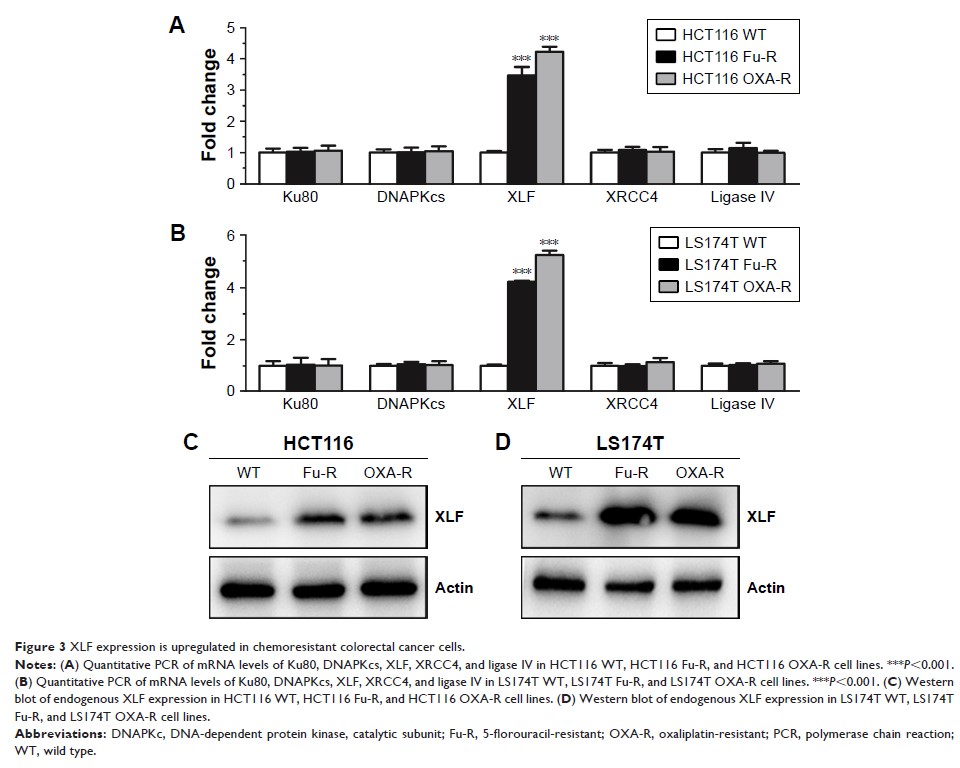
Results: Our study
found that 5-florouracil (5-Fu) and oxaliplatin (OXA)-resistant HCT116 and
LS174T cells showed upregulated efficiency of DNA double-strand repair pathway
NHEJ. We then identified that the NHEJ key factor XLF is responsible for the
chemoresistance and XLF deficiency sensitizes CRC cells to 5-Fu and OXA
significantly.
Conclusion: Our
research first demonstrates that the NHEJ pathway, especially its key factor
XLF, significantly contributes to chemoresistance in CRC.
Keywords: XLF,
nonhomologous end joining, 5-florouracil, oxaliplatin, chemoresistance,
colorectal cancer