117333
论文已发表
注册即可获取德孚的最新动态
IF 收录期刊
- 3.6 Breast Cancer (Dove Med Press)
- 4.3 Clin Epidemiol
- 2.6 Cancer Manag Res
- 3.2 Infect Drug Resist
- 4.1 Clin Interv Aging
- 6.1 Drug Des Dev Ther
- 4.1 Int J Chronic Obstr
- 8.7 Int J Nanomed
- 2.5 Int J Women's Health
- 3.2 Neuropsych Dis Treat
- 2.4 OncoTargets Ther
- 2.6 Patient Prefer Adher
- 2.6 Ther Clin Risk Manag
- 3.1 J Pain Res
- 3.5 Diabet Metab Synd Ob
- 4.5 Psychol Res Behav Ma
- 3.4 Nat Sci Sleep
- 2.4 Pharmgenomics Pers Med
- 2.6 Risk Manag Healthc Policy
- 4.6 J Inflamm Res
- 2.3 Int J Gen Med
- 3.9 J Hepatocell Carcinoma
- 3.3 J Asthma Allergy
- 2.5 Clin Cosmet Investig Dermatol
- 3.0 J Multidiscip Healthc

基于 UICC/AJCC 第 8 版鼻咽癌分期系统的 T 分期简化
Authors Pan XX, Tong LH, Chen YF, Li FL, Tang WB, Liu YJ, Yang W
Received 2 September 2018
Accepted for publication 7 March 2019
Published 11 April 2019 Volume 2019:11 Pages 3163—3169
DOI https://doi.org/10.2147/CMAR.S185860
Checked for plagiarism Yes
Review by Single-blind
Peer reviewers approved by Dr Cristina Weinberg
Peer reviewer comments 5
Editor who approved publication: Dr Rituraj Purohit
Objective: This study
aimed to establish a simplified T classification based on the 8th edition of
the Union for International Cancer Control/American Joint Committee on Cancer
(UICC/AJCC) staging system for nasopharyngeal carcinoma (NPC).
Methods: In total, 325
patients with NPC were included in this study. All patients underwent magnetic
resonance imaging, and the staging criteria were recorded. These patients were
subjected to staging with the 8th edition of the UICC/AJCC staging system for
NPC.
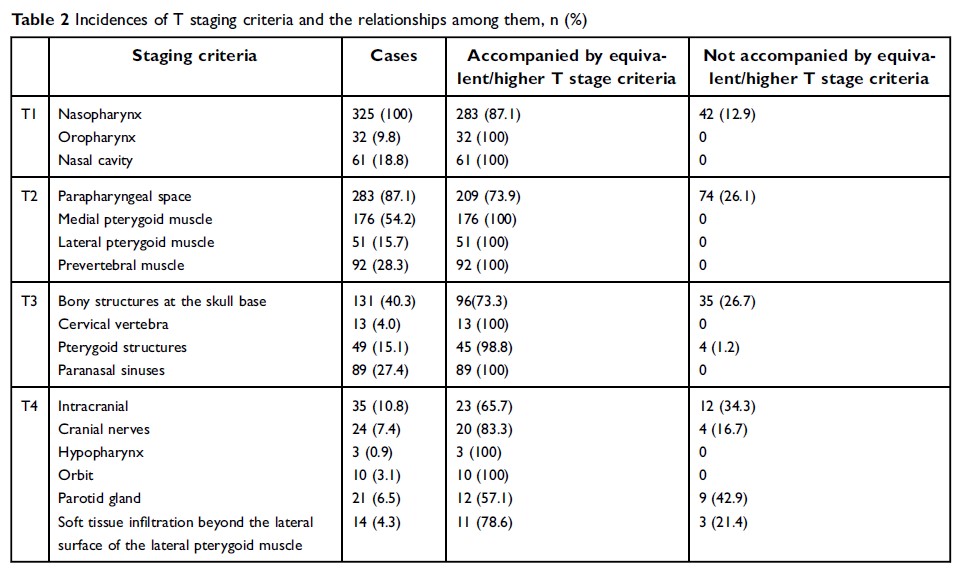
Results: Involvement
of the oropharynx, nasal cavity, adjacent soft tissue (medial pterygoid,
lateral pterygoid, and prevertebral muscles), cervical vertebra, orbit, and
hypopharynx were always accompanied by other equivalently or more advanced
T-stage classifications. All cases with involvement of the paranasal sinuses
showed skull base erosion. The majority of cases with involvement of the
pterygoid structure showed skull base erosion.
Conclusion: According
to the simplification principle, the following new T classification based on
the 8th edition of the UICC/AJCC staging system was established: T1, tumor
confined to nasopharynx, or beyond the nasopharynx without parapharyngeal
involvement; T2, tumor with extension to the parapharyngeal space; T3, tumor
with infiltration to bony structures at the skull base; T4, tumor with
intracranial extension, involvement of the cranial nerves or parotid gland,
and/or extensive soft tissue infiltration beyond the lateral surface of the
lateral pterygoid muscle. Validation with a large series of patients is needed.
Keywords: nasopharyngeal
cancer, TNM staging system, T classification