117333
论文已发表
注册即可获取德孚的最新动态
IF 收录期刊
- 3.6 Breast Cancer (Dove Med Press)
- 4.3 Clin Epidemiol
- 2.6 Cancer Manag Res
- 3.2 Infect Drug Resist
- 4.1 Clin Interv Aging
- 6.1 Drug Des Dev Ther
- 4.1 Int J Chronic Obstr
- 8.7 Int J Nanomed
- 2.5 Int J Women's Health
- 3.2 Neuropsych Dis Treat
- 2.4 OncoTargets Ther
- 2.6 Patient Prefer Adher
- 2.6 Ther Clin Risk Manag
- 3.1 J Pain Res
- 3.5 Diabet Metab Synd Ob
- 4.5 Psychol Res Behav Ma
- 3.4 Nat Sci Sleep
- 2.4 Pharmgenomics Pers Med
- 2.6 Risk Manag Healthc Policy
- 4.6 J Inflamm Res
- 2.3 Int J Gen Med
- 3.9 J Hepatocell Carcinoma
- 3.3 J Asthma Allergy
- 2.5 Clin Cosmet Investig Dermatol
- 3.0 J Multidiscip Healthc

血清 piRNA 特征作为结直肠癌的有前途的非侵入性诊断和预后生物标志物
Authors Qu A, Wang W, Yang Y, Zhang X, Dong Y, Zheng G, Wu Q, Zou M, Du L, Wang Y, Wang C
Received 4 November 2018
Accepted for publication 6 March 2019
Published 29 April 2019 Volume 2019:11 Pages 3703—3720
DOI https://doi.org/10.2147/CMAR.S193266
Checked for plagiarism Yes
Review by Single-blind
Peer reviewers approved by Dr Amy Norman
Peer reviewer comments 3
Editor who approved publication: Dr Chien-Feng Li
Purpose: Piwi-interacting
RNAs (piRNAs) are a novel class of small non-coding RNAs, which are not easily
degraded but detectable in human body fluids. Recent studies have shown that
aberrant piRNA expression is a signature feature across multiple tumor types.
However, the expressions of piRNAs in serum of tumor patients and their
potential clinical values remain largely unclear.
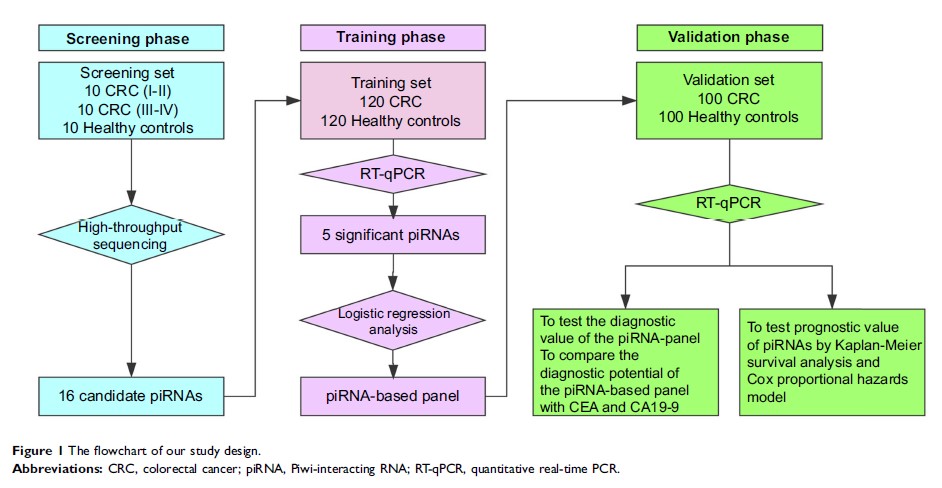
Patients and methods: High-throughput
sequencing was performed to investigate the serum piRNA profiles, followed by
evaluations in serum samples of 220 colorectal cancer (CRC) patients and 220
healthy controls using reverse transcription quantitative real-time PCR
(RT-qPCR). Biomarker panels including piRNA-based Panel I and carcinoembryonic
antigen (CEA)-based Panel II, were developed by logistic regression model, and
their diagnostic potentials were compared. Fagan’s nomogram was plotted to
promote clinical application.
Results: We identified
five differentially expressed serum piRNAs (piR-001311, piR-004153, piR-017723,
piR-017724 and piR-020365), which, when combined in the piRNA-based Panel I,
outperformed the CEA-based Panel II (P <0.001) and could detect CRC with an area under
the receiver operating characteristic curve of 0.867. In addition, Kaplan–Meier
analysis showed that patients with low serum piR-017724 level had worse overall
survival (OS) and progression-free survival (PFS). In multivariate Cox
regression analysis, serum piR-017724 was an independent prognostic factor for
OS and PFS (P <0.05).
Conclusion: Our
findings suggest serum piRNA expression signatures have potential for use as
biomarkers for CRC detection and to predict prognosis at the time of diagnosis.
Keywords: serum
piRNA, colorectal cancer, diagnosis, prognosis, nomogram