117333
论文已发表
注册即可获取德孚的最新动态
IF 收录期刊
- 3.6 Breast Cancer (Dove Med Press)
- 4.3 Clin Epidemiol
- 2.6 Cancer Manag Res
- 3.2 Infect Drug Resist
- 4.1 Clin Interv Aging
- 6.1 Drug Des Dev Ther
- 4.1 Int J Chronic Obstr
- 8.7 Int J Nanomed
- 2.5 Int J Women's Health
- 3.2 Neuropsych Dis Treat
- 2.4 OncoTargets Ther
- 2.6 Patient Prefer Adher
- 2.6 Ther Clin Risk Manag
- 3.1 J Pain Res
- 3.5 Diabet Metab Synd Ob
- 4.5 Psychol Res Behav Ma
- 3.4 Nat Sci Sleep
- 2.4 Pharmgenomics Pers Med
- 2.6 Risk Manag Healthc Policy
- 4.6 J Inflamm Res
- 2.3 Int J Gen Med
- 3.9 J Hepatocell Carcinoma
- 3.3 J Asthma Allergy
- 2.5 Clin Cosmet Investig Dermatol
- 3.0 J Multidiscip Healthc

药物输送技术中药物与载体的结合及其发展
Authors Du Y, Chen B
Received 13 December 2018
Accepted for publication 1 April 2019
Published 30 April 2019 Volume 2019:13 Pages 1401—1408
DOI https://doi.org/10.2147/DDDT.S198056
Checked for plagiarism Yes
Review by Single-blind
Peer reviewers approved by Dr Palas Chanda
Peer reviewer comments 3
Editor who approved publication: Dr Sukesh Voruganti
Abstract: The
development of drug-loading technology will bring new and rapid development to
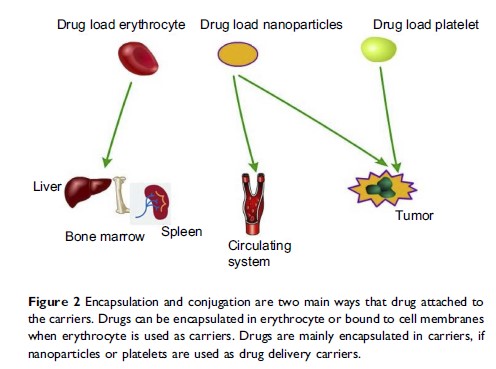
the treatment of diseases. At present, drug delivery by nanoparticles,
erythrocyte, and platelet have been studied extensively. Compared with
traditional anticancer drugs, nano-drugs have shown many obvious advantages,
disease treatment based on nanotechnology will bring a revolution in cancer
treatment. Due to its inherent biocompatibility, large drug load and long
half-life in the blood circulation, erythrocyte-inspired antibiotics, and some
anticancer drugs delivery systems have also entered the clinical trial stage.
At present, there are relatively few studies on drug delivery by platelets as
carriers. It is necessary to overcome the shortcomings of platelets, such as
easy activation, deformation, thrombosis, and difficult preservation. There are
many ways to combine drugs with these carriers, and each has its own advantages
and disadvantages. It is necessary to seek the best combination scheme to
increase drug loading and reduce the damage to therapeutic components to the
carriers, so as to bring more mature and reliable methods for the clinical
application of drug delivery technology. Several drug-loading technologies and
their development were described according to various categories. The
combination of drugs and carriers is summarized for better understanding of its
practical application.
Keywords: drug
delivery technology, carrier, combination, tumor