117333
论文已发表
注册即可获取德孚的最新动态
IF 收录期刊
- 3.6 Breast Cancer (Dove Med Press)
- 4.3 Clin Epidemiol
- 2.6 Cancer Manag Res
- 3.2 Infect Drug Resist
- 4.1 Clin Interv Aging
- 6.1 Drug Des Dev Ther
- 4.1 Int J Chronic Obstr
- 8.7 Int J Nanomed
- 2.5 Int J Women's Health
- 3.2 Neuropsych Dis Treat
- 2.4 OncoTargets Ther
- 2.6 Patient Prefer Adher
- 2.6 Ther Clin Risk Manag
- 3.1 J Pain Res
- 3.5 Diabet Metab Synd Ob
- 4.5 Psychol Res Behav Ma
- 3.4 Nat Sci Sleep
- 2.4 Pharmgenomics Pers Med
- 2.6 Risk Manag Healthc Policy
- 4.6 J Inflamm Res
- 2.3 Int J Gen Med
- 3.9 J Hepatocell Carcinoma
- 3.3 J Asthma Allergy
- 2.5 Clin Cosmet Investig Dermatol
- 3.0 J Multidiscip Healthc

体重控制对接受孕激素治疗以提高生育能力的早期子宫内膜癌或复杂非典型增生患者至关重要 系统评价和荟萃分析
Authors Li M, Guo T, Cui R, Feng Y, Bai H, Zhang Z
Received 14 November 2018
Accepted for publication 17 February 2019
Published 6 May 2019 Volume 2019:11 Pages 4005—4021
DOI https://doi.org/10.2147/CMAR.S194607
Checked for plagiarism Yes
Review by Single-blind
Peer reviewers approved by Ms Justinn Cochran
Peer reviewer comments 2
Editor who approved publication: Professor Nakshatri
Objectives: This
study aimed to identify potential prognostic factors for patients with complex
atypical hyperplasia (CAH) or early-stage endometrial cancer (EC) who received
progestin therapy to spare fertility and, thus, improve the management of this
patient group.
Materials and methods: The
PubMed, PMC, EMBASE, Web of Science, and Cochrane databases were searched for
correlational studies published in English. Studies that evaluated the
prognosis of patients with CAH or early-stage EC were pooled for a systematic
review and meta-analysis.
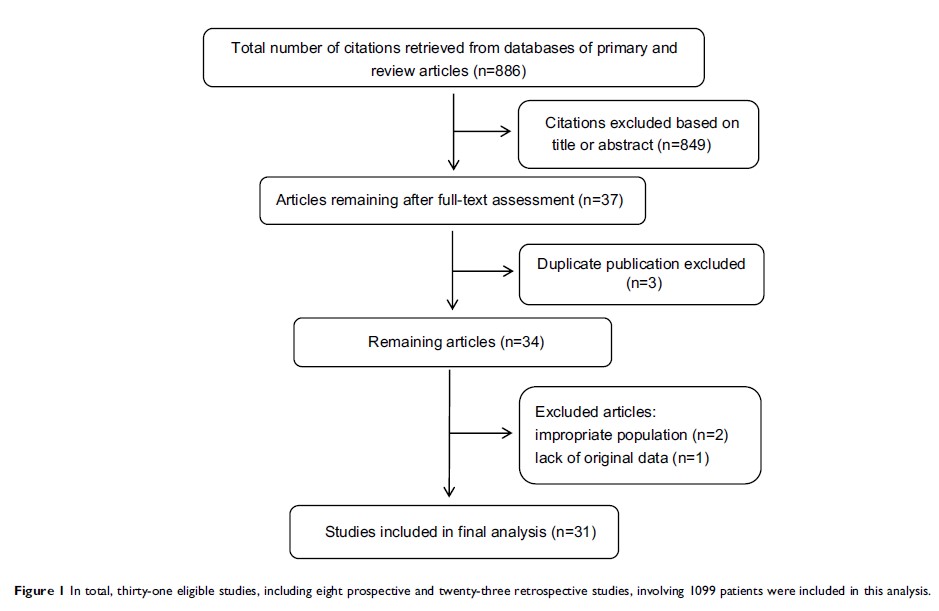
Results: In total,
31 eligible studies, including 8 prospective and 23 retrospective studies
involving 1099 patients, were included in this analysis. The most commonly used
progestin agents were medroxyprogesterone acetate (MPA, 47.0%) and megestrol
acetate (MA, 25.5%). The total complete response (CR) rate was 75.8%
(833/1099), and the median time to CR with first-line progestin therapy was 6
months. In total, 294 (26.8%) patients who achieved CR became pregnant
spontaneously (28 cases) or through assisted reproductive technology (127
cases). During the median follow-up of 39 months, 245 (22.3%) women developed
recurrence. Only one patient (0.09%) died of the disease. The meta-analysis
showed that compared to a BMI<25 kg/m2, and CAH, a
body mass index (BMI) ≥25 kg/m2 (P =0.0004, odds
ratios (OR), 0.4; 95% confidence interval, 0.3–0.6) and EC (P =0.0000, OR, 0.3;
95% confidence interval, 0.2–0.6) were significantly associated with a higher
likelihood of a CR. Patients with a BMI≥25 kg/m2 (P =0.0007, OR, 2.5;
95% confidence interval, 1.4–4.3), PCOS (P =0.0006, OR, 3.4; 95% confidence interval, 1.5–7.9),
and EC (P =0.0344,
OR, 2.8; 95% confidence interval, 1.4–5.3) had a significantly higher risk of
recurrence.
Conclusion: In
general, patients with CAH or early-stage EC who were treated with progesterone
therapy had a favorable prognosis. However, the recurrence risk was not
insignificant. Weight control is crucial for improving the clinical management
of this patient group.
Keywords: endometrial
cancer, complex atypical hyperplasia, fertility-sparing treatment,
progestogens, systematic review