117333
论文已发表
注册即可获取德孚的最新动态
IF 收录期刊
- 3.6 Breast Cancer (Dove Med Press)
- 4.3 Clin Epidemiol
- 2.6 Cancer Manag Res
- 3.2 Infect Drug Resist
- 4.1 Clin Interv Aging
- 6.1 Drug Des Dev Ther
- 4.1 Int J Chronic Obstr
- 8.7 Int J Nanomed
- 2.5 Int J Women's Health
- 3.2 Neuropsych Dis Treat
- 2.4 OncoTargets Ther
- 2.6 Patient Prefer Adher
- 2.6 Ther Clin Risk Manag
- 3.1 J Pain Res
- 3.5 Diabet Metab Synd Ob
- 4.5 Psychol Res Behav Ma
- 3.4 Nat Sci Sleep
- 2.4 Pharmgenomics Pers Med
- 2.6 Risk Manag Healthc Policy
- 4.6 J Inflamm Res
- 2.3 Int J Gen Med
- 3.9 J Hepatocell Carcinoma
- 3.3 J Asthma Allergy
- 2.5 Clin Cosmet Investig Dermatol
- 3.0 J Multidiscip Healthc

七针穴位针刺治疗颈椎病的疗效评价
Authors Gu CL, Yan Y, Zhang D, Li P
Received 28 December 2018
Accepted for publication 13 March 2019
Published 7 May 2019 Volume 2019:12 Pages 1441—1445
DOI https://doi.org/10.2147/JPR.S199798
Checked for plagiarism Yes
Review by Single-blind
Peer reviewers approved by Ms Justinn Cochran
Peer reviewer comments 2
Editor who approved publication: Dr Michael E Schatman
Objective: To
investigate the clinical efficacy of acupuncture with seven
acupoint-penetrating needles on patients with cervical spondylosis.
Patients and methods: Sixty
patients with cervical spondylosis were grouped using computer-generated random
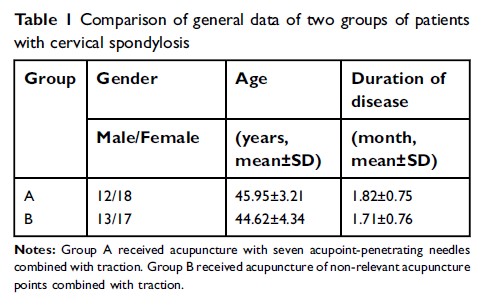
numbers. Group A (n=30) received acupuncture with seven acupoint-penetrating
needles combined with traction. Group B (n=30) received acupuncture of
non-relevant acupuncture points combined with traction. Clinical efficacy and
changes in the Visual Analogue Scale (VAS), Neck Disability Index (NDI), and
Pittsburgh Sleep Quality Index (PSQI) scores in the two groups were compared.
Results: The total
effective rate was significantly higher in group A (90.0%) than in group B
(76.6%) (P <0.05).
The VAS, NDI, and PSQI scores of the two groups after treatment were
significantly lower than scores before treatment (P <0.05). After
treatment, the NDI and PSQI scores of group A were significantly lower than
those in group B (P <0.05).
Conclusion: Acupuncture
using seven acupoint-penetrating needles combined with traction was more
effective, reduced neck pain, and improved sleep quality in patients with
cervical spondylosis compared to acupuncture of non-relevant acupuncture
points.
Keywords: cervical
spondylosis, acupuncture, seven acupoint-penetrating, traction