115195
论文已发表
注册即可获取德孚的最新动态
IF 收录期刊
- 3.6 Breast Cancer (Dove Med Press)
- 4.3 Clin Epidemiol
- 2.6 Cancer Manag Res
- 3.2 Infect Drug Resist
- 4.1 Clin Interv Aging
- 6.1 Drug Des Dev Ther
- 4.1 Int J Chronic Obstr
- 8.7 Int J Nanomed
- 2.5 Int J Women's Health
- 3.2 Neuropsych Dis Treat
- 2.4 OncoTargets Ther
- 2.6 Patient Prefer Adher
- 2.6 Ther Clin Risk Manag
- 3.1 J Pain Res
- 3.5 Diabet Metab Synd Ob
- 4.5 Psychol Res Behav Ma
- 3.4 Nat Sci Sleep
- 2.4 Pharmgenomics Pers Med
- 2.6 Risk Manag Healthc Policy
- 4.6 J Inflamm Res
- 2.3 Int J Gen Med
- 3.9 J Hepatocell Carcinoma
- 3.3 J Asthma Allergy
- 2.5 Clin Cosmet Investig Dermatol
- 3.0 J Multidiscip Healthc

胰岛素样生长因子 II mRNA 结合蛋白 3 促进人胶质母细胞瘤中的细胞增殖、迁移和侵袭
Authors Wu C, Ma H, Qi G, Chen F, Chu J
Received 9 January 2019
Accepted for publication 19 March 2019
Published 15 May 2019 Volume 2019:12 Pages 3661—3670
DOI https://doi.org/10.2147/OTT.S200901
Checked for plagiarism Yes
Review by Single-blind
Peer reviewers approved by Ms Aruna Narula
Peer reviewer comments 2
Editor who approved publication: Dr Gaetano Romano
Background/Aims: Recently,
the insulin-like growth factor mRNA-binding protein 3 (IMP3) has been reported
to be involved in tumorigenesis. We aimed to study the expression and role of
IMP3 in human glioblastoma.
Methods: We
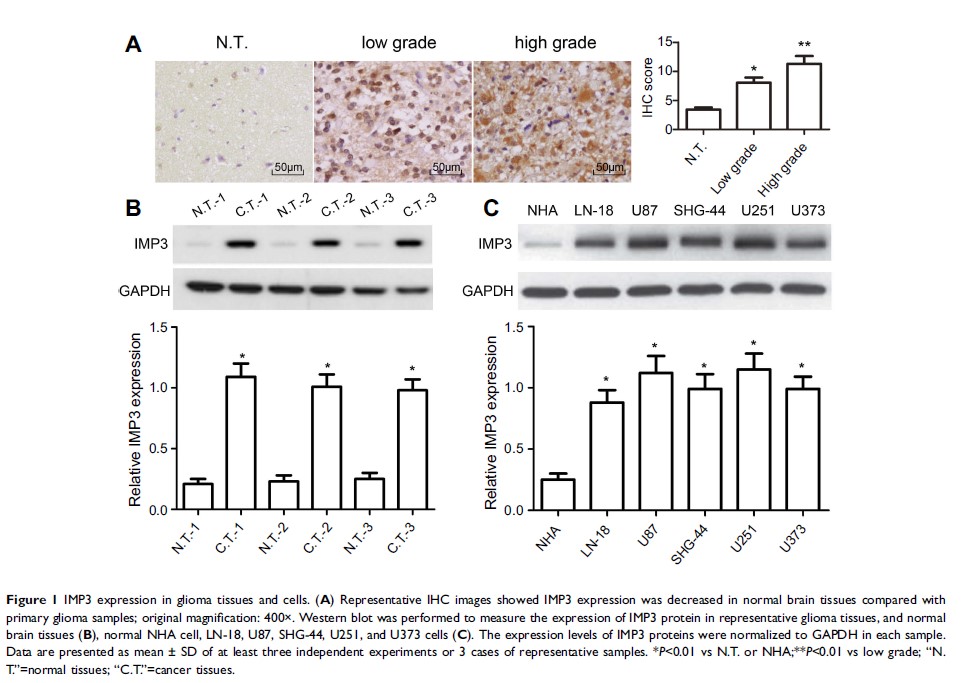
analyzed the expression of IMP3 in 70 cases of glioma tissues, normal brain
tissues and 5 kinds of cell lines using western blot. Immunohistochemistry
(IHC) was used to evaluate the expression and distribution of IMP3 in glioma
tissues. Colony formation, wound healing, migration and invasion assays and
tumorigenesis in nude mice were used to explore the function of IMP3 in vitro
and in vivo. The epithelial-mesenchymal transition (EMT)-related biomarkers
were detected by western blot.
Results: We found
that the expression level of IMP3 was obviously higher in glioma tissues than
that in normal brain tissues, and associated with glioma grade. In-vitro assays
revealed that IMP3 overexpression significantly induced cell proliferation,
migration, and invasion. Mechanically, IMP3 over-expression downregulated the
expression of E-cadherin, but upregulated the expressions of N-cadherin, vimentin,
snail, slug and MMP9. However, the inhibition of IMP3 impaired these oncogenic
effects. In vivo assay also demonstrated that silencing of IMP3 inhibited tumor
growth and improved survival of tumor-bearing xenograft nude mice.
Conclusion: IMP3 can
promote cell proliferation, migration and invasion by inducing EMT in
glioblastoma. Thus, targeting IMP3 pathway may be a novel way to treat patients
with glioblastoma.
Keywords: IMP3,
proliferation, migration, invasion, glioblastoma