115195
论文已发表
注册即可获取德孚的最新动态
IF 收录期刊
- 3.6 Breast Cancer (Dove Med Press)
- 4.3 Clin Epidemiol
- 2.6 Cancer Manag Res
- 3.2 Infect Drug Resist
- 4.1 Clin Interv Aging
- 6.1 Drug Des Dev Ther
- 4.1 Int J Chronic Obstr
- 8.7 Int J Nanomed
- 2.5 Int J Women's Health
- 3.2 Neuropsych Dis Treat
- 2.4 OncoTargets Ther
- 2.6 Patient Prefer Adher
- 2.6 Ther Clin Risk Manag
- 3.1 J Pain Res
- 3.5 Diabet Metab Synd Ob
- 4.5 Psychol Res Behav Ma
- 3.4 Nat Sci Sleep
- 2.4 Pharmgenomics Pers Med
- 2.6 Risk Manag Healthc Policy
- 4.6 J Inflamm Res
- 2.3 Int J Gen Med
- 3.9 J Hepatocell Carcinoma
- 3.3 J Asthma Allergy
- 2.5 Clin Cosmet Investig Dermatol
- 3.0 J Multidiscip Healthc

一种新的术前血浆指标,用于预测食管癌根治术后食管鳞状细胞癌的预后:纤维蛋白原与淋巴细胞的比率
Authors Fan N, Chen D, Zheng J, Wen Z, Lin P
Received 12 February 2019
Accepted for publication 23 April 2019
Published 23 May 2019 Volume 2019:11 Pages 4719—4728
DOI https://doi.org/10.2147/CMAR.S204938
Checked for plagiarism Yes
Review by Single-blind
Peer reviewers approved by Dr Colin Mak
Peer reviewer comments 2
Editor who approved publication: Dr Beicheng Sun
Purpose: The
inflammatory microenvironment and hemostatic system are involved in several
stages of tumor progression. The aim of this study was to assess the prognostic
effect of fibrinogen-to-lymphocyte ratio (FLR) in esophageal squamous cell
carcinoma (ESCC) patients who underwent radical esophagectomy.
Patients and methods: We retrospectively
reviewed 673 consecutive patients with ESCC who underwent radical esophagectomy
from January 2009 to December 2012 at a major cancer hospital in Guangzhou,
southern China. The cutoff points were defined by the X-tile software. The
prognostic value of FLR for overall survival (OS), disease-free survival (DFS),
and first-year mortality after surgery were analyzed using Cox proportional
hazard regression model and logistic regression model. Survival was estimated
by the Kaplan–Meier estimator and compared using the log-rank test.
Results: The
optimal cutoff point of FLR was 3.03. Compared with the FLR-low (≤3.03) group,
the FLR-high (>3.03) group included older patients (χ 2=7.267, P =0.007), showed
higher postoperative overall morbidity (24.7% vs 14.8%, χ 2=5.414, P =0.020) and tended
to die within one year (23.5% vs 10.9%, χ 2=10.871, P =0.001). The
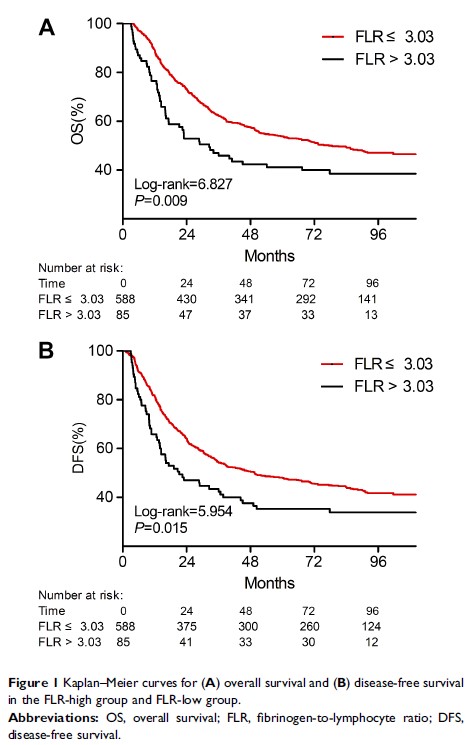
FLR-high group showed significant lower 5-year OS rates (41.2% vs 53.7%,
log-rank=6.827, P =0.009) and 5-year DFS rates (35.3% vs 48.0%,
log-rank=5.954, P =0.015) than the FLR-low group. Multivariate analyses
suggested that high FLR was an independent negative predictor of OS (HR: 1.448,
95%CI: 1.073–1.952, P =0.015), DFS (HR: 1.445, 95%CI: 1.084–1.925, P =0.012) and
first-year mortality (HR: 2.123, 95%CI: 1.157–3.898, P =0.015).
Conclusion: The
preoperative FLR level could be used as a simple, noninvasive, inexpensive, and
potentially effective indicator to evaluate the prognosis of ESCC patients
following radical esophagectomy.
Keywords: esophageal
squamous cell carcinoma, prognostic indicator, fibrinogen, lymphocyte