115195
论文已发表
注册即可获取德孚的最新动态
IF 收录期刊
- 3.6 Breast Cancer (Dove Med Press)
- 4.3 Clin Epidemiol
- 2.6 Cancer Manag Res
- 3.2 Infect Drug Resist
- 4.1 Clin Interv Aging
- 6.1 Drug Des Dev Ther
- 4.1 Int J Chronic Obstr
- 8.7 Int J Nanomed
- 2.5 Int J Women's Health
- 3.2 Neuropsych Dis Treat
- 2.4 OncoTargets Ther
- 2.6 Patient Prefer Adher
- 2.6 Ther Clin Risk Manag
- 3.1 J Pain Res
- 3.5 Diabet Metab Synd Ob
- 4.5 Psychol Res Behav Ma
- 3.4 Nat Sci Sleep
- 2.4 Pharmgenomics Pers Med
- 2.6 Risk Manag Healthc Policy
- 4.6 J Inflamm Res
- 2.3 Int J Gen Med
- 3.9 J Hepatocell Carcinoma
- 3.3 J Asthma Allergy
- 2.5 Clin Cosmet Investig Dermatol
- 3.0 J Multidiscip Healthc

miRNA 的多态性和食管癌风险:一个更新的系统回顾和综合分析
Authors Guo X, Zhao L, Shen Y, Shao Y, Wei W, Liu F
Received 8 November 2018
Accepted for publication 3 April 2019
Published 23 May 2019 Volume 2019:12 Pages 3565—3580
DOI https://doi.org/10.2147/OTT.S193958
Checked for plagiarism Yes
Review by Single-blind
Peer reviewers approved by Dr Colin Mak
Peer reviewer comments 2
Editor who approved publication: Dr XuYu Yang
Background: Accumulating evidence has demonstrated that single nucleotide polymorphisms
(SNPs) in microRNAs (miRNAs) (referred to as miR-SNPs) participate in the
process of carcinogenesis by altering the expression and structure of mature
miRNAs. However, the associations between several previously reported miR-SNPs,
including miR-196a2 rs11614913, miR-146a rs2910164, miR-34b/c rs4938723, and
miR-423 rs6505162 and the susceptibility of esophageal squamous cell carcinoma
(ESCC) remain controversial. We, therefore, performed a comprehensive
meta-analysis to systemically evaluate the correlation of genetic polymorphisms
in these four miRNAs with the risk of ESCC.
Methods: Relevant studies were searched in PubMed and other electronic
databases up to August 2018, supplemented by a manual search of references from
retrieved articles. The pooled ORs with 95% CIs were calculated using a
random-effects model.
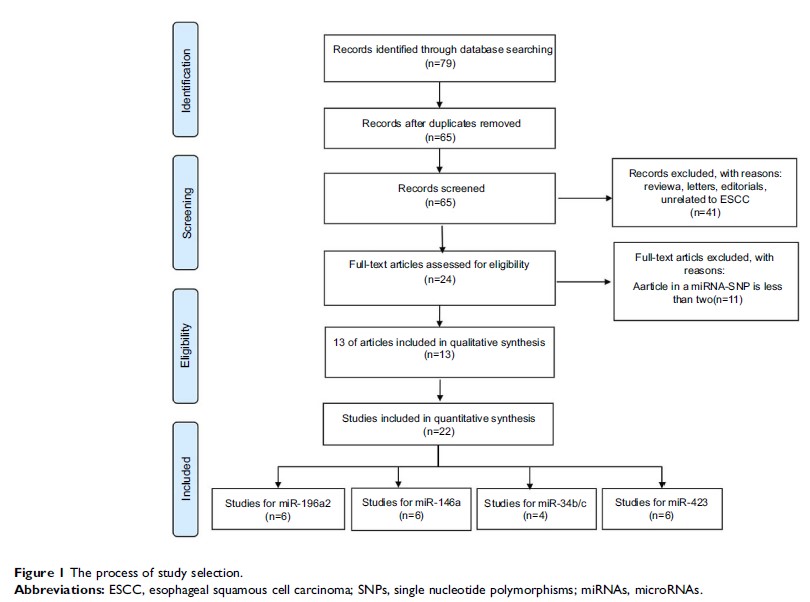
Results: A total of 22 studies from 13 published articles were included in
the meta-analysis. All studies have a relatively high score of quality
assessment. The pooled analysis indicated that individuals with the variant TT
genotype of rs11614913 in miR-196a2 gene have a significantly decreased risk of
ESCC compared with CC genotype (OR =0.83, 95% CI: 0.73–0.95). The decreased
risk of ESCC was also shown in the recessive model (TT vs CT/CC: OR=0.86,
95%CI: 0.77–0.96) and allele model (T vs C: OR=0.93, 95%CI: 0.87–0.99). The
significantly reduced risk of ESCC was also observed in the polymorphisms of
the miR-34b/c rs4938723 locus. The similar tendency was presented in the
subgroup of Chinese Han population when stratified by ethnicity. However, no
significant associations were observed in the miR-146a rs2910164 and miR-423
rs6505162 with the susceptibility of ESCC in any genetic model.
Conclusion: Our results suggested that the polymorphisms of miR-196a and
miR-34b/c genes were related to the risk of ESCC, especially among Chinese. The
findings of this study, however, need to be confirmed in further researches.
Keywords: microRNA, single nucleotide polymorphism, ESCC, meta-analysis