117923
论文已发表
注册即可获取德孚的最新动态
IF 收录期刊
- 3.6 Breast Cancer (Dove Med Press)
- 4.3 Clin Epidemiol
- 2.6 Cancer Manag Res
- 3.2 Infect Drug Resist
- 4.1 Clin Interv Aging
- 6.1 Drug Des Dev Ther
- 4.1 Int J Chronic Obstr
- 8.7 Int J Nanomed
- 2.5 Int J Women's Health
- 3.2 Neuropsych Dis Treat
- 2.4 OncoTargets Ther
- 2.6 Patient Prefer Adher
- 2.6 Ther Clin Risk Manag
- 3.1 J Pain Res
- 3.5 Diabet Metab Synd Ob
- 4.5 Psychol Res Behav Ma
- 3.4 Nat Sci Sleep
- 2.4 Pharmgenomics Pers Med
- 2.6 Risk Manag Healthc Policy
- 4.6 J Inflamm Res
- 2.3 Int J Gen Med
- 3.9 J Hepatocell Carcinoma
- 3.3 J Asthma Allergy
- 2.5 Clin Cosmet Investig Dermatol
- 3.0 J Multidiscip Healthc

ITGA3 作为胰腺癌的诊断和预后生物标志物
Authors Jiao Y, Li Y, Liu S, Chen Q, Liu Y
Received 15 January 2019
Accepted for publication 22 March 2019
Published 27 May 2019 Volume 2019:12 Pages 4141—4152
DOI https://doi.org/10.2147/OTT.S201675
Checked for plagiarism Yes
Review by Single-blind
Peer reviewers approved by Dr Jyoti Bajaj
Peer reviewer comments 2
Editor who approved publication: Dr Jianmin Xu
Background and objective: ITGA3 is
a cell surface adhesion protein that interacts with extracellular matrix
proteins which function in cancer metastasis. We examined the relationship of
pancreatic ITGA3 expression
with the clinical and pathological characteristics of patients with pancreatic
cancer.
Methods: Data
mining was used to analyze pancreatic cancer data from The Cancer Genome Atlas
database. A Chi squared test was used to evaluate correlations of ITGA3 expression
with clinical and pathological parameters. Receiver operating characteristic
(ROC) analysis was used to evaluate the diagnostic performance of ITGA3 expression.
Survival analysis and Cox regression analysis were used to examine the
prognostic value of ITGA3 expression. Gene Set Enrichment Analysis
(GSEA) was used to identify signaling pathways related to ITGA3 expression.
Results: Pancreatic
expression of ITGA3 was greater in patients with pancreatic
cancer than those without cancer, and was also associated with histological
type, histological grade, stage, T classification, vital status, and relapse.
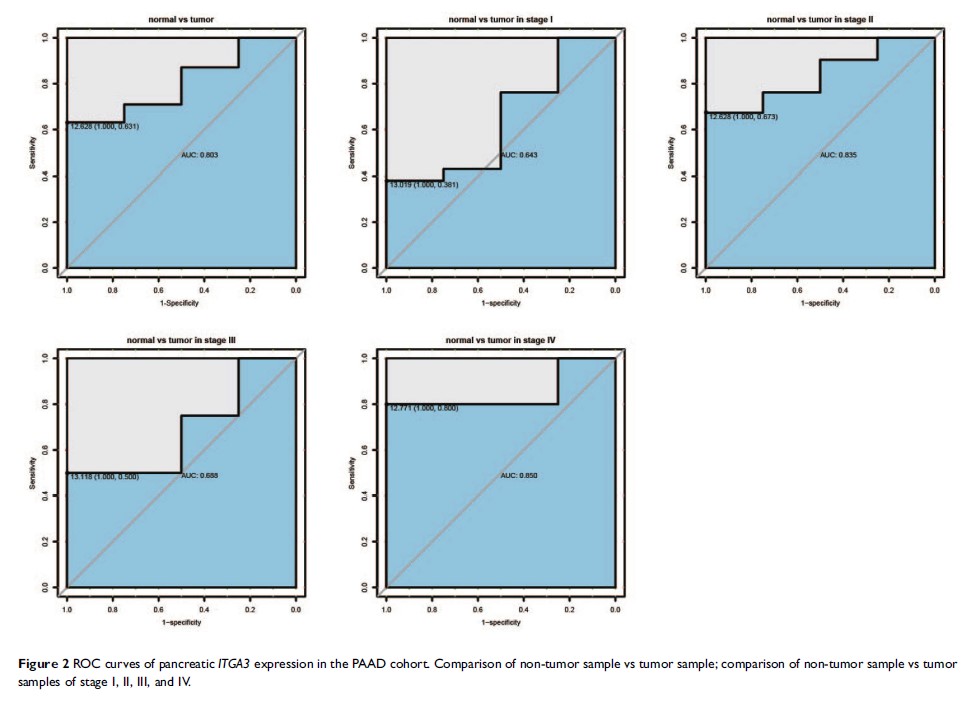
ROC analysis indicated that ITGA3 had significant diagnostic value, in that
high expression correlated with poor overall survival and relapse-free
survival, especially in patients with early-stage cancer. Cox analysis indicated
that high ITGA3 expression
was an independent prognostic factor for pancreatic cancer. GSEA analysis
identified 9 signaling pathways that were enriched in the presence of
high ITGA3 expression.
Conclusion: Expression
of ITGA3 can
be used as a diagnostic and prognostic biomarker in pancreatic cancer.
Keywords: pancreatic
cancer, diagnosis, prognosis, ITGA3 , TCGA