117923
论文已发表
注册即可获取德孚的最新动态
IF 收录期刊
- 3.6 Breast Cancer (Dove Med Press)
- 4.3 Clin Epidemiol
- 2.6 Cancer Manag Res
- 3.2 Infect Drug Resist
- 4.1 Clin Interv Aging
- 6.1 Drug Des Dev Ther
- 4.1 Int J Chronic Obstr
- 8.7 Int J Nanomed
- 2.5 Int J Women's Health
- 3.2 Neuropsych Dis Treat
- 2.4 OncoTargets Ther
- 2.6 Patient Prefer Adher
- 2.6 Ther Clin Risk Manag
- 3.1 J Pain Res
- 3.5 Diabet Metab Synd Ob
- 4.5 Psychol Res Behav Ma
- 3.4 Nat Sci Sleep
- 2.4 Pharmgenomics Pers Med
- 2.6 Risk Manag Healthc Policy
- 4.6 J Inflamm Res
- 2.3 Int J Gen Med
- 3.9 J Hepatocell Carcinoma
- 3.3 J Asthma Allergy
- 2.5 Clin Cosmet Investig Dermatol
- 3.0 J Multidiscip Healthc

CD48 是影响胶质瘤预后的免疫调节的关键分子
Authors Zou C, Zhu C, Guan G, Guo Q, Liu T, Shen S, Yan Z, Xu X, Lin Z, Chen L, Wu A, Cheng W
Received 18 December 2018
Accepted for publication 3 April 2019
Published 28 May 2019 Volume 2019:12 Pages 4181—4193
DOI https://doi.org/10.2147/OTT.S198762
Checked for plagiarism Yes
Review by Single-blind
Peer reviewers approved by Ms Rachel Predeepa
Peer reviewer comments 2
Editor who approved publication: Dr XuYu Yang
Purpose: Glioma is
a refractory disease associated with immune cell infiltration, and the
effectiveness of checkpoint blockade remains suboptimal. As an adhesion and
costimulatory molecule, CD48 plays a significant role in immunomodulation. As
such, studying CD48 may provide additional understanding of the immune and
inflammation response of glioma.
Methods: Using R
language and GraphPad Prism 7, RNA sequencing data of 946 patients from Chinese
Glioma Genome Atlas and The Cancer Genome Atlas cohorts were analyzed.
Results: CD48 was
highly expressed in the malignant progression of glioma. As an independent risk
factor, high-CD48 patients were associated with poor prognosis. CD48 influenced
glioma purity and the local immune cell subpopulation. CD48 was closely related
to immune function in glioma. Patients with an enhanced immune phenotype, high
CD48, were associated with immune suppressive molecules and checkpoints. In
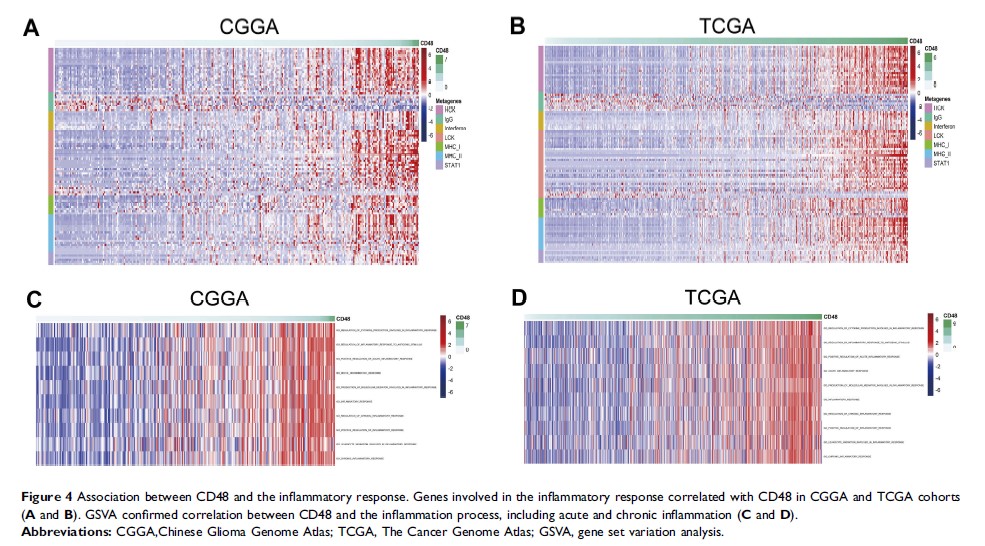
addition, CD48 correlated with the immune and inflammatory response. A
checkpoint risk score including CD48, SLAMF8 and PD-L1 was used to assess the
role of checkpoints. Risk score was particularly high in a malignant subtype of
glioma and was an independent predictive indicator of unfavorable outcome.
Additionally, age, IDH subtype and MGMT promoter status influenced the
predictive significance of checkpoint risk score.
Conclusion: CD48
exhibits a crucial role in reduced survival and immunomodulation in glioma. In
addition, we found that checkpoints play a greater role in patients older than
40 years old with IDH wild-type and MGMT methylated status. These findings
suggest that combining CD48 blockade with PD-L1 may be a promising approach to
glioma immunotherapy for specific subpopulations of patients.
Keywords: CD48,
glioma, prognosis, immunomodulation, immunotherapy