117923
论文已发表
注册即可获取德孚的最新动态
IF 收录期刊
- 3.6 Breast Cancer (Dove Med Press)
- 4.3 Clin Epidemiol
- 2.6 Cancer Manag Res
- 3.2 Infect Drug Resist
- 4.1 Clin Interv Aging
- 6.1 Drug Des Dev Ther
- 4.1 Int J Chronic Obstr
- 8.7 Int J Nanomed
- 2.5 Int J Women's Health
- 3.2 Neuropsych Dis Treat
- 2.4 OncoTargets Ther
- 2.6 Patient Prefer Adher
- 2.6 Ther Clin Risk Manag
- 3.1 J Pain Res
- 3.5 Diabet Metab Synd Ob
- 4.5 Psychol Res Behav Ma
- 3.4 Nat Sci Sleep
- 2.4 Pharmgenomics Pers Med
- 2.6 Risk Manag Healthc Policy
- 4.6 J Inflamm Res
- 2.3 Int J Gen Med
- 3.9 J Hepatocell Carcinoma
- 3.3 J Asthma Allergy
- 2.5 Clin Cosmet Investig Dermatol
- 3.0 J Multidiscip Healthc

肌少症中国老年社区居民的肌肉厚度与通过超声波所做的羽状角评估之间的关联
Authors Zhu S, Lin W, Chen S, Qi H, Wang S, Zhang A, Cai J, Lai B, Sheng Y, Ding G
Received 16 January 2019
Accepted for publication 9 April 2019
Published 28 May 2019 Volume 2019:14 Pages 987—996
DOI https://doi.org/10.2147/CIA.S201777
Checked for plagiarism Yes
Review by Single-blind
Peer reviewers approved by Ms Justinn Cochran
Peer reviewer comments 2
Editor who approved publication: Dr Zhi-Ying Wu
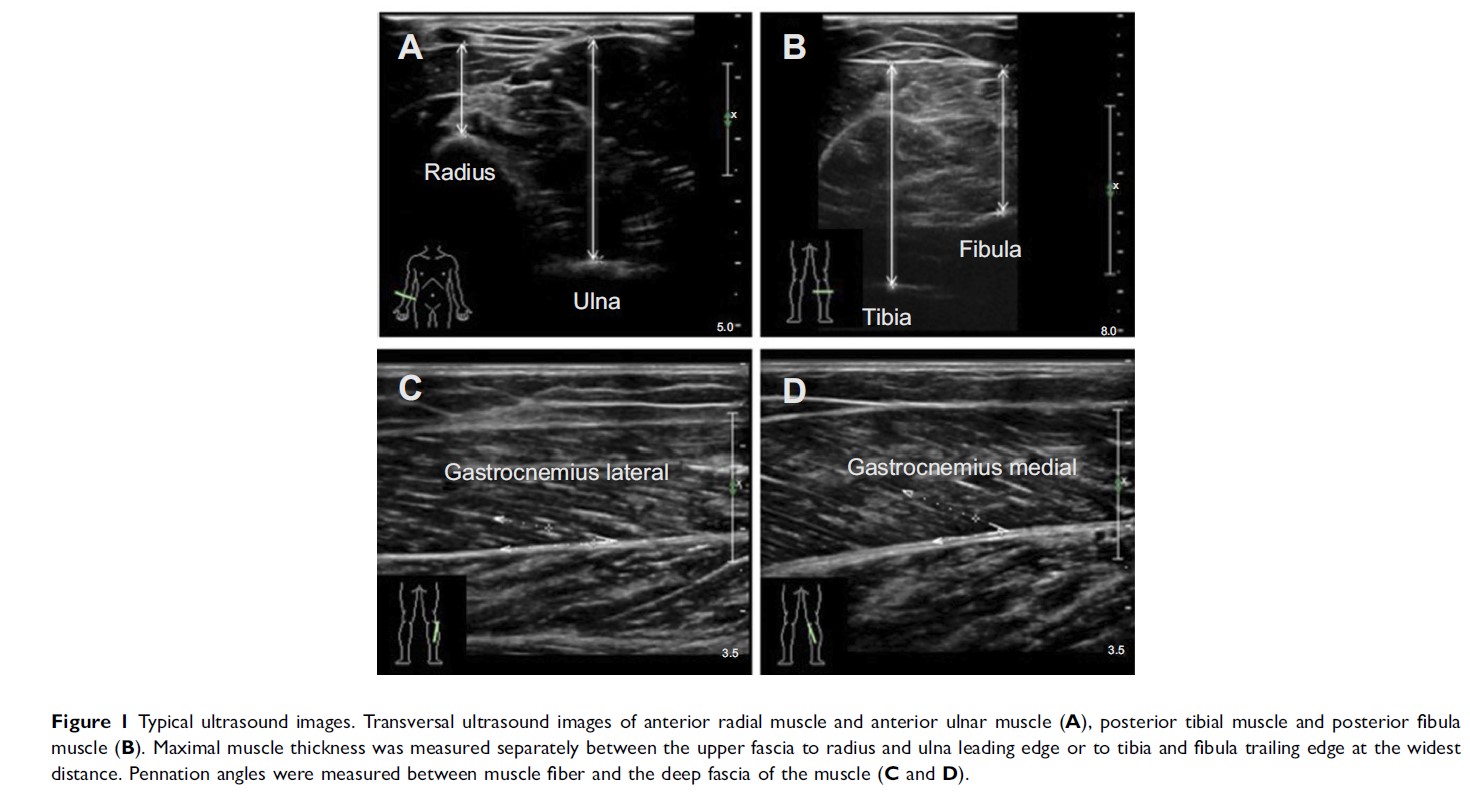
Background: Sarcopenia is typically defined as the loss of muscle mass, strength and low physical performance with aging. Ultrasound is a safe and easy method for evaluating muscle mass and quality by muscle thickness (MT) and pennation angle (PA), respectively. Although the positive correlations between MT and muscle mass and handgrip strength were observed, the relationship between MT, PA and physical performance remains unclear.
Purpose: This study aimed to investigate the correlation of aforementioned ultrasound parameters with muscle mass, muscle strength and physical performance and explore the utility of ultrasound in predicting sarcopenia.
Patients and methods: A total of 265 elderly Chinese community dwellers were included. MT of both forearm and lower leg as well as PA of gastrocnemius was assessed by ultrasound. Muscle mass was assessed by dual-energy X-ray absorptiometry. Muscle strength was measured by a Jamar hand dynamometer. Physical performance was assessed by the Short Physical Performance Battery (SPPB).
Results: Anterior radial MT in men and regional MTs except posterior fibula in women were negatively correlated with the age. No significant correlation was observed between PA and the age in both genders. Posterior tibial MT and posterior fibula MT were positively correlated with the relative appendicular skeletal muscle mass in men and women, respectively. Anterior ulnar MT was positively correlated with grip strength in both genders. Moreover, gastrocnemius medialis PA showed a positive association with gait speed and SPPB in women but not in men.
Conclusion: A combination of posterior fibula MT, anterior ulnar MT and gastrocnemius medialis PA measured by muscle ultrasound is helpful for the assessment of sarcopenia in Chinese elderly women. In addition, a combination of posterior tibial MT and anterior ulnar MT measured by muscle ultrasound is helpful for the assessment of sarcopenia in Chinese elderly men.
Keywords: B-mode ultrasound, muscle thickness, pennation angle, muscle mass, muscle strength, physical performance