117923
论文已发表
注册即可获取德孚的最新动态
IF 收录期刊
- 3.6 Breast Cancer (Dove Med Press)
- 4.3 Clin Epidemiol
- 2.6 Cancer Manag Res
- 3.2 Infect Drug Resist
- 4.1 Clin Interv Aging
- 6.1 Drug Des Dev Ther
- 4.1 Int J Chronic Obstr
- 8.7 Int J Nanomed
- 2.5 Int J Women's Health
- 3.2 Neuropsych Dis Treat
- 2.4 OncoTargets Ther
- 2.6 Patient Prefer Adher
- 2.6 Ther Clin Risk Manag
- 3.1 J Pain Res
- 3.5 Diabet Metab Synd Ob
- 4.5 Psychol Res Behav Ma
- 3.4 Nat Sci Sleep
- 2.4 Pharmgenomics Pers Med
- 2.6 Risk Manag Healthc Policy
- 4.6 J Inflamm Res
- 2.3 Int J Gen Med
- 3.9 J Hepatocell Carcinoma
- 3.3 J Asthma Allergy
- 2.5 Clin Cosmet Investig Dermatol
- 3.0 J Multidiscip Healthc

槲皮素通过 SCAP-SREBP2-LDLr 信号通路改善早期糖尿病肾病的脂质代谢
Authors Jiang X, Yu J, Wang X, Ge J, Li N
Received 28 November 2018
Accepted for publication 22 March 2019
Published 30 May 2019 Volume 2019:12 Pages 827—839
DOI https://doi.org/10.2147/DMSO.S195456
Checked for plagiarism Yes
Review by Single-blind
Peer reviewers approved by Dr Andrew Yee
Peer reviewer comments 2
Editor who approved publication: Dr Konstantinos Tziomalos
Purpose: Quercetin, the most widely distributed flavonoid, has been shown to have multiple properties and beneficial effects on various metabolic diseases. Thus, our aim was to investigate the underlying mechanism whereby quercetin regulates renal lipid accumulation and ameliorates early diabetic renal injuries in Leprdb/Leprdb (db/db) mice, a model of type 2 diabetes.
Methods: db/db mice were administered either 50 mg/kg or 100 mg/kg quercetin by oral gavage once a day to evaluate its effects on early stage diabetic nephropathy; mice were sacrificed at the end of the 10th week after intervention; a similar number of db/db and db/m mice were used as controls. During the experimental study, the general status of the animals was observed daily; body weight and blood glucose concentrations were measured at bi-weekly intervals. Biochemical parameters of lipid metabolism were measured by automatic biochemical analyzer. Renal function parameters were performed using commercial kits. Early renal histological changes and lipid accumulation were demonstrated by H&E staining and Oil-Red-O staining, respectively. Moreover, the expression of key proteins in the low-density lipoprotein receptors (LDLr)-SREBP-2-SREBP cSCAP signaling pathway in the kidneys of diabetic mice was detected by Western blot assay.
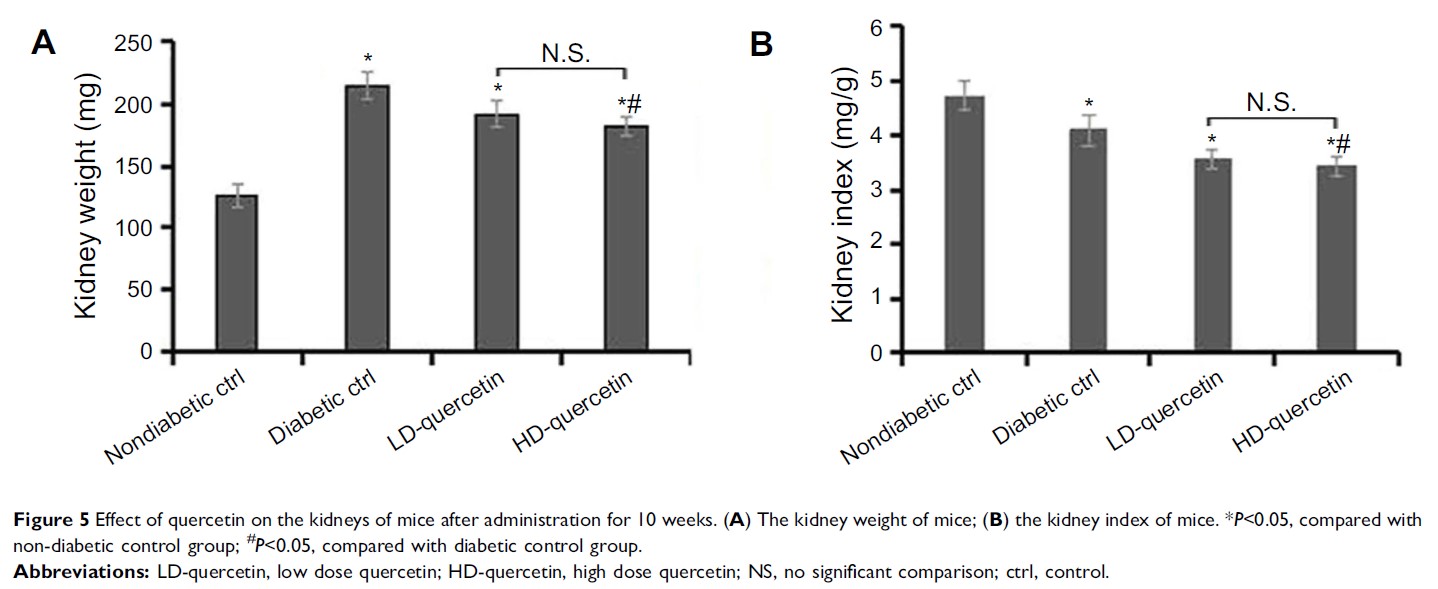
Results: Compared with diabetic controls, quercetin not only ameliorated albuminuria and urinary albumin-to-creatinine ratio, but also decreased blood urea nitrogen and glucose, serum cholesterol, triglycerides, and low-density lipoprotein cholesterol, whereas it had no remarkable effect on the high-density lipoprotein cholesterol in diabetic db/db mice. Additionally, the evidently down regulated expression of LDLr, HMGCR, SREBP-2, and SCAP subsequently attenuated the renal lipid profile change and lipid droplet accumulation, resulting in the alleviation of renal injury of db/db mice.
Conclusion: Quercetin safely and efficiently alleviates early diabetic renal injuries, possibly through improving the lipid metabolism via SCAP-SREBP2-LDLr signaling pathway.
Keywords: quercetin, diabetic nephropathy, lipid metabolism, renal function, low density lipoprotein receptor