117923
论文已发表
注册即可获取德孚的最新动态
IF 收录期刊
- 3.6 Breast Cancer (Dove Med Press)
- 4.3 Clin Epidemiol
- 2.6 Cancer Manag Res
- 3.2 Infect Drug Resist
- 4.1 Clin Interv Aging
- 6.1 Drug Des Dev Ther
- 4.1 Int J Chronic Obstr
- 8.7 Int J Nanomed
- 2.5 Int J Women's Health
- 3.2 Neuropsych Dis Treat
- 2.4 OncoTargets Ther
- 2.6 Patient Prefer Adher
- 2.6 Ther Clin Risk Manag
- 3.1 J Pain Res
- 3.5 Diabet Metab Synd Ob
- 4.5 Psychol Res Behav Ma
- 3.4 Nat Sci Sleep
- 2.4 Pharmgenomics Pers Med
- 2.6 Risk Manag Healthc Policy
- 4.6 J Inflamm Res
- 2.3 Int J Gen Med
- 3.9 J Hepatocell Carcinoma
- 3.3 J Asthma Allergy
- 2.5 Clin Cosmet Investig Dermatol
- 3.0 J Multidiscip Healthc

中国东北地区农村贫困人口的癌症患病率
Authors Liu B, Lao X, Feng Y, Liu J, Jiao M, Zhao M, Wang J, Zhang X, Liu J, Qi X, Liu H, Chen R, Wu Q, Hao Y
Received 18 February 2019
Accepted for publication 5 May 2019
Published 31 May 2019 Volume 2019:11 Pages 5101—5112
DOI https://doi.org/10.2147/CMAR.S205867
Checked for plagiarism Yes
Review by Single-blind
Peer reviewers approved by Dr Cristina Weinberg
Peer reviewer comments 2
Editor who approved publication: Dr Chien-Feng Li
Purpose: The burden of cancer impacts many of the world’s top concerns, but little information is published about the characteristics of cancer prevalence in the poor population.
Materials and methods: Data on cancer prevalence were obtained from the Health Poverty Alleviation Information System of Heilongjiang province. Prevalence was defined as all living cancer cases on October 1, 2018. Geographical area, cancer site, sex, age, educational level, and time since diagnosis were investigated.
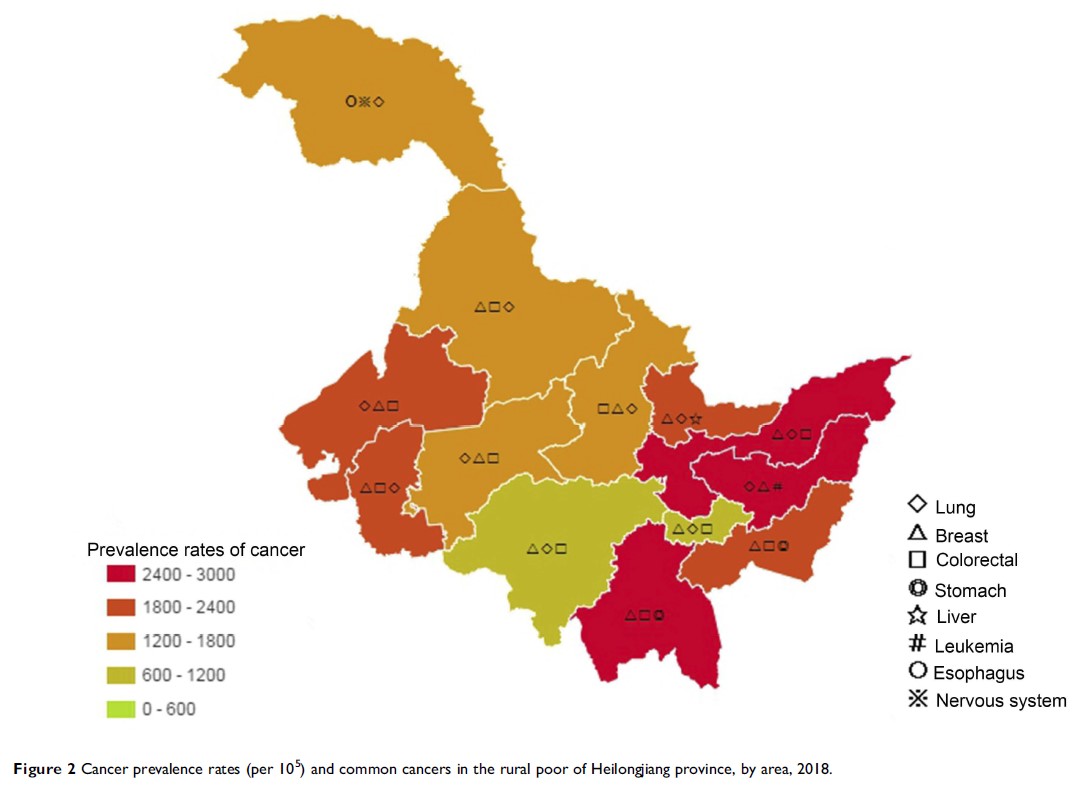
Results: There were 10,529 cancer cases among 624,869 poor rural people in Heilongjiang up to October 1, 2018, and 77% of them did not have labor ability. Females accounted for 53.4%. The top five common cancers were lung, breast, colorectal, stomach, and liver cancer. There were distinct regional, sex, and age distribution differences in cancers. The prevalence rate for overall cancers was 1,685.0 per 100,000 people, which was much higher than that of the national level. Cancer prevalence peaked at an earlier age group (65–69 year). The 5-year cancer prevalence was 80.1% of the total cases.
Conclusion: Cancer imposes significant health and financial burdens in the rural poor. This study presents total and partial prevalence for the first time using actual dates from a large poor population in China, providing valuable information for tailored cancer prevention and control, quantifying the cancer burden and identifying priorities for poverty alleviation plans.
Keywords: cancer burden, prevalence, rural, poverty-stricken population