117923
论文已发表
注册即可获取德孚的最新动态
IF 收录期刊
- 3.6 Breast Cancer (Dove Med Press)
- 4.3 Clin Epidemiol
- 2.6 Cancer Manag Res
- 3.2 Infect Drug Resist
- 4.1 Clin Interv Aging
- 6.1 Drug Des Dev Ther
- 4.1 Int J Chronic Obstr
- 8.7 Int J Nanomed
- 2.5 Int J Women's Health
- 3.2 Neuropsych Dis Treat
- 2.4 OncoTargets Ther
- 2.6 Patient Prefer Adher
- 2.6 Ther Clin Risk Manag
- 3.1 J Pain Res
- 3.5 Diabet Metab Synd Ob
- 4.5 Psychol Res Behav Ma
- 3.4 Nat Sci Sleep
- 2.4 Pharmgenomics Pers Med
- 2.6 Risk Manag Healthc Policy
- 4.6 J Inflamm Res
- 2.3 Int J Gen Med
- 3.9 J Hepatocell Carcinoma
- 3.3 J Asthma Allergy
- 2.5 Clin Cosmet Investig Dermatol
- 3.0 J Multidiscip Healthc

TPM4 通过调节肺癌中 F-肌动蛋白的形成来促进细胞迁移
Authors Zhao X, Jiang M, Wang Z
Received 17 December 2018
Accepted for publication 8 April 2019
Published 31 May 2019 Volume 2019:12 Pages 4055—4063
DOI https://doi.org/10.2147/OTT.S198542
Checked for plagiarism Yes
Review by Single-blind
Peer reviewers approved by Dr Jyoti Bajaj
Peer reviewer comments 2
Editor who approved publication: Dr Sanjeev Srivastava
Background: Tropomyosin 4 (TPM4) is a member of the tropomyosin family of actin-binding proteins. Abnormal level of TPM4 is found in several cancers, and TPM4 is considered as a potential detecting marker for ovarian cancer, breast cancer, colon cancer, keratoacanthoma and esophageal squamous cell carcinoma. In this paper, the function of TPM4 in lung cancer cell lines was determined.
Materials and methods: TPM4 knockout cells were constructed by CRISPR/CAS9 technique. TPM4 overexpression cells were also constructed based on TPM4 knockout cells. Cell growth ability was detected by MTS assay. The potency of cell motility was investigated using transwell assay and wound scratch assay. The protein levels in lung cancer cells were determined by western-blot. Immunofluorescence technique was used to image the structure of F-actin.
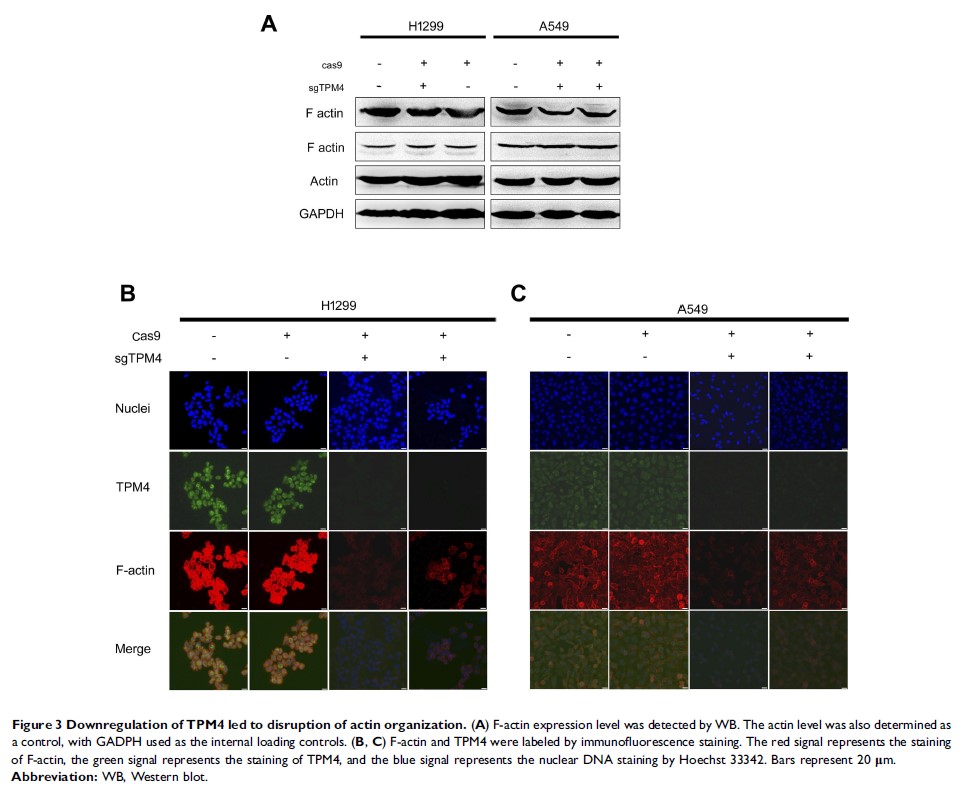
Results: As a result, TPM4 downregulation and TPM4 upregulation cell models were obtained successfully. Cell motility was inhibited by the suppression of TPM4 while cell migration was enhanced in TPM4 upregulated cells. But TPM4 was not involved in cell proliferation and EMT progression. Microfilaments were depolymerized result from the suppression of TPM4 expression. And F-actin assembly was increased when TPM4 was upregulated.
Conclusion: In summary, TPM4 was able to promote cell motility by altering the actin cytoskeleton directly.
Keywords: TPM4, cell migration, F-actin, lung cancer