117806
论文已发表
注册即可获取德孚的最新动态
IF 收录期刊
- 3.6 Breast Cancer (Dove Med Press)
- 4.3 Clin Epidemiol
- 2.6 Cancer Manag Res
- 3.2 Infect Drug Resist
- 4.1 Clin Interv Aging
- 6.1 Drug Des Dev Ther
- 4.1 Int J Chronic Obstr
- 8.7 Int J Nanomed
- 2.5 Int J Women's Health
- 3.2 Neuropsych Dis Treat
- 2.4 OncoTargets Ther
- 2.6 Patient Prefer Adher
- 2.6 Ther Clin Risk Manag
- 3.1 J Pain Res
- 3.5 Diabet Metab Synd Ob
- 4.5 Psychol Res Behav Ma
- 3.4 Nat Sci Sleep
- 2.4 Pharmgenomics Pers Med
- 2.6 Risk Manag Healthc Policy
- 4.6 J Inflamm Res
- 2.3 Int J Gen Med
- 3.9 J Hepatocell Carcinoma
- 3.3 J Asthma Allergy
- 2.5 Clin Cosmet Investig Dermatol
- 3.0 J Multidiscip Healthc

术前中性粒细胞 - 淋巴细胞和血小板 - 淋巴细胞比率作为 T 期肝门部胆管癌的独立预测因子
Authors Huang H, Wan X, Bai Y, Bian J, Xiong J, Xu Y, Sang X, Zhao H
Received 28 October 2018
Accepted for publication 24 April 2019
Published 4 June 2019 Volume 2019:11 Pages 5157—5162
DOI https://doi.org/10.2147/CMAR.S192532
Checked for plagiarism Yes
Review by Single-blind
Peer reviewers approved by Dr Andrew Yee
Peer reviewer comments 2
Editor who approved publication: Dr Rituraj Purohit
Background: The purpose of this study was to evaluate the relationship between preoperative inflammatory markers (neutrophil–lymphocyte ratio (NLR) and platelet–lymphocyte ratio (PLR)) and different American Joint Committee on Cancer (AJCC) T stages in patients with hilar cholangiocarcinoma.
Methods: A total of 101 patients who underwent surgical treatment for hilar cholangiocarcinoma between 2003 and 2014 in Peking Union Medical College Hospital were retrospectively analyzed. Receiver-operating curves were used to calculate optimal cutoff values for the NLR and the PLR. Univariate and multivariate analyses were used to identify whether the NLR and PLR can independently predict different AJCC T stages.
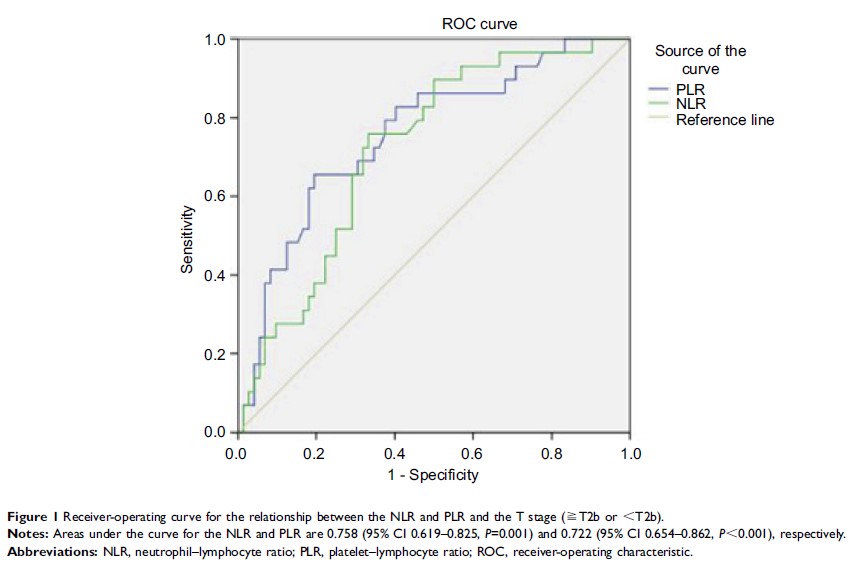
Results: Multivariate analysis showed that higher NLR and PLR independently predicted advanced AJCC T stages (OR 3.74, 95% CI 1.09–12.83, P =0.036; and OR 7.86, 95% CI 2.25–27.43, P =0.001, respectively). At a threshold of 2.75, the NLR was 75.9% sensitive and 66.7% specific for different AJCC T stages; at a threshold of 172.25, the PLR was 65.5% sensitive and 80.6% specific.
Conclusion: Preoperative NLR and PLR can be used as independent predictors of different AJCC T stages in patients with hilar cholangiocarcinoma.
Keywords: neutrophil–lymphocyte ratio, platelet–lymphocyte ratio, hilar cholangiocarcinoma