117806
论文已发表
注册即可获取德孚的最新动态
IF 收录期刊
- 3.6 Breast Cancer (Dove Med Press)
- 4.3 Clin Epidemiol
- 2.6 Cancer Manag Res
- 3.2 Infect Drug Resist
- 4.1 Clin Interv Aging
- 6.1 Drug Des Dev Ther
- 4.1 Int J Chronic Obstr
- 8.7 Int J Nanomed
- 2.5 Int J Women's Health
- 3.2 Neuropsych Dis Treat
- 2.4 OncoTargets Ther
- 2.6 Patient Prefer Adher
- 2.6 Ther Clin Risk Manag
- 3.1 J Pain Res
- 3.5 Diabet Metab Synd Ob
- 4.5 Psychol Res Behav Ma
- 3.4 Nat Sci Sleep
- 2.4 Pharmgenomics Pers Med
- 2.6 Risk Manag Healthc Policy
- 4.6 J Inflamm Res
- 2.3 Int J Gen Med
- 3.9 J Hepatocell Carcinoma
- 3.3 J Asthma Allergy
- 2.5 Clin Cosmet Investig Dermatol
- 3.0 J Multidiscip Healthc

Management of acute pain in dementia: a feasibility study of a robot-assisted intervention
Authors Demange M, Pino M, Kerhervé H, Rigaud AS, Cantegreil-Kallen I
Received 11 October 2018
Accepted for publication 18 February 2019
Published 7 June 2019 Volume 2019:12 Pages 1833—1846
DOI https://doi.org/10.2147/JPR.S179640
Checked for plagiarism Yes
Review by Single-blind
Peer reviewers approved by Dr Amy Norman
Peer reviewer comments 4
Editor who approved publication: Dr E Alfonso Romero-Sandoval
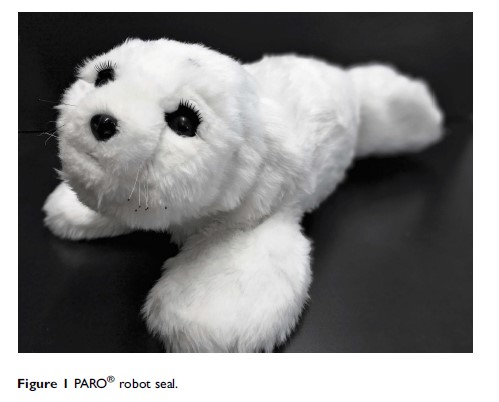
Background: The management of pain is particularly challenging in patients with moderate to severe dementia owing to the loss of communication ability or underlying causes such as behavioral symptoms. It is often associated with health care professionals’ frustration and feeling of helplessness. The present study determined a framework and examined the feasibility of an innovative intervention using the PARO® robot for the management of acute pain in dementia.
Method: A mixed-methods research design combining qualitative (five focus groups) and quantitative (questionnaire survey) approaches was used to define the intervention framework. We recruited 57 health care professionals from various medical and paramedical specialties (eg, nursing auxiliaries, nurses, physicians, psychologists) and with expertise in gerontology. The feasibility of the intervention was subsequently assessed with 12 patients suffering from dementia in painful situations to validate the procedure.
Results: Four main issues have been addressed: 1) the identification of a core group of painful situations associated with care (washing, dressing/change, transfer/mobilization), currently considered as inefficiently managed; 2) the selection of an appropriate assessment methodology including criteria and tools for pain evaluation; 3) the definition of health professionals’ training needs and organizational requirements for their implementation; and 4) the perceived usefulness of a robot-assisted intervention for the management of pain in dementia in daily practice. The feasibility study showed that the predefined intervention framework was applicable and acceptable for the majority of professionals and patients.
Conclusion: A consistent and feasible intervention framework for the management of painful situations associated with care in dementia using the PARO robot was defined. Understanding of professionals’ needs, opinions and perceived obstacles regarding the intervention was a useful step in the preparation of the forthcoming clinical trial.
Keywords: pain, pain management, dementia, nonpharmacological intervention, PARO® robot, feasibility study