117745
论文已发表
注册即可获取德孚的最新动态
IF 收录期刊
- 3.6 Breast Cancer (Dove Med Press)
- 4.3 Clin Epidemiol
- 2.6 Cancer Manag Res
- 3.2 Infect Drug Resist
- 4.1 Clin Interv Aging
- 6.1 Drug Des Dev Ther
- 4.1 Int J Chronic Obstr
- 8.7 Int J Nanomed
- 2.5 Int J Women's Health
- 3.2 Neuropsych Dis Treat
- 2.4 OncoTargets Ther
- 2.6 Patient Prefer Adher
- 2.6 Ther Clin Risk Manag
- 3.1 J Pain Res
- 3.5 Diabet Metab Synd Ob
- 4.5 Psychol Res Behav Ma
- 3.4 Nat Sci Sleep
- 2.4 Pharmgenomics Pers Med
- 2.6 Risk Manag Healthc Policy
- 4.6 J Inflamm Res
- 2.3 Int J Gen Med
- 3.9 J Hepatocell Carcinoma
- 3.3 J Asthma Allergy
- 2.5 Clin Cosmet Investig Dermatol
- 3.0 J Multidiscip Healthc

MicroRNA-371-3 簇作为癌症诊断和预后的生物标志物
Authors Pan B, He B, Xu X, Liu X, Xu T, Xu M, Chen X, Zeng K, Lin K, Hu X, Sun L, Pan Y, Sun H, Wang S
Received 14 October 2018
Accepted for publication 23 April 2019
Published 13 June 2019 Volume 2019:11 Pages 5437—5457
DOI https://doi.org/10.2147/CMAR.S190833
Checked for plagiarism Yes
Review by Single-blind
Peer reviewers approved by Dr Colin Mak
Peer reviewer comments 4
Editor who approved publication: Dr Rituraj Purohit
Purpose: To date, increasing evidences have demonstrated that the aberrant expression of miR-371–3 cluster has been verified in various cancers and could be potentially used as a biomarker for tumor diagnosis and prognosis. To explore the role of miR-371–3 cluster in tumor diagnosis and prognosis, we conducted this study based on the published data.
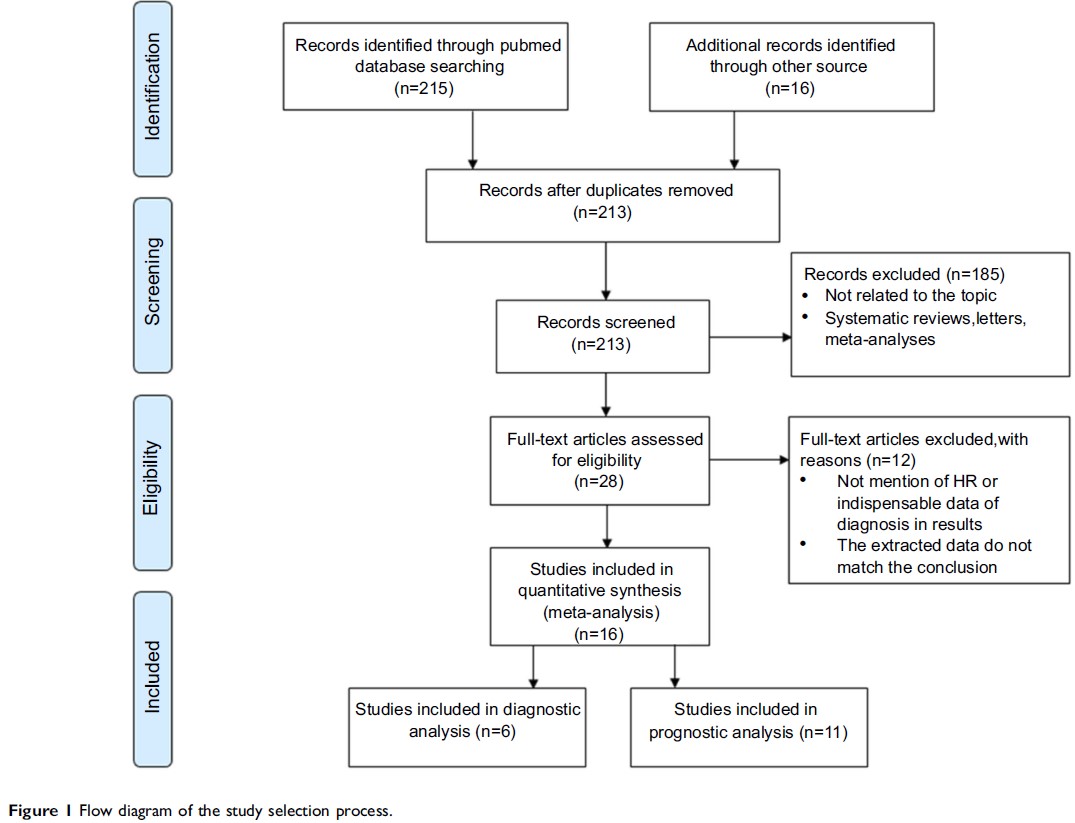
Methods: We searched electronic databases (PubMed, EMBASE and Web of Science databases) (Jan 1, 2007 to Jun 1, 2018). The pooled sensitivity, specificity and area under the curve (AUC) of summary receiver operator characteristic (SROC) curve were used for diagnostic values, meanwhile the pooled hazard ration (HR) and 95% CI were used to explore the prognosis capacity of miR-372 and miR-373. In addition, the publication bias of the enrolled studies was tested and a sensitivity analysis of each study was performed to evaluate the stability of the pooled result.
Results: A total of eleven eligible studies containing six eligible studies containing 870 participants for diagnosis and 1218 cancer cases for prognosis were selected for this study. For diagnosis, the pooled results revealed that the miR-371 (sensitivity: 0.85, specificity: 0.92, AUC: 0.92) and miR-373 (sensitivity: 0.81, specificity: 0.93, AUC: 0.93) could be used as diagnostic biomarkers. For prognosis, we observed that elevated miR-372 indicated poor prognosis (HR=2.31, 95% CI: 1.04–5.14), especially in the cutoff value subgroup of median (HR=2.62, 95% CI: 1.54–4.46). In addition, pooled results showed that expression of miR-373 was not related to prognosis because of the significant heterogeneity, and the high miR-373 expression presented favorable prognosis in Asians (HR=0.34, 95% CI: 0.23–0.50) after omitting the study of heterogeneity origin.
Conclusion: The current studies demonstrated that miR-371 and miR-373 could be predictive tumor diagnostic biomarkers and the expression of miR-372 and miR-373 may indicate prognosis of cancer patients.
Keywords: cancer, miR-371, miR-372, miR-373, diagnosis, prognosis, biomarkers