117745
论文已发表
注册即可获取德孚的最新动态
IF 收录期刊
- 3.6 Breast Cancer (Dove Med Press)
- 4.3 Clin Epidemiol
- 2.6 Cancer Manag Res
- 3.2 Infect Drug Resist
- 4.1 Clin Interv Aging
- 6.1 Drug Des Dev Ther
- 4.1 Int J Chronic Obstr
- 8.7 Int J Nanomed
- 2.5 Int J Women's Health
- 3.2 Neuropsych Dis Treat
- 2.4 OncoTargets Ther
- 2.6 Patient Prefer Adher
- 2.6 Ther Clin Risk Manag
- 3.1 J Pain Res
- 3.5 Diabet Metab Synd Ob
- 4.5 Psychol Res Behav Ma
- 3.4 Nat Sci Sleep
- 2.4 Pharmgenomics Pers Med
- 2.6 Risk Manag Healthc Policy
- 4.6 J Inflamm Res
- 2.3 Int J Gen Med
- 3.9 J Hepatocell Carcinoma
- 3.3 J Asthma Allergy
- 2.5 Clin Cosmet Investig Dermatol
- 3.0 J Multidiscip Healthc

伊马替尼治疗方案对高危胃肠道间质瘤患者术后预后的影响
Authors Li YS, Li W, Zeng QS, Fu WH
Received 13 December 2018
Accepted for publication 26 April 2019
Published 18 June 2019 Volume 2019:12 Pages 4713—4719
DOI https://doi.org/10.2147/OTT.S198129
Checked for plagiarism Yes
Review by Single-blind
Peer reviewers approved by Dr Andrew Yee
Peer reviewer comments 2
Editor who approved publication: Dr William Cho
Background: Surgical resection is the standard treatment for localized and potentially resectable gastrointestinal stromal tumors (GISTs), If the postoperative pathology diagnosis indicates that patients are at high risk of recurrence, they should be treated with imatinib. Even though the introduction of imatinib substantially improved the outcome of GIST patients, it is unclear whether different imatinib treatment regimens affect patients’ survival.
Methods: This retrospective study included 120 patients who underwent tumor resection for high-risk GISTs between January 2009 and October 2018. The patients were divided into three groups: one group of patients received postoperative imatinib adjuvant therapy regularly (regular treatment group); the second group was not treated with imatinib until they were found to have disease progression (observation group); the third group was treated with postoperative imatinib adjuvant therapy irregularly (irregularly treatment group). The progression-free survival (PFS) and overall survival (OS) were compared between the three groups, and the prognostic risk factors were analysed by the Cox regression model.
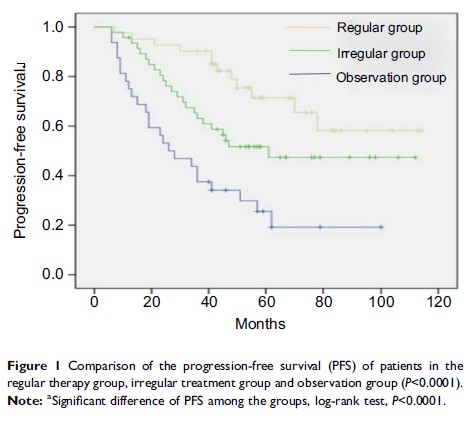
Results: The median PFS was 45 months (range: 25–59). The 3- and 5-year PFS values were 71.3% and 49.9%, respectively. The PFS in the regular group was longer than in the observation group and irregular group (P <0.001). The median OS was 59 months (range:47–78). The 3- and 5-year OS values were 91.6% and 84.2%, respectively. There were no differences in OS among the three groups (P =0.150). The extent of radical resection (P <0.001) and intraoperative tumor rupture (P =0.005) were independent prognostic factors influencing OS.
Conclusions: Irregular administration of imatinib was associated with a worse PFS, but it did not affect the OS of patients with high-risk GISTs. Avoiding intraoperative tumor rupture and R0 resection were associated with better survival.
Keywords: gastrointestinal stromal tumor, imatinib, overall survival, progression-free survival, surgery