117745
论文已发表
注册即可获取德孚的最新动态
IF 收录期刊
- 3.6 Breast Cancer (Dove Med Press)
- 4.3 Clin Epidemiol
- 2.6 Cancer Manag Res
- 3.2 Infect Drug Resist
- 4.1 Clin Interv Aging
- 6.1 Drug Des Dev Ther
- 4.1 Int J Chronic Obstr
- 8.7 Int J Nanomed
- 2.5 Int J Women's Health
- 3.2 Neuropsych Dis Treat
- 2.4 OncoTargets Ther
- 2.6 Patient Prefer Adher
- 2.6 Ther Clin Risk Manag
- 3.1 J Pain Res
- 3.5 Diabet Metab Synd Ob
- 4.5 Psychol Res Behav Ma
- 3.4 Nat Sci Sleep
- 2.4 Pharmgenomics Pers Med
- 2.6 Risk Manag Healthc Policy
- 4.6 J Inflamm Res
- 2.3 Int J Gen Med
- 3.9 J Hepatocell Carcinoma
- 3.3 J Asthma Allergy
- 2.5 Clin Cosmet Investig Dermatol
- 3.0 J Multidiscip Healthc

他汀类药物的使用及其在食管癌中的潜在治疗作用:系统评价和荟萃分析
Authors Zhou C, Zhong X, Gao P, Wu Z, Shi J, Guo Z, Wang Z, Song Y
Received 8 November 2018
Accepted for publication 30 April 2019
Published 19 June 2019 Volume 2019:11 Pages 5655—5663
DOI https://doi.org/10.2147/CMAR.S193945
Checked for plagiarism Yes
Review by Single-blind
Peer reviewers approved by Dr Andrew Yee
Peer reviewer comments 2
Editor who approved publication: Dr Rituraj Purohit
Purpose: Statins, known as inhibitors of 3-hydroxy-3-methylglutaryl-coenzyme A (HMG CoA) reductases, are designed to treat lipid disorders, especially hypercholesterolemia. Apart from their role in preventing heart diseases in patients with high cholesterol, recent evidence suggests that statins have anti-tumor properties. However, studies assessing the association between statin use and esophageal cancer survival outcomes have provided controversial results.
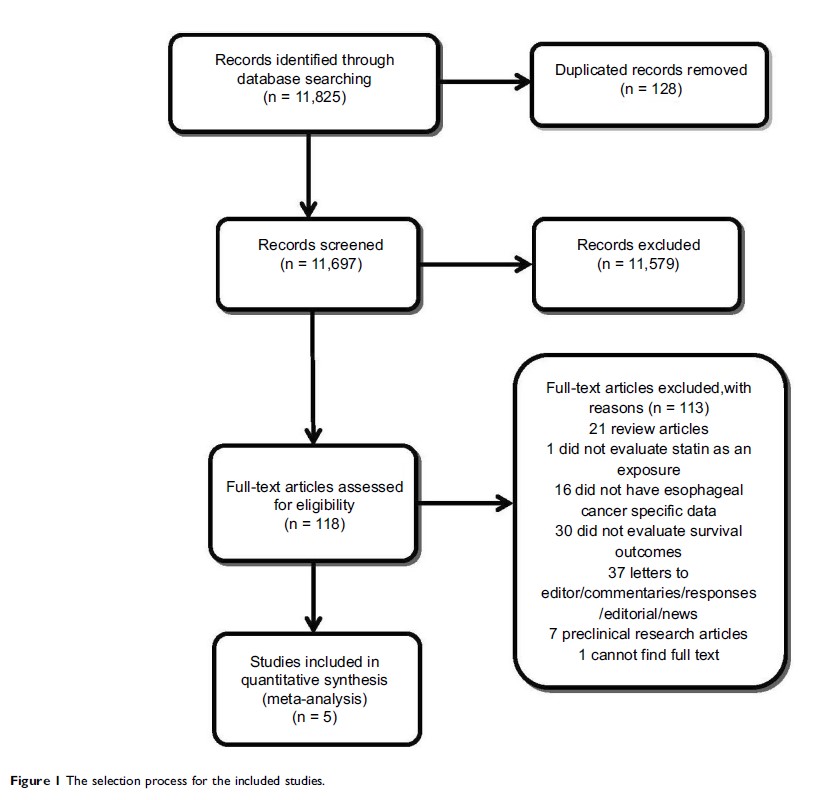
Methods: We conducted a systematic review and meta-analysis focusing on studies evaluating associations between statin use and survival outcomes for esophageal cancer patients.
Results: A total of five cohort studies comprising 24,576 patients were included. Statin use associated with improved overall survival (OS: HR 0.84, 95% CI, 0.75–0.94) and disease-free survival (DFS: HR 0.84, 95% CI, 0.75–0.96) of esophageal cancer patients. The improved survival outcomes were consistent in the esophageal adenocarcinoma subgroup and the esophageal squamous cell cancer subgroup.
Conclusion: A potential therapeutic role of statins in esophageal cancer has been demonstrated in our study, however, the results should be interpreted cautiously and need further confirmation by future studies.
Keywords: statins, esophageal cancer, survival outcome, drug repositioning