117745
论文已发表
注册即可获取德孚的最新动态
IF 收录期刊
- 3.6 Breast Cancer (Dove Med Press)
- 4.3 Clin Epidemiol
- 2.6 Cancer Manag Res
- 3.2 Infect Drug Resist
- 4.1 Clin Interv Aging
- 6.1 Drug Des Dev Ther
- 4.1 Int J Chronic Obstr
- 8.7 Int J Nanomed
- 2.5 Int J Women's Health
- 3.2 Neuropsych Dis Treat
- 2.4 OncoTargets Ther
- 2.6 Patient Prefer Adher
- 2.6 Ther Clin Risk Manag
- 3.1 J Pain Res
- 3.5 Diabet Metab Synd Ob
- 4.5 Psychol Res Behav Ma
- 3.4 Nat Sci Sleep
- 2.4 Pharmgenomics Pers Med
- 2.6 Risk Manag Healthc Policy
- 4.6 J Inflamm Res
- 2.3 Int J Gen Med
- 3.9 J Hepatocell Carcinoma
- 3.3 J Asthma Allergy
- 2.5 Clin Cosmet Investig Dermatol
- 3.0 J Multidiscip Healthc

长链非编码 RNA LINC-PINT 通过 EZH2 促进增殖,并预测透明细胞肾细胞癌的预后不良
Authors Duan J, Ma X, Shi J, Xuan Y, Wang H, Li P, Zhang Y, Fan Y, Gong H, Ma X, Pang Y, Wang L, Yan Y, Zhang X
Received 25 January 2019
Accepted for publication 16 May 2019
Published 19 June 2019 Volume 2019:12 Pages 4729—4740
DOI https://doi.org/10.2147/OTT.S202938
Checked for plagiarism Yes
Review by Single-blind
Peer reviewers approved by Ms Shreya Arora
Peer reviewer comments 2
Editor who approved publication: Dr Sanjeev Srivastava
Background: Renal cell carcinoma (RCC) is one of the most common types of urological malignant tumors. Despite recent advances in diagnosis and management of RCC, its prognosis remains poor. Emerging evidence has shown that long noncoding RNAs (lncRNAs) play crucial regulatory roles in cancer biology.
Materials and methods: The most abundant transcript of long intergenic non-protein coding RNA p53 induced transcript (LINC-PINT ) in clear cell RCC (ccRCC) was determined by RT-PCR. Quantitative real-time PCR was performed to examine LINC-PINT expression in paired ccRCC samples and cell lines. The relationship of LINC-PINT expression with clinicopathologic characteristics and clinical outcome was analyzed. The biological function of LINC-PINT was studied by MTS and colony formation. The flow cytometry was used to analyze cell cycle distribution and apoptosis. The subcelluar fractionation and RIP assay was performed to explore the molecular mechanism of LINC-PINT . Western blotting and immunofluorescence was carried out to examine EZH2 and p53.
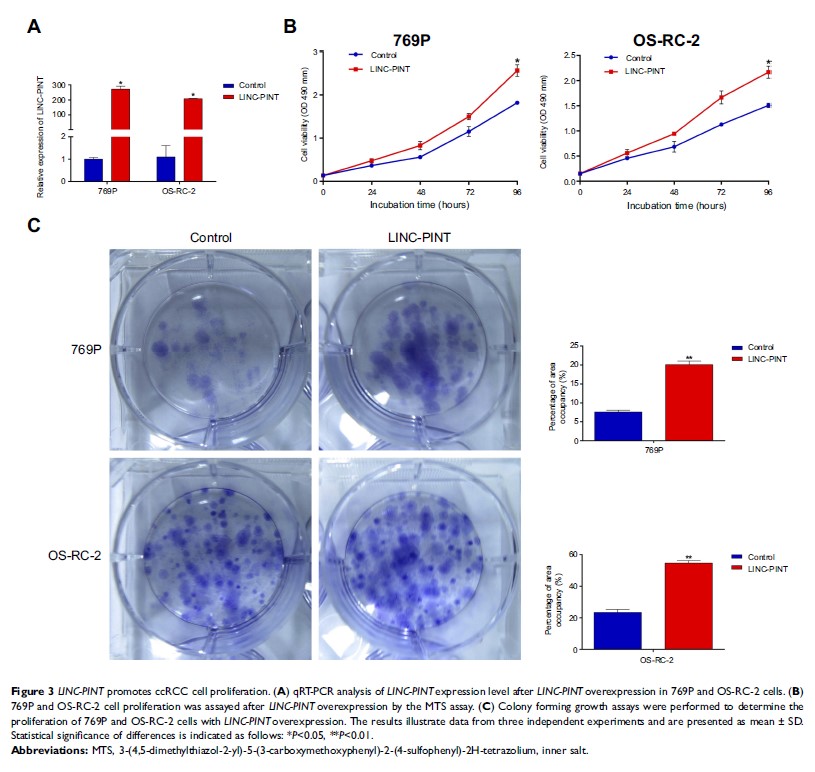
Results: We found that the LINC-PINT was frequently upregulated in ccRCC samples. Furthermore, we observed that the level of LINC-PINT depended on gender as well as on pT and TNM stage of patients with ccRCC. Moreover, patients with high LINC-PINT expression had poor disease-free survival and overall survival. Functionally, overexpression of LINC-PINT promoted ccRCC cell proliferation, induced cell cycle progression, and inhibited apoptosis. LINC-PINT was primarily located in cell nuclei and interacted with EZH2. When EZH2 was knocked down in 769P and OS-RC-2 cells overexpressing LINC-PINT , the effect of LINC-PINT on cell proliferation, cell cycle, and apoptosis was partially reversed. Additionally, inducing p53 by doxorubicin (Dox) promoted LINC-PINT expression.
Conclusion: Collectively, our results provide novel insights into the important role of LINC-PINT in ccRCC development and indicate that LINC-PINT may serve as a valuable prognostic biomarker for ccRCC.
Keywords: long noncoding RNA, LINC-PINT, clear cell renal cell carcinoma, prognosis, cell proliferation, EZH2